Starting a Food Delivery Business in Dubai: Complete Checklist & Step-by-Step Guide
Dubai’s food delivery ecosystem is booming — and for good reason. The market isn’t showing signs of slowing down anytime soon.
The numbers tell a compelling story: the UAE’s food service market was valued at USD 18.78 billion in 2024 and is projected to reach USD 84.85 billion by 2033. Within this larger trend, food delivery specifically has carved out a significant niche, accounting for over 20% of the total food and beverage revenue in the region.
But here’s what matters for entrepreneurs: Dubai issued nearly 1,200 new restaurant and food business licenses in 2024 alone, with 2,336 new food establishments launched in just the first half of 2025. These numbers signal an extraordinary opportunity window.
The challenge? Knowing where to start, what permissions you need, how much it actually costs, and whether you’re building the right kind of business for Dubai’s specific regulatory and market environment.
This guide walks through everything — from the first decision you’ll make to the day you take your first order. It’s based on official government sources, actual business startup data, and the real costs entrepreneurs are facing in Dubai right now.
Part 1: Why Now? The Opportunity in Dubai’s Food Delivery Space
Dubai’s population is over 200 nationalities strong, making it one of the most diverse consumer markets globally. That diversity means demand for every type of cuisine, dietary preference, and delivery model imaginable.
Tourism amplifies this. Dubai welcomed over 17 million international visitors in 2023, with numbers tracking higher in 2025. Food and beverage spending accounts for over 30% of tourism expenditure in Dubai. About 70% of restaurant-goers in the UAE check social media for recommendations before choosing where to eat, and many of those recommendations include delivery options.
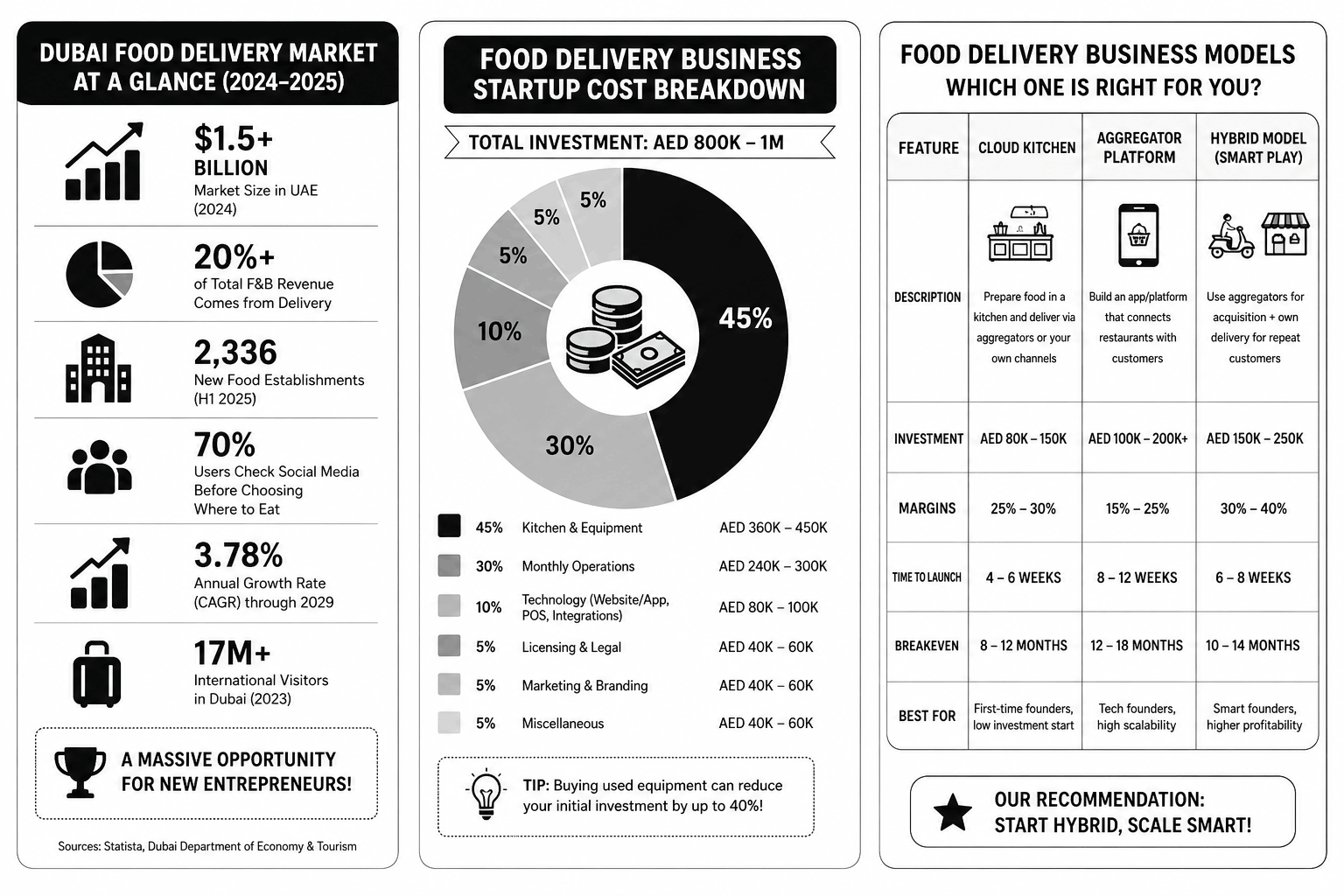
Key Market Metrics (2024–2025):
- Food delivery market in UAE: $1.5 billion+ (valued in 2024)
- Projected to exceed: AED 5 billion by 2025
- Annual growth rate: 3.78% CAGR through 2029
- New food establishments (H1 2025): 2,336 licenses issued
Part 2: What Kind of Delivery Business Are You Building?
There are three primary models in Dubai:
Model A: Cloud Kitchen (Lowest Capital Requirement)
You lease commercial kitchen space and prepare food exclusively for delivery — no dine-in customers, no front-of-house staff. Pure production and food delivery services focus.
- Cost: AED 80,000–150,000 first year
- Margins: 25–30%
- Timeline to launch: 4–6 weeks
- Breakeven: 8–12 months
This model dominates Dubai right now because it works. You skip massive overhead and can test multiple cuisine concepts from a single kitchen. Many successful operators run 2–3 brand concepts from one facility.
Pro tip: Once your kitchen is set up, partnering with a reliable last-mile delivery company in Dubai like Zone Delivery Services means you don’t have to hire, train, or manage your own rider fleet.
Model B: Delivery Platform / Aggregator
You build an app or platform that connects restaurants to customers, taking a commission on each order (typically 15–35%). This requires significant upfront tech investment but scales differently.
- Cost: AED 100,000–200,000+ (app development alone)
- Margins: 15–25% per order (commission-based)
- Timeline to launch: 8–12 weeks
- Breakeven: 12–18 months
This model is harder for first-time entrepreneurs unless you have technical co-founders.
Model C: Hybrid Model (Smart Play)
You start with a cloud kitchen and also develop your own delivery network for repeat customers. Early on, you use aggregators for customer acquisition, but you maintain your own riders for your repeat base.
- Cost: AED 150,000–250,000 (first year)
- Margins: 30–40%
- Timeline to launch: 6–8 weeks
- Breakeven: 10–14 months
This model reduces your delivery costs by 40% compared to pure aggregator dependency. Many hybrid operators outsource their direct delivery to professional bike delivery courier services rather than managing their own fleet — giving them the cost savings of direct delivery without the operational headache.
Part 3: Where in Dubai Do You Want to Operate?
Mainland (Dubai Proper)
- You can trade directly with local customers
- More regulatory requirements
- Requires local sponsorship for non-UAE nationals
- Rent is typically higher in prime areas
- License costs: AED 6,000–7,000
Free Zone (like Meydan Free Zone)
- 100% foreign ownership
- No local sponsor required
- Faster licensing (under 60 minutes for Fawri license at Meydan)
- Can’t sell directly to mainland consumers without a distributor
- Popular for digital-first and tech-forward businesses
Hybrid Approach: Many entrepreneurs set up in a Free Zone for operational efficiency, then partner with aggregators or a delivery service partner in Dubai who handles on-ground last-mile operations across the mainland.
Part 4: The Licensing Roadmap
There are multiple licenses and approvals required, not just one.
License 1: Trade License (From DED)
Your foundational business license — it says you exist as a legal entity and can conduct business in Dubai.
- Trade name registration: AED 620–720
- Initial approval (NOC certificate): AED 115–125
- License fee: AED 500–1,500
- Total: approximately AED 2,000–3,000
Where to apply: ded.ae
License 2: Food Safety License (From Dubai Municipality)
No food safety license = no legal food preparation or delivery in Dubai. Dubai Municipality’s Food Safety Department issues this after inspection.
- Food safety license: AED 10,000–12,000
- RTA food delivery permit: AED 1,000 (annual)
- Building/floor plan approval: AED 500–1,000
- Total: approximately AED 11,500–13,000
- Timeline: 3–6 weeks
Where to apply: dm.gov.ae
Common inspection failure reasons: inadequate ventilation, poor raw/cooked food separation, insufficient storage, pest control issues.
License 3: Home-Based Food License (Alternative)
For small home-based operations, the FoodWatch platform offers registration for AED 200/year. But if you’re serious about building a scalable business, this option is too restrictive — it limits food categories and won’t give you credibility with major delivery platforms.
Approval Workflow (Exact Order)
- Decide on jurisdiction (Mainland vs. Free Zone)
- Choose business structure (LLC recommended)
- Reserve business name with DED
- Get initial approval (NOC) from DED
- Secure kitchen/commercial space
- Get kitchen layout approved by Dubai Municipality
- Complete kitchen build-out
- Apply for food safety license
- Pass food safety inspection
- Receive food safety license
- Apply for trade license (DED)
- Open corporate bank account
- Hire staff and complete visa/health requirements
- Set up operations — POS, delivery logistics, supplier contracts
- Launch
Total timeline: 6–10 weeks (budget 12 weeks to be safe)
Part 5: The Real Costs — What You Actually Need to Budget
Licensing & Legal (One-Time)
| Item | Cost |
|---|---|
| Business setup consultation | AED 3,000–5,000 |
| Trade name registration | AED 720 |
| Initial approval (NOC) | AED 125 |
| Trade license (LLC) | AED 1,500 |
| Food safety license | AED 12,000 |
| RTA delivery permit | AED 1,000 |
| Building/kitchen approval | AED 750 |
| Legal documentation (MOA, AOA) | AED 1,500 |
| Subtotal | ~AED 20,500 |
Kitchen & Equipment (One-Time)
| Item | Cost |
|---|---|
| Monthly rent (3-month deposit) | AED 15,000 |
| Kitchen equipment (basic) | AED 60,000 |
| Ventilation/extraction system | AED 8,000 |
| Food storage (fridges, freezers) | AED 15,000 |
| Cooking equipment | AED 25,000 |
| Workstations & prep tables | AED 8,000 |
| Cleaning equipment & supplies | AED 2,000 |
| Subtotal | ~AED 133,000 |
Technology & Systems (One-Time)
| Item | Cost |
|---|---|
| POS system + software | AED 20,000 |
| Delivery app integration | AED 15,000 |
| Website + online ordering | AED 5,000 |
| Payment gateway setup | AED 1,000 |
| Security cameras | AED 3,000 |
| Subtotal | ~AED 44,000 |
Monthly Recurring Costs
| Item | Cost |
|---|---|
| Kitchen rent | AED 5,000 |
| Utilities | AED 1,500 |
| Staff salaries (3–4 people) | AED 12,000 |
| Food cost of goods | AED 30,000 |
| Packaging | AED 5,000 |
| Insurance | AED 1,500 |
| Cleaning & maintenance | AED 2,000 |
| Permits & licenses renewal | AED 200 |
| Monthly Total | ~AED 57,200 |
Cost-saving tip: Many cloud kitchen operators avoid the expense and complexity of running their own rider fleet by partnering with a professional same-day delivery service in UAE. You pay per delivery rather than carrying fixed rider costs — which significantly lowers your break-even point in the early months.
Part 6: Regulatory Compliance — What the Government Actually Requires
Every food business in the UAE operates under the UAE Food Code. Key requirements include:
Kitchen Layout:
- Separate storage for raw and cooked food
- Dedicated washing stations
- Commercial-grade ventilation
- Documented pest control measures
- Temperature-controlled storage
Food Handling:
- All staff must hold food handler certification (~AED 500/person, 2–3 days)
- HACCP system documented
- Temperature monitoring logs
- Full supplier traceability
Packaging & Labeling:
- Food-safe packaging
- Allergen information included
- Expiration dates where applicable
- Business name and contact on packaging
Real-Time Tracking:
- A live order tracking system is mandatory
- Customers must be able to see their order and delivery status
- This is a documentation requirement for Dubai Municipality
This is where professional delivery partners add real value. Zone Delivery Services operates a technology-driven logistics system with real-time tracking — helping food businesses meet this compliance requirement without building their own tracking infrastructure.
Part 7: Step-by-Step Implementation Timeline
Weeks 1–2: Planning & Setup Decisions
- Decide on business model and jurisdiction
- Choose business structure (LLC recommended)
- Create basic business plan and secure funding
- Brainstorm and check business name availability at ded.ae
Weeks 3–4: Secure Kitchen Space
- Scout locations — Al Quoz, Qusais, Dubai Investment Park are popular
- Negotiate rent (AED 5,000–8,000/month for 500–800 sq ft)
- Sign tenancy agreement and register with Ejari
- Get landlord’s letter of permission for business use
Cost: First deposit (2–3 months) = AED 10,000–24,000
Week 5: Initial Applications
- Apply for business name reservation with DED
- Submit kitchen floor plan to Dubai Municipality
- Begin kitchen layout modifications if needed
Weeks 6–8: Kitchen Build-Out
- Install commercial equipment (stove, fryer, grill, fridges, freezers)
- Install ventilation/extraction system
- Set up washing stations and sanitization areas
- Document everything with photos for inspection
Week 8: Food Safety License Application
- Enroll staff in food handler training
- Prepare HACCP documentation and supplier list
- Apply for food safety license with Dubai Municipality
Week 9: Inspection & License Issuance
- Pass food safety inspection
- Receive food safety license
- Now eligible for trade license
Week 10: Trade License & Business Finalization
- Apply for trade license (DED)
- Open corporate bank account
- Set up staff visas, health insurance, and WPS registration
Weeks 11–12: Operations Setup & Launch
- Hire and train kitchen staff
- Set up POS and inventory management
- Integrate with delivery platforms (Talabat, Deliveroo, Noon)
- Set up your last-mile delivery solution — either own riders or a logistics partner
- Launch marketing campaign and take first orders
Part 8: Choosing Your Delivery Model
Option A: Aggregator Platforms (Talabat, Deliveroo, Noon)
Pros: Instant customer access, no delivery infrastructure needed, payments handled for you.
Cons: Commission of 25–35% per order, no direct customer relationship, limited branding control, no customer data ownership.
Best for: Starting out, testing concepts, scaling quickly without logistics headaches.
Option B: Your Own Delivery App / Platform
Pros: Higher margins, own customer data and loyalty, full branding control.
Cons: App development costs AED 50,000–150,000+, requires an existing customer base, you manage riders, payments, and support.
Best for: Established brands, niche concepts, multi-brand operators.
Option C: Hybrid Model (Smartest Play)
- Year 1: 100% aggregator (building customer base)
- Year 2: 60% aggregator, 40% direct
- Year 3: 40% aggregator, 60% direct
At 500 orders/month:
- Pure aggregator: AED 35,000 revenue
- Hybrid (Year 3): AED 41,000 revenue
- Difference: AED 6,000/month = AED 72,000/year
The key to making the hybrid model work is having a reliable delivery partner for your direct channel. Rather than managing your own rider fleet, many hybrid operators use Zone Delivery Services’ bike delivery couriers for on-demand fulfillment — getting the margin benefits of direct delivery without the HR and operational overhead.
Part 9: Common Mistakes to Avoid
1. Underestimating Licensing Delays Most entrepreneurs add 4–6 weeks to their timeline. Budget 12 weeks, not 8.
2. Poor Location Choice Cheap rent in a bad location = terrible delivery logistics. Al Quoz and Dubai Investment Park aren’t glamorous, but they’re central and delivery-friendly.
3. Inadequate Food Cost Management Industry target: 28–32% of revenue. If your food costs run 40%+, the business doesn’t work. Form buying groups with other operators to negotiate better supplier rates.
4. Hiring Too Early Start with 2–3 core people. Add staff as orders scale. A better approach: outsource delivery to a professional courier service instead of hiring in-house riders before you have the volume.
5. Ignoring Food Safety Inspection Requirements Hire an inspector-turned-consultant (AED 2,000–3,000) to pre-audit your kitchen. This investment pays for itself in avoided delays.
6. Banking on Day 1 Profitability Realistic timeline: 8–12 months to profitability. Budget for 6 months of operating losses.
Part 10: The Financial Reality
At 400 orders/month, AED 80 average order value (Hybrid Model, Year 2):
- Total Revenue: AED 24,576
- Total Costs: AED 33,464
- Gross Profit: –AED 8,888 (still losing money)
At 800 orders/month:
- Revenue: AED 49,152
- Costs: ~AED 42,000
- Gross Profit: AED 7,152 (finally profitable)
You need volume to break even. This is why customer acquisition and retention matter so much — and why keeping your delivery costs lean (by outsourcing to a partner rather than maintaining your own fleet) is critical in the early months.
Part 11: What Actually Works — The Success Playbook
1. Start with a concept that solves a problem. Don’t copy competitors. Fill a specific gap: premium healthy bowls in under 20 minutes, traditional regional cuisine for expats, or a ghost restaurant brand with low overhead.
2. Obsess over delivery speed. Customers in Dubai expect order confirmation in 2 minutes, preparation in 15–20 minutes, and delivery in 25–35 minutes total. If you consistently miss these windows on aggregator platforms, your placement gets downgraded. Using a fast, professional same-day delivery partner helps you protect your ratings.
3. Nail your first 100 orders. Do quality checks personally. Respond to feedback immediately. Offer discounts on second orders. Ask for ratings — they affect the aggregator algorithm significantly.
4. Build a repeat customer base fast. The 80/20 rule: 80% of your revenue comes from 20% of customers. Use WhatsApp marketing, loyalty programs, SMS alerts for new items, and personalization to cultivate that 20%.
5. Keep your delivery costs lean. Once you’re running 300+ orders a month, your delivery cost per order becomes a major lever on profitability. Many successful operators in Dubai use Zone Delivery Services as their direct-channel delivery partner — avoiding fixed rider costs while maintaining the speed and reliability that protects their aggregator ratings.
Part 12: Your 30-Day Action Checklist
Week 1:
- Finalize business concept and target customer
- Research 3–5 kitchen locations (focus on Al Quoz, Dubai Investment Park)
- Meet with a business setup consultant
- Build a basic financial model
Week 2:
- Secure kitchen space (sign tenancy)
- Reserve business name with DED
- Begin staff recruitment
- Shortlist a delivery logistics partner for post-launch
Week 3:
- Submit kitchen floor plan to Dubai Municipality
- Get initial approval (NOC) from DED
- Finalize menu and supplier agreements
- Begin kitchen equipment procurement
Week 4:
- Complete kitchen build-out (equipment, ventilation)
- Enroll staff in food handler training
- Apply for food safety license
- Create social media accounts and basic branding
Key Resources & Government Contacts
Official Government Portals:
- Department of Economic Development (DED)
- Dubai Municipality
- FoodWatch Platform (for home food licenses)
Delivery & Logistics:
- Zone Delivery Services — Food Delivery in Dubai
- Last-Mile Delivery Solutions UAE
- Same-Day Delivery Services UAE
- Bike Delivery Courier Services UAE
- Temperature-Controlled Delivery UAE
- Cash on Delivery Services UAE
Business Setup:
- Commitbiz — transparent pricing, good for first-timers
- Start Any Business — known for food business expertise
- Meydan Free Zone — for the free zone route
Delivery Platforms:
The Final Word
Starting a food delivery business in Dubai isn’t complicated. It’s systematic and regulatory.
The entrepreneurs who succeed are those who understand the exact sequence of approvals, budget realistically for both time and money, focus on customer problems rather than just food, build systems for scaling, and obsess over unit economics.
The window is open. Dubai issued 2,336 new food establishments in the first half of 2025 alone.
Your next step is simple: pick your model, secure a kitchen, and start the licensing process. The path from application to first order takes 8–10 weeks.
When you’re ready to launch — or when you’re looking to reduce your delivery costs and scale your direct channel — Zone Delivery Services provides trained riders, real-time tracking, and last-mile delivery across Dubai and the UAE so you can focus on the food.
The market is hungry. Let’s go.
Leave a Reply