Author: suraj agarwal

  • How to Set Up a Micro-Fulfillment Center 

    How to Set Up a Micro-Fulfillment Center 

    Micro-Fulfillment Center Setup 2026 | Zone Delivery Services
    Micro-Fulfillment Center Setup 2026 — Zone Delivery Services Blueprint for Faster Q-Commerce Operations
    Q-Commerce 2026 Guide | ⏱ 14 min read

    The 2026 Playbook: How to Set Up a Micro-Fulfillment Center That Actually Turns a Profit

    Last-mile delivery now devours more than 55% of total logistics spend — and the warehouses that survive 2026 aren’t the ones with the most square footage. They’re the ones closest to the customer. This guide unpacks exactly how to design, fund, and operate a high-performance micro-fulfillment center in today’s Q-commerce landscape.

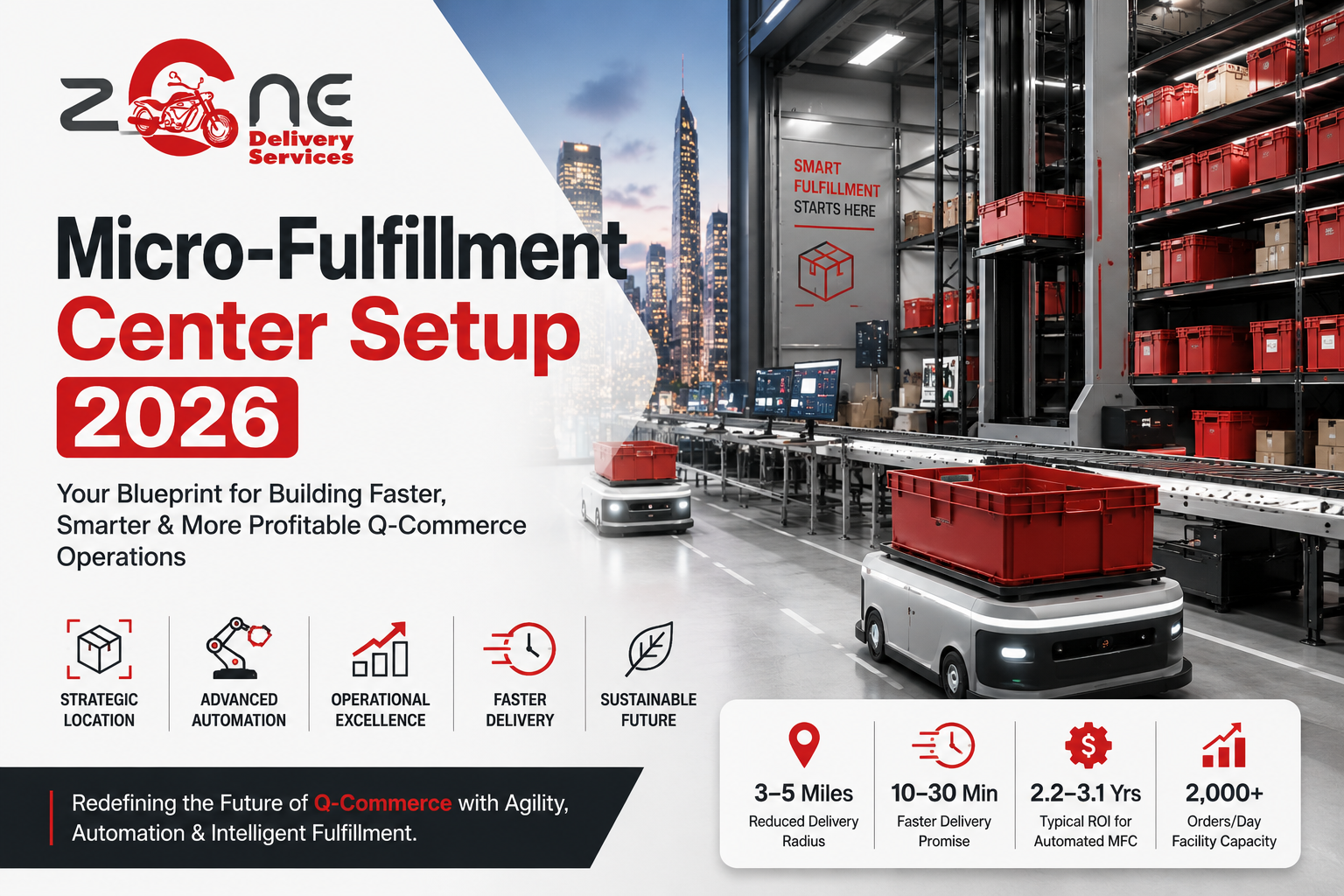
    3–5 miReduced Delivery Radius
    10–30Min Delivery Promise
    2.2–3.1Yrs Typical ROI
    2,000+Orders/Day Capacity

    There’s a brutal math problem sitting at the center of modern retail logistics: the closer a customer is to your inventory, the more profitable every order becomes. Yet most brands still ship from centralized distribution hubs located 20 to 30 miles from dense urban demand — paying full price for a model designed for a slower, less demanding world.

    Micro-fulfillment centers (MFCs) flip that model entirely. By embedding compact, highly automated nodes directly inside urban demand zones, forward-thinking operators are compressing delivery radii from 25 miles down to under 3. The result? Lower last-mile costs, faster same-day delivery windows, and a competitive edge that is becoming non-negotiable as consumer expectations tighten.

    But setting one up is not simply a matter of leasing a small warehouse and buying shelves. In 2026, the difference between an MFC that delivers strong ROI within three years and one that bleeds cash is almost entirely determined by decisions made before a single robot is installed.


    Zone Delivery Services — UAE

    Powering Q-Commerce Fulfillment Across the UAE

    Zone Delivery Services operates a full-spectrum delivery network across the UAE, purpose-built for the speed and reliability that modern Q-commerce demands. Explore our services:

    Before diving into setup, it’s worth being precise about what qualifies as a true MFC — because conflating it with simpler dark store models leads operators to make expensive mistakes.

    Dark Store vs. True MFC

    A dark store is a retail location closed to the public and repurposed for fulfillment. It uses standard horizontal shelving, human pickers, and conventional warehouse workflows. Setup costs typically run under $750,000, making them accessible entry points for smaller operations.

    A micro-fulfillment center is categorically different. It combines:

    • Automated Storage and Retrieval Systems (ASRS) or Autonomous Mobile Robots (AMRs) that pick and transport inventory
    • AI-powered orchestration software managing order flow, inventory positioning, and capacity throttling in real time
    • Vertical cubic storage architecture that maximizes throughput per square foot
    • Integration with external data APIs — traffic, weather, local events — to anticipate demand before it arrives
    • Seamless connectivity with e-commerce delivery and last-mile dispatch networks for end-to-end fulfilment

    The key distinction: Dark stores break even faster but plateau earlier. True MFCs require more upfront investment but scale with demand in ways dark stores structurally cannot. At 800–1,000+ daily orders, the cost-per-order economics of a manual dark store become worse than a smaller, fully automated facility.


    Why 2026 Is the Inflection Point

    Three forces are converging this year to make micro-fulfillment more viable — and more necessary — than at any point in the past decade.

    🤖

    The RaaS Revolution

    Robotics-as-a-Service converts multi-million CapEx into manageable monthly OpEx, opening full automation to mid-sized operators who previously couldn’t justify the numbers. Explore Zone’s full delivery services.

    🌱

    Urban Eco-Zoning

    Cities now offer tax breaks, expedited permits, and incentives for facilities running 100% EV dispatch fleets — directly compressing payback periods.

    ⚡

    Labor Economics Shift

    Warehouse labor shortages and unprecedented hourly wages have made automation a survival requirement for operators processing 1,000+ daily orders. Agile bike delivery courier networks help bridge the gap.

    📊

    Software-First Era

    Hardware is increasingly commoditized. The true differentiator driving ROI in 2026 is the AI control layer — the intelligence that orchestrates every pick, slot, and same-day dispatch decision.


    The Anatomy of a High-ROI MFC: Hardware & Software Foundations

    ASRS Grids vs. Autonomous Mobile Robots: Choosing Your Hardware Paradigm

    The two dominant automation paradigms in 2026 serve different operational profiles. Getting this decision wrong in year one can cost millions in retrofit expenses by year three.

    Hardware Type Best For Peak Throughput Flexibility Typical Cost
    ASRS Grid High-SKU, high-volume, stable assortments 600–1,200 lines/hr Low $2M–$5M+
    AMR Fleet Dynamic product mix, seasonal assortments 300–700 lines/hr High $800K–$2.5M
    Hybrid ASRS + AMR Enterprise-scale, diverse categories 800–1,800 lines/hr Medium-High $4M–$8M+
    Manual (Dark Store) Validation phase, under 800 orders/day 100–300 lines/hr Very High $300K–$750K

    A growing number of enterprise-scale MFCs in 2026 deploy hybrid configurations: ASRS grids handle the top 20% of SKUs that drive 80% of order volume, while AMR systems serve the long-tail assortment. This architecture optimizes peak throughput where it matters most while maintaining flexibility everywhere else.

    The Software Imperative: AI Control Layers & Digital Twins

    Here’s a counterintuitive truth: in 2026, the hardware is increasingly commoditized. What differentiates a high-performing MFC is the intelligence layer orchestrating it.

    • Predictive Slotting: AI ingests external feeds — weather forecasts, city events, sports schedules — and pre-positions inventory before demand spikes arrive. Operators running predictive slotting consistently report 12–18% improvements in pick-path efficiency.
    • Algorithmic Order Throttling: When real-time fleet capacity tightens, the system intelligently pauses order acceptance at the customer layer before a backlog builds — protecting both unit economics and delivery SLAs simultaneously.
    • Digital Twin Pressure-Testing: A full virtual simulation of the MFC is built and stress-tested for months before physical construction begins. Facilities using Digital Twins consistently resolve critical workflow bottlenecks that would otherwise take 6–18 months to surface in live operations.

    “In 2026, robotics hardware is the commodity. The AI control layer is the product. Every MFC operator should be evaluating their software stack before they ever talk to a robot vendor.”


    Step-by-Step Implementation Guide

    1

    Phase 1 — Data-Driven Site Selection: Heatmapping Urban Demand

    Build an order density heatmap at ZIP code level from historical OMS data. Model delivery radii using drive-time, not straight-line distance. Identify the demand centroid — the point that minimizes average delivery time across the top 80% of order density. Only then filter available properties within that zone. In high-density markets like Dubai or Abu Dhabi, this produces a shortlist ranked by logistical fit rather than cost per square foot.

    2

    Phase 2 — Solving the Zoning Puzzle: Urban Logistics Compliance

    Urban zoning is the most underestimated challenge in MFC development. Pursue the Hybrid Dark Hub strategy — repurposed retail basements, dormant parking garage decks, and decommissioned light industrial units often carry more permissive zoning classifications than purpose-built commercial real estate, at lower per-square-foot lease rates. Commit to EV dispatch early to qualify for Urban Logistics Zone incentives that can cut permitting timelines from 12 months to 4–6 months.

    3

    Phase 3 — Hardware Integration & Vendor Selection

    Evaluate vendors on four non-negotiables: API-first architecture (can the system accept instructions from a third-party AI layer?), documented degraded-mode operating procedures for robot failures, a clear software upgrade roadmap, and for RaaS contracts — precise uptime SLAs with financial remedies for breach. Avoid single-vendor integrated stacks that create dangerous dependencies in live operations. Your dispatch layer should integrate cleanly with same-day and next-day delivery networks from day one.


    The Financial Breakdown: CapEx vs. RaaS

    Bootstrapping Path: Manual Dark Store Under $1M

    This model is viable for operators processing 300–800 daily orders who need to validate the concept before committing to automation. Lease and fit-out typically runs $180K–$320K; standard racking and conveyors add $80K–$150K; WMS software costs $40K–$80K per year. Total initial outlay: $300K–$750K. For UAE operators, pairing this with a reliable domestic courier service and a cash on delivery solution can bridge the gap while automation is phased in. The honest caveat — labor costs scale linearly with volume. Above 1,000 daily orders, this model’s cost-per-order deteriorates sharply.

    The RaaS Path: Full Automation Without CapEx

    Under a mid-scale RaaS model (10,000–15,000 sq ft, 2,000–4,000 daily orders): initial setup fees run $200K–$500K versus a $2M–$4M equivalent CapEx commitment. Monthly subscription costs fall between $35K–$80K depending on throughput tier. Break-even versus the owned model lands at 36–54 months, with the critical advantage that underperforming volumes can be scaled back rather than written off.

    Full CapEx Automation: The $5M+ Hub

    For operators confident in volumes above 3,500 daily orders, owned ASRS infrastructure delivers the best long-term unit economics. Cost-per-order for the fulfillment component typically falls to $0.80–$1.40 versus $1.60–$2.80 for a RaaS equivalent. ROI window for a 2,000+ orders/day facility: 2.2 to 3.1 years from go-live.

    Model Upfront Cost Monthly Opex Break-Even Scalability
    Manual Dark Store $300K–$750K High (labor-driven) 12–24 months Limited
    RaaS Mid-Scale $200K–$500K $35K–$80K 18–30 months High
    Owned ASRS Full $3M–$8M+ Low (maintenance) 28–42 months Very High

    Future-Proofing with Predictive Slotting & External API Integration

    The gap between an MFC that performs well today and one that outperforms in three years is almost entirely in this section. Three foundational integrations most operators initially overlook:

    🌤

    Weather Data APIs

    Temperature drops correlate directly with pantry-stocking behavior. Pre-position shelf-stable goods 36–48 hours before the demand wave. For perishables and pharmaceuticals, pair this with a specialist temperature-controlled delivery network to maintain cold chain integrity.

    🎵

    Local Events Calendars

    City-level event data provides advance visibility into micro-demand spikes at neighborhood resolution. A 40,000-person concert within 2 miles drives measurable lift in ready-to-eat and beverage SKUs — lift the system can prepare for in advance.

    🚦

    Traffic & Routing APIs

    Real-time fleet routing data feeds back into the picking schedule. Severe congestion that will delay afternoon dispatch triggers a reallocation of picking capacity to the evening wave — preventing backlog before it forms. Bike couriers act as a flexible overflow layer during peak traffic windows.

    📈

    Order Throttling Engine

    The 2026 control layer doesn’t just slow picking when capacity is constrained — it intelligently pauses order acceptance at the customer-facing layer, protecting both delivery SLAs and unit economics simultaneously.

    Pro Tip: Operators who implement all three API integrations in year one consistently outperform those who add them incrementally. The data relationships take time to train — earlier data collection means faster model maturity and better predictive accuracy.


    Regional Considerations: Adapting the Model to Your Market

    Tier-1 Metro Markets

    Highest real estate costs, greatest demand density. The priority is vertical efficiency — ASRS systems maximizing throughput from limited floorplates are almost always the right architecture. Demand volumes to justify them invariably exist. In the UAE, Dubai represents the clearest Tier-1 use case — dense residential clusters, high consumer spending, and strong same-day delivery expectations.

    Tier-2 and Tier-3 Markets

    Lower demand density weakens the case for full ASRS but strengthens the case for strategic hub positioning within underserved zones. Hybrid AMR systems with lower fixed costs and higher flexibility often outperform ASRS here. Zoning complexity is typically lower, reducing time-to-market meaningfully. UAE markets such as Sharjah, Al Ain, and Ajman are prime examples of this profile.

    Cross-Docking as a Complement

    In markets where a single MFC cannot economically serve the full catchment area, lightweight cross-dock “spoke” locations — simple urban staging points without automation — can extend delivery coverage without replicating full MFC infrastructure costs.

    Zone Delivery Services operates across the UAE — find your location:


    FAQ: Micro-Fulfillment Center Setup 2026

    What is the typical ROI period for an automated micro-fulfillment center? ▾
    For facilities processing more than 2,000 orders per day, the typical ROI window is 2.2 to 3.1 years from go-live. Facilities running below 1,000 daily orders under a RaaS model typically see break-even between 18 and 30 months due to lower initial capital outlay.
    How much physical space does a micro-fulfillment center require? ▾
    Functional MFCs range from 5,000 to 25,000 square feet. The key variable is verticality — an ASRS-equipped 8,000 sq ft space with 30-foot ceilings can outperform a 20,000 sq ft flat-floor dark store in both storage density and throughput.
    Can a functional dark store be established for under $1 million? ▾
    Yes. Manual or lightly automated dark stores average under $750,000 in initial setup costs. This model is viable for validating demand and building operational knowledge, but faces linear labor cost scaling that makes it less competitive above 800–1,000 daily orders.
    What differentiates a dark store from a true MFC? ▾
    The degree of automation and the utilization of vertical cubic space. A dark store uses standard shelving and human pickers. A true MFC uses ASRS or AMR systems to automate the pick cycle and typically achieves 3 to 5 times the inventory density per square foot through vertical storage architecture.
    What is Robotics-as-a-Service (RaaS) in logistics? ▾
    RaaS is a subscription model where operators pay recurring fees for robotic infrastructure rather than owning it outright. It converts what was previously multi-million-dollar CapEx into manageable monthly OpEx, making full automation accessible to mid-sized operators who couldn’t previously justify the capital commitment.
    What is a Digital Twin in micro-fulfillment? ▾
    A Digital Twin is a full virtual simulation of a planned MFC that models every aspect of operations — picking throughput, conveyor logistics, receiving workflows, dispatch sequences — before physical construction begins. Operators use it to identify and resolve bottlenecks that would otherwise take months to surface in a live facility.
    How does predictive slotting work in a micro-fulfillment center? ▾
    Predictive slotting uses AI to ingest external data — weather forecasts, local event calendars, traffic patterns — and proactively repositions inventory to optimal pick locations before demand spikes arrive. This is distinct from reactive replenishment, which responds to demand after it occurs. The result is a measurable reduction in pick-path travel time and order cycle time during high-demand windows.

    Conclusion: Build for Elasticity, Not Static Capacity

    The framing that best captures where Q-commerce infrastructure is heading is not “small warehouse” — it’s elastic fulfillment. The highest-performing MFCs are architected to contract and expand dynamically: throttling order acceptance when fleet capacity tightens, pre-slotting inventory when external signals point to an incoming surge, scaling robotic capacity up or down on subscription models without long-term CapEx commitments.

    Getting there requires making the right decisions in the right order: demand data before site selection, Digital Twin before construction, software stack before hardware procurement. The businesses defining Q-commerce delivery standards through 2027 and beyond are building elastic, software-first fulfillment infrastructure right now. This is how they’re doing it.

    Ready to Build Your MFC?

    Zone Delivery Services provides the last-mile and same-day delivery infrastructure to power your fulfillment operations across the UAE.

    Read more expert logistics guides on the Zone Delivery Services blog →

    Primary keyword: micro-fulfillment center setup  |  Semantic coverage: dark store, Q-commerce logistics, ASRS, AMR, RaaS, predictive slotting, Digital Twin, urban logistics zones, last-mile delivery, warehouse automation 2026, algorithmic order throttling, elastic fulfillment.
  • Starting a Food Delivery Business in Dubai

    Starting a Food Delivery Business in Dubai


    Starting a Food Delivery Business in Dubai: Complete Checklist & Step-by-Step Guide

    Dubai’s food delivery ecosystem is booming — and for good reason. The market isn’t showing signs of slowing down anytime soon.

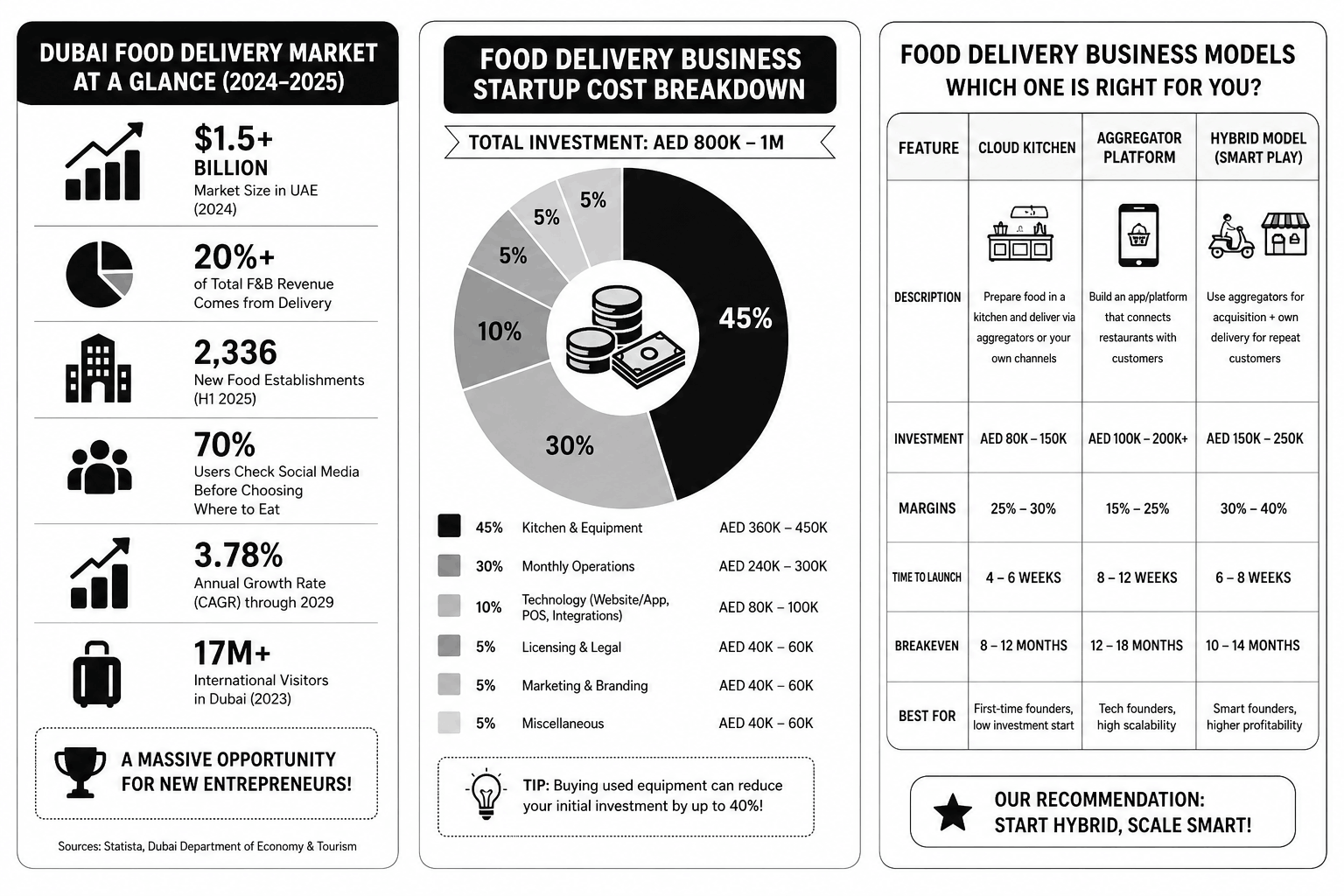
    The numbers tell a compelling story: the UAE’s food service market was valued at USD 18.78 billion in 2024 and is projected to reach USD 84.85 billion by 2033. Within this larger trend, food delivery specifically has carved out a significant niche, accounting for over 20% of the total food and beverage revenue in the region.

    But here’s what matters for entrepreneurs: Dubai issued nearly 1,200 new restaurant and food business licenses in 2024 alone, with 2,336 new food establishments launched in just the first half of 2025. These numbers signal an extraordinary opportunity window.

    The challenge? Knowing where to start, what permissions you need, how much it actually costs, and whether you’re building the right kind of business for Dubai’s specific regulatory and market environment.

    This guide walks through everything — from the first decision you’ll make to the day you take your first order. It’s based on official government sources, actual business startup data, and the real costs entrepreneurs are facing in Dubai right now.


    Starting a Food Delivery Business in Dubai - Complete Checklist & Step-by-Step Guide
    Starting a Food Delivery Business in Dubai – Complete Checklist & Step-by-Step Guide

    Part 1: Why Now? The Opportunity in Dubai’s Food Delivery Space

    Dubai’s population is over 200 nationalities strong, making it one of the most diverse consumer markets globally. That diversity means demand for every type of cuisine, dietary preference, and delivery model imaginable.

    Tourism amplifies this. Dubai welcomed over 17 million international visitors in 2023, with numbers tracking higher in 2025. Food and beverage spending accounts for over 30% of tourism expenditure in Dubai. About 70% of restaurant-goers in the UAE check social media for recommendations before choosing where to eat, and many of those recommendations include delivery options.

    Key Market Metrics (2024–2025):

    • Food delivery market in UAE: $1.5 billion+ (valued in 2024)
    • Projected to exceed: AED 5 billion by 2025
    • Annual growth rate: 3.78% CAGR through 2029
    • New food establishments (H1 2025): 2,336 licenses issued

    Part 2: What Kind of Delivery Business Are You Building?

    There are three primary models in Dubai:

    Model A: Cloud Kitchen (Lowest Capital Requirement)

    You lease commercial kitchen space and prepare food exclusively for delivery — no dine-in customers, no front-of-house staff. Pure production and food delivery services focus.

    • Cost: AED 80,000–150,000 first year
    • Margins: 25–30%
    • Timeline to launch: 4–6 weeks
    • Breakeven: 8–12 months

    This model dominates Dubai right now because it works. You skip massive overhead and can test multiple cuisine concepts from a single kitchen. Many successful operators run 2–3 brand concepts from one facility.

    Pro tip: Once your kitchen is set up, partnering with a reliable last-mile delivery company in Dubai like Zone Delivery Services means you don’t have to hire, train, or manage your own rider fleet.

    Model B: Delivery Platform / Aggregator

    You build an app or platform that connects restaurants to customers, taking a commission on each order (typically 15–35%). This requires significant upfront tech investment but scales differently.

    • Cost: AED 100,000–200,000+ (app development alone)
    • Margins: 15–25% per order (commission-based)
    • Timeline to launch: 8–12 weeks
    • Breakeven: 12–18 months

    This model is harder for first-time entrepreneurs unless you have technical co-founders.

    Model C: Hybrid Model (Smart Play)

    You start with a cloud kitchen and also develop your own delivery network for repeat customers. Early on, you use aggregators for customer acquisition, but you maintain your own riders for your repeat base.

    • Cost: AED 150,000–250,000 (first year)
    • Margins: 30–40%
    • Timeline to launch: 6–8 weeks
    • Breakeven: 10–14 months

    This model reduces your delivery costs by 40% compared to pure aggregator dependency. Many hybrid operators outsource their direct delivery to professional bike delivery courier services rather than managing their own fleet — giving them the cost savings of direct delivery without the operational headache.


    Part 3: Where in Dubai Do You Want to Operate?

    Mainland (Dubai Proper)

    • You can trade directly with local customers
    • More regulatory requirements
    • Requires local sponsorship for non-UAE nationals
    • Rent is typically higher in prime areas
    • License costs: AED 6,000–7,000

    Free Zone (like Meydan Free Zone)

    • 100% foreign ownership
    • No local sponsor required
    • Faster licensing (under 60 minutes for Fawri license at Meydan)
    • Can’t sell directly to mainland consumers without a distributor
    • Popular for digital-first and tech-forward businesses

    Hybrid Approach: Many entrepreneurs set up in a Free Zone for operational efficiency, then partner with aggregators or a delivery service partner in Dubai who handles on-ground last-mile operations across the mainland.


    Part 4: The Licensing Roadmap

    There are multiple licenses and approvals required, not just one.

    License 1: Trade License (From DED)

    Your foundational business license — it says you exist as a legal entity and can conduct business in Dubai.

    • Trade name registration: AED 620–720
    • Initial approval (NOC certificate): AED 115–125
    • License fee: AED 500–1,500
    • Total: approximately AED 2,000–3,000

    Where to apply: ded.ae

    License 2: Food Safety License (From Dubai Municipality)

    No food safety license = no legal food preparation or delivery in Dubai. Dubai Municipality’s Food Safety Department issues this after inspection.

    • Food safety license: AED 10,000–12,000
    • RTA food delivery permit: AED 1,000 (annual)
    • Building/floor plan approval: AED 500–1,000
    • Total: approximately AED 11,500–13,000
    • Timeline: 3–6 weeks

    Where to apply: dm.gov.ae

    Common inspection failure reasons: inadequate ventilation, poor raw/cooked food separation, insufficient storage, pest control issues.

    License 3: Home-Based Food License (Alternative)

    For small home-based operations, the FoodWatch platform offers registration for AED 200/year. But if you’re serious about building a scalable business, this option is too restrictive — it limits food categories and won’t give you credibility with major delivery platforms.


    Approval Workflow (Exact Order)

    1. Decide on jurisdiction (Mainland vs. Free Zone)
    2. Choose business structure (LLC recommended)
    3. Reserve business name with DED
    4. Get initial approval (NOC) from DED
    5. Secure kitchen/commercial space
    6. Get kitchen layout approved by Dubai Municipality
    7. Complete kitchen build-out
    8. Apply for food safety license
    9. Pass food safety inspection
    10. Receive food safety license
    11. Apply for trade license (DED)
    12. Open corporate bank account
    13. Hire staff and complete visa/health requirements
    14. Set up operations — POS, delivery logistics, supplier contracts
    15. Launch

    Total timeline: 6–10 weeks (budget 12 weeks to be safe)


    Part 5: The Real Costs — What You Actually Need to Budget

    Licensing & Legal (One-Time)

    ItemCost
    Business setup consultationAED 3,000–5,000
    Trade name registrationAED 720
    Initial approval (NOC)AED 125
    Trade license (LLC)AED 1,500
    Food safety licenseAED 12,000
    RTA delivery permitAED 1,000
    Building/kitchen approvalAED 750
    Legal documentation (MOA, AOA)AED 1,500
    Subtotal~AED 20,500

    Kitchen & Equipment (One-Time)

    ItemCost
    Monthly rent (3-month deposit)AED 15,000
    Kitchen equipment (basic)AED 60,000
    Ventilation/extraction systemAED 8,000
    Food storage (fridges, freezers)AED 15,000
    Cooking equipmentAED 25,000
    Workstations & prep tablesAED 8,000
    Cleaning equipment & suppliesAED 2,000
    Subtotal~AED 133,000

    Technology & Systems (One-Time)

    ItemCost
    POS system + softwareAED 20,000
    Delivery app integrationAED 15,000
    Website + online orderingAED 5,000
    Payment gateway setupAED 1,000
    Security camerasAED 3,000
    Subtotal~AED 44,000

    Monthly Recurring Costs

    ItemCost
    Kitchen rentAED 5,000
    UtilitiesAED 1,500
    Staff salaries (3–4 people)AED 12,000
    Food cost of goodsAED 30,000
    PackagingAED 5,000
    InsuranceAED 1,500
    Cleaning & maintenanceAED 2,000
    Permits & licenses renewalAED 200
    Monthly Total~AED 57,200

    Cost-saving tip: Many cloud kitchen operators avoid the expense and complexity of running their own rider fleet by partnering with a professional same-day delivery service in UAE. You pay per delivery rather than carrying fixed rider costs — which significantly lowers your break-even point in the early months.


    Part 6: Regulatory Compliance — What the Government Actually Requires

    Every food business in the UAE operates under the UAE Food Code. Key requirements include:

    Kitchen Layout:

    • Separate storage for raw and cooked food
    • Dedicated washing stations
    • Commercial-grade ventilation
    • Documented pest control measures
    • Temperature-controlled storage

    Food Handling:

    • All staff must hold food handler certification (~AED 500/person, 2–3 days)
    • HACCP system documented
    • Temperature monitoring logs
    • Full supplier traceability

    Packaging & Labeling:

    • Food-safe packaging
    • Allergen information included
    • Expiration dates where applicable
    • Business name and contact on packaging

    Real-Time Tracking:

    • A live order tracking system is mandatory
    • Customers must be able to see their order and delivery status
    • This is a documentation requirement for Dubai Municipality

    This is where professional delivery partners add real value. Zone Delivery Services operates a technology-driven logistics system with real-time tracking — helping food businesses meet this compliance requirement without building their own tracking infrastructure.


    Part 7: Step-by-Step Implementation Timeline

    Weeks 1–2: Planning & Setup Decisions

    • Decide on business model and jurisdiction
    • Choose business structure (LLC recommended)
    • Create basic business plan and secure funding
    • Brainstorm and check business name availability at ded.ae

    Weeks 3–4: Secure Kitchen Space

    • Scout locations — Al Quoz, Qusais, Dubai Investment Park are popular
    • Negotiate rent (AED 5,000–8,000/month for 500–800 sq ft)
    • Sign tenancy agreement and register with Ejari
    • Get landlord’s letter of permission for business use

    Cost: First deposit (2–3 months) = AED 10,000–24,000

    Week 5: Initial Applications

    • Apply for business name reservation with DED
    • Submit kitchen floor plan to Dubai Municipality
    • Begin kitchen layout modifications if needed

    Weeks 6–8: Kitchen Build-Out

    • Install commercial equipment (stove, fryer, grill, fridges, freezers)
    • Install ventilation/extraction system
    • Set up washing stations and sanitization areas
    • Document everything with photos for inspection

    Week 8: Food Safety License Application

    • Enroll staff in food handler training
    • Prepare HACCP documentation and supplier list
    • Apply for food safety license with Dubai Municipality

    Week 9: Inspection & License Issuance

    • Pass food safety inspection
    • Receive food safety license
    • Now eligible for trade license

    Week 10: Trade License & Business Finalization

    • Apply for trade license (DED)
    • Open corporate bank account
    • Set up staff visas, health insurance, and WPS registration

    Weeks 11–12: Operations Setup & Launch

    • Hire and train kitchen staff
    • Set up POS and inventory management
    • Integrate with delivery platforms (Talabat, Deliveroo, Noon)
    • Set up your last-mile delivery solution — either own riders or a logistics partner
    • Launch marketing campaign and take first orders

    Part 8: Choosing Your Delivery Model

    Option A: Aggregator Platforms (Talabat, Deliveroo, Noon)

    Pros: Instant customer access, no delivery infrastructure needed, payments handled for you.

    Cons: Commission of 25–35% per order, no direct customer relationship, limited branding control, no customer data ownership.

    Best for: Starting out, testing concepts, scaling quickly without logistics headaches.

    Option B: Your Own Delivery App / Platform

    Pros: Higher margins, own customer data and loyalty, full branding control.

    Cons: App development costs AED 50,000–150,000+, requires an existing customer base, you manage riders, payments, and support.

    Best for: Established brands, niche concepts, multi-brand operators.

    Option C: Hybrid Model (Smartest Play)

    • Year 1: 100% aggregator (building customer base)
    • Year 2: 60% aggregator, 40% direct
    • Year 3: 40% aggregator, 60% direct

    At 500 orders/month:

    • Pure aggregator: AED 35,000 revenue
    • Hybrid (Year 3): AED 41,000 revenue
    • Difference: AED 6,000/month = AED 72,000/year

    The key to making the hybrid model work is having a reliable delivery partner for your direct channel. Rather than managing your own rider fleet, many hybrid operators use Zone Delivery Services’ bike delivery couriers for on-demand fulfillment — getting the margin benefits of direct delivery without the HR and operational overhead.


    Part 9: Common Mistakes to Avoid

    1. Underestimating Licensing Delays Most entrepreneurs add 4–6 weeks to their timeline. Budget 12 weeks, not 8.

    2. Poor Location Choice Cheap rent in a bad location = terrible delivery logistics. Al Quoz and Dubai Investment Park aren’t glamorous, but they’re central and delivery-friendly.

    3. Inadequate Food Cost Management Industry target: 28–32% of revenue. If your food costs run 40%+, the business doesn’t work. Form buying groups with other operators to negotiate better supplier rates.

    4. Hiring Too Early Start with 2–3 core people. Add staff as orders scale. A better approach: outsource delivery to a professional courier service instead of hiring in-house riders before you have the volume.

    5. Ignoring Food Safety Inspection Requirements Hire an inspector-turned-consultant (AED 2,000–3,000) to pre-audit your kitchen. This investment pays for itself in avoided delays.

    6. Banking on Day 1 Profitability Realistic timeline: 8–12 months to profitability. Budget for 6 months of operating losses.


    Part 10: The Financial Reality

    At 400 orders/month, AED 80 average order value (Hybrid Model, Year 2):

    • Total Revenue: AED 24,576
    • Total Costs: AED 33,464
    • Gross Profit: –AED 8,888 (still losing money)

    At 800 orders/month:

    • Revenue: AED 49,152
    • Costs: ~AED 42,000
    • Gross Profit: AED 7,152 (finally profitable)

    You need volume to break even. This is why customer acquisition and retention matter so much — and why keeping your delivery costs lean (by outsourcing to a partner rather than maintaining your own fleet) is critical in the early months.


    Part 11: What Actually Works — The Success Playbook

    1. Start with a concept that solves a problem. Don’t copy competitors. Fill a specific gap: premium healthy bowls in under 20 minutes, traditional regional cuisine for expats, or a ghost restaurant brand with low overhead.

    2. Obsess over delivery speed. Customers in Dubai expect order confirmation in 2 minutes, preparation in 15–20 minutes, and delivery in 25–35 minutes total. If you consistently miss these windows on aggregator platforms, your placement gets downgraded. Using a fast, professional same-day delivery partner helps you protect your ratings.

    3. Nail your first 100 orders. Do quality checks personally. Respond to feedback immediately. Offer discounts on second orders. Ask for ratings — they affect the aggregator algorithm significantly.

    4. Build a repeat customer base fast. The 80/20 rule: 80% of your revenue comes from 20% of customers. Use WhatsApp marketing, loyalty programs, SMS alerts for new items, and personalization to cultivate that 20%.

    5. Keep your delivery costs lean. Once you’re running 300+ orders a month, your delivery cost per order becomes a major lever on profitability. Many successful operators in Dubai use Zone Delivery Services as their direct-channel delivery partner — avoiding fixed rider costs while maintaining the speed and reliability that protects their aggregator ratings.


    Part 12: Your 30-Day Action Checklist

    Week 1:

    • Finalize business concept and target customer
    • Research 3–5 kitchen locations (focus on Al Quoz, Dubai Investment Park)
    • Meet with a business setup consultant
    • Build a basic financial model

    Week 2:

    • Secure kitchen space (sign tenancy)
    • Reserve business name with DED
    • Begin staff recruitment
    • Shortlist a delivery logistics partner for post-launch

    Week 3:

    • Submit kitchen floor plan to Dubai Municipality
    • Get initial approval (NOC) from DED
    • Finalize menu and supplier agreements
    • Begin kitchen equipment procurement

    Week 4:

    • Complete kitchen build-out (equipment, ventilation)
    • Enroll staff in food handler training
    • Apply for food safety license
    • Create social media accounts and basic branding

    Key Resources & Government Contacts

    Official Government Portals:

    Delivery & Logistics:

    Business Setup:

    Delivery Platforms:


    The Final Word

    Starting a food delivery business in Dubai isn’t complicated. It’s systematic and regulatory.

    The entrepreneurs who succeed are those who understand the exact sequence of approvals, budget realistically for both time and money, focus on customer problems rather than just food, build systems for scaling, and obsess over unit economics.

    The window is open. Dubai issued 2,336 new food establishments in the first half of 2025 alone.

    Your next step is simple: pick your model, secure a kitchen, and start the licensing process. The path from application to first order takes 8–10 weeks.

    When you’re ready to launch — or when you’re looking to reduce your delivery costs and scale your direct channel — Zone Delivery Services provides trained riders, real-time tracking, and last-mile delivery across Dubai and the UAE so you can focus on the food.

    The market is hungry. Let’s go.

    FREQUENTLY ASKED QUESTIONS

    Starting a Food Delivery Business in Dubai

    Everything you need to know about licenses, costs, timelines, and what it actually takes to launch.

    Q01  How much does it cost to start a food delivery business in Dubai?

    For a cloud kitchen model, expect to spend AED 400,000–1,000,000 in the first year for a serious, scalable operation. If you use used equipment and keep costs lean, you can launch for AED 400,000–500,000. This includes licensing (~AED 20,500), kitchen setup (~AED 133,000), technology (~AED 44,000), and monthly operating costs.

    Q02  What licenses do I need to start a food delivery business in Dubai?

    You need three main licenses: (1) Trade License from DED — total ~AED 2,000–3,000; (2) Food Safety License from Dubai Municipality — ~AED 11,500–13,000; (3) RTA Food Delivery Permit — AED 1,000 per year. If you’re starting a small home-based operation, a FoodWatch Home-Based Food License is available for just AED 200/year, but it’s too restrictive for scaling.

    Q03  How long does it take to get all the licenses?

    The full process takes 6–10 weeks if everything goes smoothly — budget 12 weeks to be safe. DED approval takes 5–7 days, while Dubai Municipality’s food safety inspection takes 3–6 weeks. If your kitchen fails inspection, add another 2–4 weeks for re-inspection.

    Q04  Should I set up on the Mainland or in a Free Zone?

    Free Zones (like Meydan) offer 100% foreign ownership, no local sponsor required, and faster licensing. The downside: you can’t sell directly to mainland customers — you’ll need to use aggregators like Talabat or Deliveroo. Mainland allows direct trade but may require local sponsorship for non-UAE nationals and typically has higher rent.

    Q05  Should I use Talabat/Deliveroo or build my own app?

    Start with aggregators — they give you instant access to millions of customers with no delivery infrastructure needed. Their commission is 25–35% per order. Building your own app costs AED 50,000–150,000 and requires an existing customer base to work. The smartest approach is the Hybrid Model: use aggregators to acquire customers, then gradually shift repeat customers to your own direct channel.

    Q06  What happens during the Dubai Municipality food safety inspection?

    Inspectors can show up unannounced. They check temperature logs, cleanliness, food storage, pest control measures, and staff certifications. Common reasons for rejection include poor ventilation, cross-contamination between raw and cooked food, pest evidence, expired ingredients, or staff without valid food handler certificates. If you fail, you have 30 days to fix issues and request a re-inspection.

    Q07  How many orders do I need to break even?

    For a typical cloud kitchen, you’ll likely still be losing money at 400–500 orders/month. Profitability typically kicks in at 800+ orders/month (roughly AED 7,000+ monthly profit). This is why customer retention and repeat orders are critical. The realistic breakeven timeline is 8–12 months.

    Q08  What are the best locations for a cloud kitchen in Dubai?

    Al Quoz (central, affordable at ~AED 5,000/month), Qusais (emerging, cheaper), and Dubai Investment Park (great for logistics) are the most popular choices. Avoid glamorous or expensive areas — in a delivery business, what matters is delivery coverage and proximity to high-order-density neighborhoods, not how the street looks.

    Q09  What are the staff requirements for a food delivery business?

    All food-handling staff must hold a Food Handler Certificate — a 2–3 day course costing ~AED 500 per person. You also need a documented HACCP (food safety management) system. To start, 2–3 core people are sufficient: a chef, a prep cook, and a delivery coordinator. Hiring too many staff early will drain your cash flow before you have the order volume to support it.

    Q10  Where do I apply for the licenses?

    Trade License: DED portal at ded.ae. Food Safety License: Dubai Municipality at dm.gov.ae. Home-based food license: FoodWatch at foodwatch.ae. You can also use business setup consultants like Commitbiz (commitbiz.com) or Start Any Business (startanybusiness.ae) — they can speed up your timeline by up to 40% by handling paperwork on your behalf.