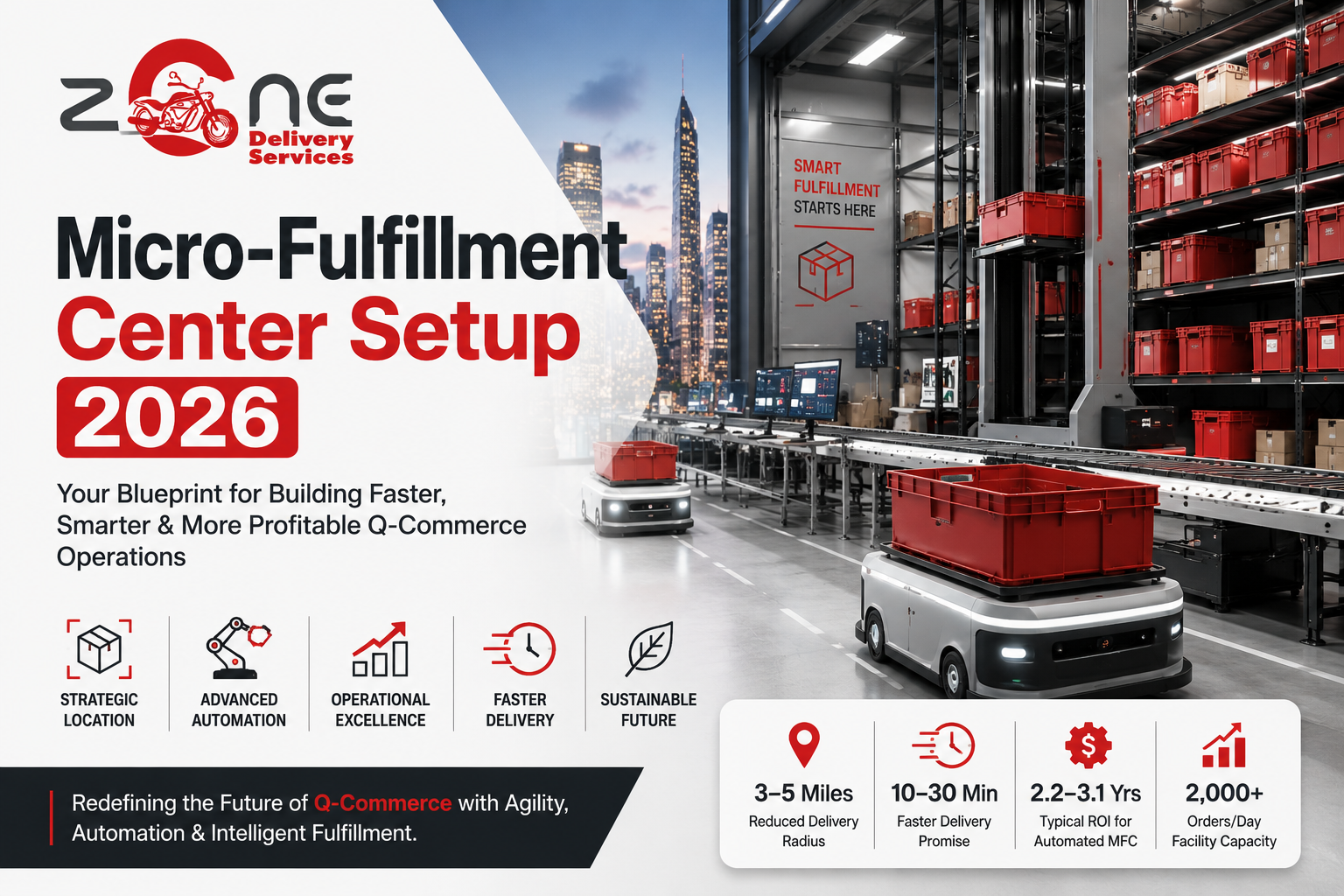
The 2026 Playbook: How to Set Up a Micro-Fulfillment Center That Actually Turns a Profit
Last-mile delivery now devours more than 55% of total logistics spend — and the warehouses that survive 2026 aren’t the ones with the most square footage. They’re the ones closest to the customer. This guide unpacks exactly how to design, fund, and operate a high-performance micro-fulfillment center in today’s Q-commerce landscape.
There’s a brutal math problem sitting at the center of modern retail logistics: the closer a customer is to your inventory, the more profitable every order becomes. Yet most brands still ship from centralized distribution hubs located 20 to 30 miles from dense urban demand — paying full price for a model designed for a slower, less demanding world.
Micro-fulfillment centers (MFCs) flip that model entirely. By embedding compact, highly automated nodes directly inside urban demand zones, forward-thinking operators are compressing delivery radii from 25 miles down to under 3. The result? Lower last-mile costs, faster same-day delivery windows, and a competitive edge that is becoming non-negotiable as consumer expectations tighten.
But setting one up is not simply a matter of leasing a small warehouse and buying shelves. In 2026, the difference between an MFC that delivers strong ROI within three years and one that bleeds cash is almost entirely determined by decisions made before a single robot is installed.
Powering Q-Commerce Fulfillment Across the UAE
Zone Delivery Services operates a full-spectrum delivery network across the UAE, purpose-built for the speed and reliability that modern Q-commerce demands. Explore our services:
Before diving into setup, it’s worth being precise about what qualifies as a true MFC — because conflating it with simpler dark store models leads operators to make expensive mistakes.
Dark Store vs. True MFC
A dark store is a retail location closed to the public and repurposed for fulfillment. It uses standard horizontal shelving, human pickers, and conventional warehouse workflows. Setup costs typically run under $750,000, making them accessible entry points for smaller operations.
A micro-fulfillment center is categorically different. It combines:
- Automated Storage and Retrieval Systems (ASRS) or Autonomous Mobile Robots (AMRs) that pick and transport inventory
- AI-powered orchestration software managing order flow, inventory positioning, and capacity throttling in real time
- Vertical cubic storage architecture that maximizes throughput per square foot
- Integration with external data APIs — traffic, weather, local events — to anticipate demand before it arrives
- Seamless connectivity with e-commerce delivery and last-mile dispatch networks for end-to-end fulfilment
The key distinction: Dark stores break even faster but plateau earlier. True MFCs require more upfront investment but scale with demand in ways dark stores structurally cannot. At 800–1,000+ daily orders, the cost-per-order economics of a manual dark store become worse than a smaller, fully automated facility.
Why 2026 Is the Inflection Point
Three forces are converging this year to make micro-fulfillment more viable — and more necessary — than at any point in the past decade.
The RaaS Revolution
Robotics-as-a-Service converts multi-million CapEx into manageable monthly OpEx, opening full automation to mid-sized operators who previously couldn’t justify the numbers. Explore Zone’s full delivery services.
Urban Eco-Zoning
Cities now offer tax breaks, expedited permits, and incentives for facilities running 100% EV dispatch fleets — directly compressing payback periods.
Labor Economics Shift
Warehouse labor shortages and unprecedented hourly wages have made automation a survival requirement for operators processing 1,000+ daily orders. Agile bike delivery courier networks help bridge the gap.
Software-First Era
Hardware is increasingly commoditized. The true differentiator driving ROI in 2026 is the AI control layer — the intelligence that orchestrates every pick, slot, and same-day dispatch decision.
The Anatomy of a High-ROI MFC: Hardware & Software Foundations
ASRS Grids vs. Autonomous Mobile Robots: Choosing Your Hardware Paradigm
The two dominant automation paradigms in 2026 serve different operational profiles. Getting this decision wrong in year one can cost millions in retrofit expenses by year three.
| Hardware Type | Best For | Peak Throughput | Flexibility | Typical Cost |
|---|---|---|---|---|
| ASRS Grid | High-SKU, high-volume, stable assortments | 600–1,200 lines/hr | Low | $2M–$5M+ |
| AMR Fleet | Dynamic product mix, seasonal assortments | 300–700 lines/hr | High | $800K–$2.5M |
| Hybrid ASRS + AMR | Enterprise-scale, diverse categories | 800–1,800 lines/hr | Medium-High | $4M–$8M+ |
| Manual (Dark Store) | Validation phase, under 800 orders/day | 100–300 lines/hr | Very High | $300K–$750K |
A growing number of enterprise-scale MFCs in 2026 deploy hybrid configurations: ASRS grids handle the top 20% of SKUs that drive 80% of order volume, while AMR systems serve the long-tail assortment. This architecture optimizes peak throughput where it matters most while maintaining flexibility everywhere else.
The Software Imperative: AI Control Layers & Digital Twins
Here’s a counterintuitive truth: in 2026, the hardware is increasingly commoditized. What differentiates a high-performing MFC is the intelligence layer orchestrating it.
- Predictive Slotting: AI ingests external feeds — weather forecasts, city events, sports schedules — and pre-positions inventory before demand spikes arrive. Operators running predictive slotting consistently report 12–18% improvements in pick-path efficiency.
- Algorithmic Order Throttling: When real-time fleet capacity tightens, the system intelligently pauses order acceptance at the customer layer before a backlog builds — protecting both unit economics and delivery SLAs simultaneously.
- Digital Twin Pressure-Testing: A full virtual simulation of the MFC is built and stress-tested for months before physical construction begins. Facilities using Digital Twins consistently resolve critical workflow bottlenecks that would otherwise take 6–18 months to surface in live operations.
“In 2026, robotics hardware is the commodity. The AI control layer is the product. Every MFC operator should be evaluating their software stack before they ever talk to a robot vendor.”
Step-by-Step Implementation Guide
Phase 1 — Data-Driven Site Selection: Heatmapping Urban Demand
Build an order density heatmap at ZIP code level from historical OMS data. Model delivery radii using drive-time, not straight-line distance. Identify the demand centroid — the point that minimizes average delivery time across the top 80% of order density. Only then filter available properties within that zone. In high-density markets like Dubai or Abu Dhabi, this produces a shortlist ranked by logistical fit rather than cost per square foot.
Phase 2 — Solving the Zoning Puzzle: Urban Logistics Compliance
Urban zoning is the most underestimated challenge in MFC development. Pursue the Hybrid Dark Hub strategy — repurposed retail basements, dormant parking garage decks, and decommissioned light industrial units often carry more permissive zoning classifications than purpose-built commercial real estate, at lower per-square-foot lease rates. Commit to EV dispatch early to qualify for Urban Logistics Zone incentives that can cut permitting timelines from 12 months to 4–6 months.
Phase 3 — Hardware Integration & Vendor Selection
Evaluate vendors on four non-negotiables: API-first architecture (can the system accept instructions from a third-party AI layer?), documented degraded-mode operating procedures for robot failures, a clear software upgrade roadmap, and for RaaS contracts — precise uptime SLAs with financial remedies for breach. Avoid single-vendor integrated stacks that create dangerous dependencies in live operations. Your dispatch layer should integrate cleanly with same-day and next-day delivery networks from day one.
The Financial Breakdown: CapEx vs. RaaS
Bootstrapping Path: Manual Dark Store Under $1M
This model is viable for operators processing 300–800 daily orders who need to validate the concept before committing to automation. Lease and fit-out typically runs $180K–$320K; standard racking and conveyors add $80K–$150K; WMS software costs $40K–$80K per year. Total initial outlay: $300K–$750K. For UAE operators, pairing this with a reliable domestic courier service and a cash on delivery solution can bridge the gap while automation is phased in. The honest caveat — labor costs scale linearly with volume. Above 1,000 daily orders, this model’s cost-per-order deteriorates sharply.
The RaaS Path: Full Automation Without CapEx
Under a mid-scale RaaS model (10,000–15,000 sq ft, 2,000–4,000 daily orders): initial setup fees run $200K–$500K versus a $2M–$4M equivalent CapEx commitment. Monthly subscription costs fall between $35K–$80K depending on throughput tier. Break-even versus the owned model lands at 36–54 months, with the critical advantage that underperforming volumes can be scaled back rather than written off.
Full CapEx Automation: The $5M+ Hub
For operators confident in volumes above 3,500 daily orders, owned ASRS infrastructure delivers the best long-term unit economics. Cost-per-order for the fulfillment component typically falls to $0.80–$1.40 versus $1.60–$2.80 for a RaaS equivalent. ROI window for a 2,000+ orders/day facility: 2.2 to 3.1 years from go-live.
| Model | Upfront Cost | Monthly Opex | Break-Even | Scalability |
|---|---|---|---|---|
| Manual Dark Store | $300K–$750K | High (labor-driven) | 12–24 months | Limited |
| RaaS Mid-Scale | $200K–$500K | $35K–$80K | 18–30 months | High |
| Owned ASRS Full | $3M–$8M+ | Low (maintenance) | 28–42 months | Very High |
Future-Proofing with Predictive Slotting & External API Integration
The gap between an MFC that performs well today and one that outperforms in three years is almost entirely in this section. Three foundational integrations most operators initially overlook:
Weather Data APIs
Temperature drops correlate directly with pantry-stocking behavior. Pre-position shelf-stable goods 36–48 hours before the demand wave. For perishables and pharmaceuticals, pair this with a specialist temperature-controlled delivery network to maintain cold chain integrity.
Local Events Calendars
City-level event data provides advance visibility into micro-demand spikes at neighborhood resolution. A 40,000-person concert within 2 miles drives measurable lift in ready-to-eat and beverage SKUs — lift the system can prepare for in advance.
Traffic & Routing APIs
Real-time fleet routing data feeds back into the picking schedule. Severe congestion that will delay afternoon dispatch triggers a reallocation of picking capacity to the evening wave — preventing backlog before it forms. Bike couriers act as a flexible overflow layer during peak traffic windows.
Order Throttling Engine
The 2026 control layer doesn’t just slow picking when capacity is constrained — it intelligently pauses order acceptance at the customer-facing layer, protecting both delivery SLAs and unit economics simultaneously.
Pro Tip: Operators who implement all three API integrations in year one consistently outperform those who add them incrementally. The data relationships take time to train — earlier data collection means faster model maturity and better predictive accuracy.
Regional Considerations: Adapting the Model to Your Market
Tier-1 Metro Markets
Highest real estate costs, greatest demand density. The priority is vertical efficiency — ASRS systems maximizing throughput from limited floorplates are almost always the right architecture. Demand volumes to justify them invariably exist. In the UAE, Dubai represents the clearest Tier-1 use case — dense residential clusters, high consumer spending, and strong same-day delivery expectations.
Tier-2 and Tier-3 Markets
Lower demand density weakens the case for full ASRS but strengthens the case for strategic hub positioning within underserved zones. Hybrid AMR systems with lower fixed costs and higher flexibility often outperform ASRS here. Zoning complexity is typically lower, reducing time-to-market meaningfully. UAE markets such as Sharjah, Al Ain, and Ajman are prime examples of this profile.
Cross-Docking as a Complement
In markets where a single MFC cannot economically serve the full catchment area, lightweight cross-dock “spoke” locations — simple urban staging points without automation — can extend delivery coverage without replicating full MFC infrastructure costs.
Zone Delivery Services operates across the UAE — find your location:
FAQ: Micro-Fulfillment Center Setup 2026
Conclusion: Build for Elasticity, Not Static Capacity
The framing that best captures where Q-commerce infrastructure is heading is not “small warehouse” — it’s elastic fulfillment. The highest-performing MFCs are architected to contract and expand dynamically: throttling order acceptance when fleet capacity tightens, pre-slotting inventory when external signals point to an incoming surge, scaling robotic capacity up or down on subscription models without long-term CapEx commitments.
Getting there requires making the right decisions in the right order: demand data before site selection, Digital Twin before construction, software stack before hardware procurement. The businesses defining Q-commerce delivery standards through 2027 and beyond are building elastic, software-first fulfillment infrastructure right now. This is how they’re doing it.
Ready to Build Your MFC?
Zone Delivery Services provides the last-mile and same-day delivery infrastructure to power your fulfillment operations across the UAE.
Read more expert logistics guides on the Zone Delivery Services blog →
Primary keyword: micro-fulfillment center setup | Semantic coverage: dark store, Q-commerce logistics, ASRS, AMR, RaaS, predictive slotting, Digital Twin, urban logistics zones, last-mile delivery, warehouse automation 2026, algorithmic order throttling, elastic fulfillment.
Leave a Reply