Category: Uncategorized

  • Bike Rider Supply Company UAE | Top 3PL Fleet Partner

    Bike Rider Supply Company UAE | Top 3PL Fleet Partner

    Zone Delivery Services — UAE

    Scale your delivery operations instantly with fully compliant, RTA-certified bike riders. We handle the visas, licensing, and strict RTA regulations so you can focus entirely on business growth.

    500+Active Riders
    100%RTA Compliant
    24hReplacement

    A bike rider supply company in the UAE acts as a Third-Party Logistics (3PL) partner. Instead of your business bearing the heavy burden of directly recruiting, licensing, and managing delivery staff, the supply company provides you with fully trained, legally compliant motorcycle riders on a flexible contract basis.

    Industry Fact: The largest delivery platforms in the region—such as Talabat, Noon Food, Deliveroo, and Careem—do not directly employ their riders. They rely exclusively on approved 3PL fleet partners to scale capacity rapidly.

    At Zone Delivery Services, we supply trained, insured, and deeply vetted riders to restaurants, cloud kitchens, courier companies, and e-commerce brands across the Emirates.

    The Compliance Challenge: Why Direct Hiring is Failing

    In the past, restaurants and retail stores attempted to hire delivery riders directly. Today, managing an in-house fleet has become a high-risk, high-cost operation.

    💸

    Visa & Labour Costs

    Processing a UAE residency visa and work permit costs an average of AED 5,000–8,000 upfront per direct hire.

    🛵

    RTA Licensing Delays

    Securing a UAE Motorcycle License can take 1 to 3 months and cost up to AED 4,800 per rider.

    ⚖️

    WPS Payroll Fines

    The Wage Protection System monitors salary payouts. Minor delays in paying direct staff trigger immediate corporate fines.

    🔄

    High Turnover

    When an in-house rider resigns or takes leave, your deliveries stop. Finding a legal replacement quickly is difficult.

    New Dubai RTA Regulations

    The Dubai Roads and Transport Authority (RTA) has rolled out strict new operational rules. Partnering with a professional bike rider supply company shields you from these legal liabilities.

    ⚠️
    Crucial Updates:
    1. Lane Restrictions: Delivery motorcycles are strictly banned from using the two leftmost high-speed lanes on major Dubai roads.
    2. Front Number Plates: All company-operated delivery bikes must now display specialized front plates with the gold category code.

    How Our Rider Supply Process Works

    We have engineered our onboarding process to be fast and frictionless, allowing you to deploy professional riders in a matter of days:

    1

    Requirement Analysis

    We analyze your business type, delivery zones, and required rider volume to match you with the correct service package.

    2

    Sourcing & Certification

    We source riders who already possess valid UAE motorcycle licenses and ensure they pass strict RTA Qualification tests.

    3

    Deployment & Management

    Riders integrate directly into your operations. We handle the background HR management and guarantee 24-hour replacements for sick leaves.

    In-House vs. Rider Supply Company

    Operational Factor Direct In-House Hiring Zone Delivery Supply
    Visa Sponsorship Your HR liability Managed by Us
    RTA Licensing Months of delays Pre-certified Riders
    Payroll Compliance Your legal risk Our responsibility
    Leave Replacement You must find cover 24h Replacement
    Cost Structure High fixed overhead Predictable fee

    Why Choose Zone Delivery Services?

    Headquartered in Al Quoz, Dubai, Zone Delivery Services is a premier logistics backbone for the UAE’s commerce sector.

    • Trusted Platform Partner: We supply large fleets to Talabat, Noon, Deliveroo, NowNow, and Porter.
    • Massive Capacity: Operating with over 500+ active riders across the UAE.
    • Zero Compliance Risk: Every single rider is legally sponsored, fully insured, and carries valid certifications.

    Frequently Asked Questions

    A bike rider supply company in the UAE is a 3PL business that provides trained, licensed, and RTA-certified motorcycle riders to other companies. They manage recruitment, visas, payroll, and fleet operations, allowing businesses to scale deliveries without direct HR overhead.
    The cost typically ranges from AED 2,500 to AED 4,500 per rider per month, depending on whether the contract includes just the rider, or a full package with the motorcycle, fuel, maintenance, and insurance.
    Yes. Zone Delivery Services strictly trains all supplied riders on the latest RTA regulations, including the rule that bans delivery bikes from the high-speed leftmost lanes in Dubai, ensuring your operations never face RTA fines.
    For standard requests, Zone Delivery Services can deploy RTA-certified bike riders within 24 to 72 hours.

    Need a Reliable Bike Rider Supply Partner?

    Zone Delivery Services operates 500+ active riders across the UAE. Fully RTA compliant, heavily vetted, and ready to deploy.

    Partner With Us Today
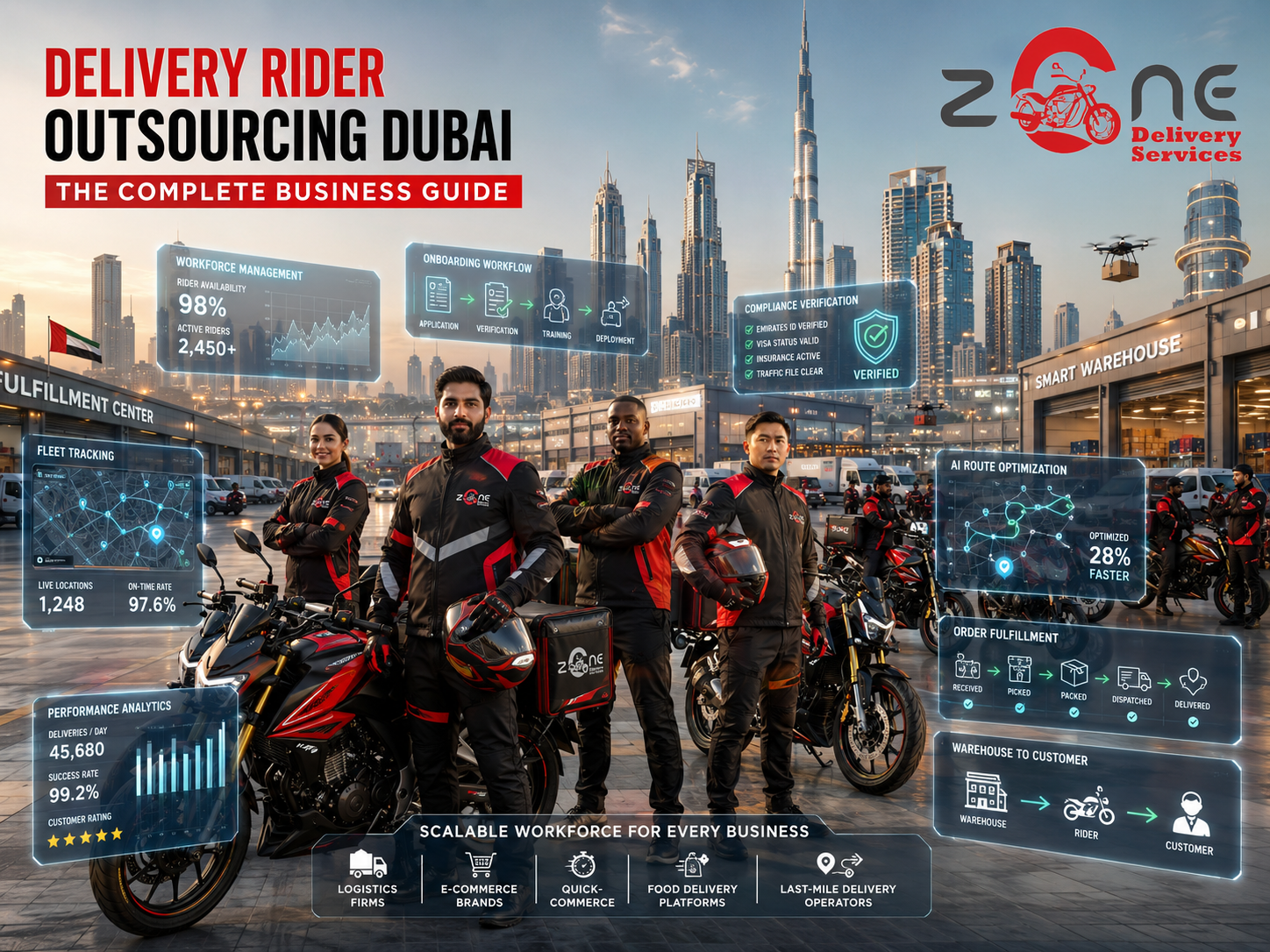
  • Delivery Rider Outsourcing Dubai: The Complete Business Guide

    Delivery Rider Outsourcing Dubai: The Complete Business Guide

    Zone Delivery Services — UAE

    Scale your delivery operations with trained, RTA-certified bike riders — no hiring headaches, no visa stress, no fleet management. Just riders, ready to deliver.

    Get a Free Quote →
    500+Active Riders
    30 minAvg. Delivery Time
    99%On-Time Rate
    9+Emirates Covered
    Topics: Rider Outsourcing Last Mile Delivery Dubai Delivery B2B Logistics 3PL Company UAE Fleet Partner Bike Riders Supply RTA Certified Talabat Partner Noon Fleet

    What Is Delivery Rider Outsourcing in Dubai?

    Delivery rider outsourcing in Dubai means hiring a third-party company to recruit, train, manage, and deploy motorbike riders on your behalf. Instead of going through the complex process of visa sponsorship, RTA licensing, insurance, and day-to-day rider management, businesses partner with a professional 3PL (Third Party Logistics) rider company that handles everything end-to-end.

    This model has become the backbone of Dubai’s delivery ecosystem. Major platforms including Talabat, Noon, Deliveroo, NowNow, and Porter all rely on fleet partner companies — not direct employment — to operate their rider networks.

    Key fact: Talabat’s fleet of nearly 20,000 riders across the UAE operates entirely through 3PL fleet partner companies — not direct employment. If you’re running a delivery platform or need rider capacity, outsourcing is the industry standard.

    At Zone Delivery Services, we are an active fleet partner for major delivery platforms and supply trained, insured, and RTA-certified riders to businesses across all UAE emirates.

    Why Businesses in Dubai Choose to Outsource Delivery Riders

    Managing an in-house rider team in Dubai involves significant operational, legal, and financial complexity. Here is why hundreds of businesses — from cloud kitchens to large e-commerce brands — choose delivery rider outsourcing instead:

    📋

    No Visa Hassle

    The outsourcing company handles all visa sponsorship, Emirates ID, and labour contracts for every rider.

    ⚡

    Fast Deployment

    Scale rider capacity within 24–72 hours — no lengthy recruitment process required.

    ✅

    Full Compliance

    RTA certification, WPS payroll compliance, and UAE labour law handled completely by the provider.

    💰

    Lower Fixed Costs

    Convert heavy fixed HR costs into flexible operational expenses that scale with your business.

    🏍️

    Trained Riders

    All riders are trained in safe delivery practices, customer service, and route optimisation.

    📈

    Scalable On Demand

    Increase or decrease rider count based on seasonal peaks — Ramadan, White Friday, and more.

    Who Needs Delivery Rider Outsourcing in Dubai?

    Delivery rider outsourcing is relevant for any business that needs consistent, reliable bike rider capacity without the burden of direct employment. This includes:

    • Food delivery platforms — Talabat, Deliveroo, Noon Food, Keeta, NowNow fleet operations
    • Restaurants and cloud kitchens — managing daily delivery volume without HR overhead
    • E-commerce companies needing last-mile eCommerce delivery service in UAE
    • Grocery and supermarket chains requiring same-day delivery riders
    • Pharmacies and medical suppliers needing temperature-sensitive express riders
    • Courier and logistics companies looking to expand fleet capacity quickly
    • Quick commerce (q-commerce) startups needing on-demand last mile coverage

    How Delivery Rider Outsourcing Works — Step by Step

    The outsourcing process at Zone Delivery Services is straightforward and built for fast deployment:

    1

    Requirement Assessment

    We understand your business type, delivery zones, order volumes, and operational hours to size the right rider team for you.

    2

    Rider Selection & Training

    Riders are screened, interviewed, RTA-certified, and trained in your delivery standards before deployment begins.

    3

    Visa, Insurance & Compliance

    All visa sponsorship, Emirates ID, health insurance, and WPS-compliant payroll are managed entirely by Zone Delivery Services.

    4

    Fleet & Equipment Provision

    Riders are provided with delivery-ready motorcycles, delivery boxes, SIM cards, fuel cards, and safety gear per your requirements.

    5

    Deployment & Ongoing Management

    Riders are deployed to your operations. We handle ongoing performance, replacements, shift management, and escalations.

    In-House Riders vs. Outsourced Riders — Full Comparison

    Should your business hire riders directly or outsource to a specialist company? The table below breaks down the key differences clearly:

    Feature In-House Riders Outsourced Riders (Zone)
    Visa & Sponsorship Your responsibility (High cost & admin) Fully Handled by Zone
    Deployment Speed Weeks or Months 24-72 Hours
    RTA Certification You must arrange testing & passes 100% Pre-Certified Riders
    Scalability Difficult to adjust staff sizes fast Highly Flexible On-Demand
  • Bike Rider Supply for E-Commerce Deliveries in UAE — Scale Fast Without Hiring Headaches

    Bike Rider Supply for E-Commerce Deliveries in UAE — Scale Fast Without Hiring Headaches

    Bike Rider Supply for E-Commerce Deliveries in UAE — Scale Fast Without Hiring Headaches | Zone Delivery Services
    Home › Blog › Bike Rider Supply for E-Commerce UAE
    📦 E-Commerce Logistics Guide — UAE

    The UAE last mile delivery market is racing toward USD 5.2 billion by 2030. E-commerce sales spike 30–50% during Ramadan. Your riders need to scale with it — without the hiring delays, CapEx burden, or compliance risk of building an in-house fleet.

    E-Commerce Delivery Last Mile Delivery Bike Rider Supply Same Day Delivery Fleet Manpower UAE Noon / Amazon.ae CapEx vs OpEx Peak Season Scaling
    📅 May 30, 2026 ⏱ 9 min read ✍️ Zone Delivery Services 📍 Dubai, UAE
    $5.2B UAE Last Mile Market by 2030
    12.5% Market CAGR — fastest in region
    39.7% Motorcycles share of all delivery vehicles
    +203% Online sales growth, Ramadan 2025

    If you are an operations manager at an e-commerce platform, a growing D2C brand, or a quick-commerce operator in the UAE, you already understand the delivery rider problem: orders scale unpredictably, full-time headcount is expensive, and building your own compliant rider fleet takes months you don’t have.

    The smarter model — used by platforms from Noon and Amazon.ae down to fast-growing D2C stores — is outsourced bike rider supply: a B2B partnership where a specialist operator like Zone Delivery Services deploys pre-trained, fully compliant, plug-and-play riders to your operations on demand.

    This guide explains the market context, the gaps your competitors are missing, and exactly how to use outsourced rider manpower as a genuine scalability engine for your e-commerce delivery operations in UAE.

    The UAE E-Commerce Delivery Opportunity in 2026

    The numbers are unambiguous. The UAE is the most mature e-commerce logistics market in the Middle East, holding 38.5% of the entire region’s last mile delivery market share. And the infrastructure powering all of it is two-wheeled.

    📊 Market Data

    The UAE last mile delivery market is projected to reach USD 5.2 billion by 2030, growing at a CAGR of 12.5%. Motorcycles and scooters represent the largest vehicle type share at 39.7% of all deliveries — confirming that bike riders are the essential workforce of UAE e-commerce logistics. The e-commerce segment alone accounts for 42.5% of all last mile delivery end-use.

    The competitive landscape is intensifying rapidly. In January 2026, Noon activated 20 additional dark stores across Dubai and Abu Dhabi, shrinking average delivery windows to 12 minutes. In October 2025, Amazon launched its 15-minute delivery service (Amazon Now) to the UAE. In March 2025, Talabat acquired Instashop, consolidating quick-commerce grocery delivery under Delivery Hero.

    What all of this means for e-commerce operators: delivery speed and fleet capacity are now competitive differentiators, not just operational necessities. And the only way to compete without burning capital is to outsource your rider supply.

    Gap Analysis: What Your Competitors Are Missing Research-Backed

    After analysing the top-ranking UAE rider supply pages — including Roadline Delivery, AK International, King Riders, Al Busayra, and Motoboy — we identified three critical gaps that none of them address fully. These are the angles that will make your operations decision-making smarter and this content rank higher:

    Gap 1 — They List Services. They Don’t Solve the Peak Season Surge.

    Competitors mention “flexible scaling” but give no framework for how to actually execute it during Ramadan, Eid, or White Friday. Most operations managers discover during a peak week that their supplier can’t deliver extra riders in time — because pre-cleared rider pools require weeks of preparation. Zone maintains a standing pool of pre-licensed, pre-vetted riders specifically for surge deployment.

    Gap 2 — No One Addresses the CapEx vs. OpEx Decision

    Finance teams at e-commerce companies are asking: “Should we own our fleet or outsource it?” Competitors never answer this question. We do — with numbers. Owning bikes, hiring riders, and managing compliance is pure CapEx. Outsourcing is pure OpEx: predictable, scalable, and immediately tax-deductible in the current period.

    Gap 3 — “Trained Riders” Means Different Things to Different Suppliers

    Most suppliers call their riders “trained” after a 2-hour safety briefing. True plug-and-play deployment for e-commerce means riders arrive knowing your scanner app, your package handling SOP, your escalation process for failed deliveries, and your customer communication standard. Zone trains riders on each platform’s specific workflow before Day 1.

    The Peak Season Problem — and the Scalability Hack

    No e-commerce challenge in the UAE is more operationally punishing than peak season delivery demand. Order volumes don’t just increase — they multiply. Here’s what the data shows:

    🌙 Ramadan +203% Online sales growth, UAE 2025
    🎁 Eid Al-Fitr +50% Gifting sales growth forecast
    🖤 White Friday +44% E-commerce vs. monthly average
    📱 Black Friday (UAE) +31% Spending vs. non-peak periods

    The real operational challenge: During Ramadan 2025, UAE e-commerce saw a 143% year-over-year increase in online marketplace spending. Three peak ordering windows replace the standard single evening peak — pre-iftar (4–5 PM), post-iftar (8 PM–2 AM), and pre-suhoor (around 4 AM, with grocery orders up 70%). A static rider fleet cannot serve all three windows profitably.

    The Scalability Hack: On-Demand Rider Pools

    The solution is not hiring 300% more full-time riders in October to be ready for Ramadan in February. That approach ties up budget, creates year-round payroll for underutilised headcount, and collapses your cost-per-delivery metrics outside of peak.

    The scalability hack is outsourcing to a supplier who maintains a standing pool of pre-cleared riders — UAE-licensed, visa-sponsored, platform-trained, and available for rapid deployment. You scale up weeks before peak, and scale back down after Eid with zero long-term commitment.

    1. Pre-Peak Planning (4–6 weeks before) Confirm your projected order volume surge with Zone. We identify the rider count increase, confirm pre-cleared rider availability, and schedule platform briefings.
    2. Surge Deployment (7–10 days before peak) Additional riders deployed and briefed on your app, zones, and surge SOPs. No new visa processing, no license delays.
    3. Peak Operations Zone’s field supervisors monitor performance in real time. Absent riders replaced same day. SLA maintained throughout surge period.
    4. Post-Peak Scale-Down Riders return to the general pool. Your headcount and cost return to baseline. No redundancy costs, no gratuity obligations on your side.

    CapEx vs. OpEx — Why Outsourcing Wins for E-Commerce Fleets

    This is the question every CFO and operations director at an e-commerce company faces: do we own our delivery fleet, or do we outsource it? The answer, for virtually every UAE e-commerce operator outside the largest platforms, is OpEx — and here’s why:

    Cost Factor In-House CapEx Model Zone OpEx Model
    Bike purchase (per unit) AED 4,500–9,000 upfront Included in monthly rate
    UAE motorcycle license AED 3,000–4,800 per rider Managed by Zone
    Residency visa AED 5,000–8,000 per rider On Zone’s visa
    Insurance & WPS Your HR team manages Fully covered
    Peak season scaling Weeks of hiring delays 7–10 days deployment
    Balance sheet impact Assets depreciate, tied-up capital Pure OpEx — fully deductible
    Flexibility Headcount locked in Scale up / down on demand
    Gratuity & leave liability Your company’s obligation Zone’s obligation — not yours

    Finance insight: Under the OpEx model, every dirham paid to Zone Delivery Services is fully deductible as an operating expense in the same period — unlike CapEx bike purchases, which depreciate over years and tie up working capital. For e-commerce companies in a growth phase, preserving capital for inventory, marketing, and platform development while outsourcing delivery fleet costs is the strategically correct move.

    Plug-and-Play SOPs: What “Ready to Ride” Actually Means

    Most rider suppliers hand over a rider with a license and a helmet and call them “trained.” That’s not plug-and-play — that’s a liability. Here’s what genuine e-commerce-ready deployment looks like at Zone Delivery Services:

    📱 Platform App Training

    Riders trained on your specific delivery app — Noon, Amazon.ae, Talabat, Porter, NowNow, Instashop, Deliveroo — before their first shift. They know the acceptance flow, status updates, and escalation steps.

    📦 Package Handling SOP

    Riders briefed on your specific package types — fragile items, temperature-sensitive goods, oversized orders — and how to handle, secure, and deliver each correctly.

    🗺️ Zone & Route Familiarity

    Riders assigned to their specific delivery zones with pre-briefing on building access points, parking restrictions, and common delivery address challenges in that area.

    🔄 Failed Delivery Protocol

    Riders trained on your escalation process for failed delivery attempts — customer call script, re-attempt timing, return procedure — reducing failed delivery rates from Day 1.

    🧍 Customer Conduct Standards

    Grooming, communication, and professionalism standards aligned with your brand. Riders know they represent your company, not just a generic delivery service.

    ⚙️ GPS & Salik Management

    Riders equipped with GPS-enabled devices and briefed on Salik-efficient routing to minimise toll costs and maximise delivery density per shift.

    What a Full E-Commerce Rider Supply Package Covers

    Every rider supplied by Zone Delivery Services for e-commerce operations comes with full compliance and operational coverage:

    • UAE Residency Visa: All riders on Zone’s visa — zero immigration liability on your business
    • UAE Category 1 Motorcycle License: Verified or facilitated by Zone before deployment
    • WPS Payroll Compliance: 100% MOHRE-compliant salary processing — not your payroll burden
    • OHC & Food Watch Card: Dubai Health Authority and Dubai Municipality compliance for food/grocery delivery roles
    • Workmen Compensation Insurance: On Zone’s employer policy — not your liability
    • Helmet, Jacket & Safety Gear: Full RTA-compliant safety kit included
    • GPS Device & SIM Card: Real-time rider visibility for your operations dashboard
    • E-commerce Platform Training: App-specific briefing before first deployment
    • Bike Option: With-bike or without-bike packages — Honda or e-bike available
    • Same-Day Rider Replacement: Written SLA guarantee for absences or underperformance
    • Peak Season Surge Capacity: Pre-cleared rider pool for Ramadan, Eid, White Friday scaling
    • End-of-Service Gratuity: Zone’s obligation — completely off your balance sheet

    How Zone Delivery Services Works With E-Commerce Brands

    Zone Delivery Services is not a staffing agency that passes riders over a fence. We are an active last-mile delivery operator with 500+ riders currently deployed across UAE platforms. We understand e-commerce operations from the inside — which means when we supply riders to you, they’re already calibrated to the pace and precision that e-commerce delivery demands.

    • Currently supplying riders to Noon, Talabat, Deliveroo, Porter, NowNow, Careem, Instashop and multiple D2C brands
    • Operations across Dubai, Abu Dhabi, Sharjah, Ajman, Ras Al Khaimah, Fujairah, and Al Ain
    • Flexible contracts: fixed monthly rider packages, per-delivery pricing, or hybrid models
    • E-bike fleet available for platforms preparing for UAE’s 2030 EV delivery mandate
    • Part of Zone Multiverse — a multi-subsidiary group with deep UAE logistics roots
    • 99% on-time delivery rate maintained across all active operations
    • 30-minute average delivery time across major Dubai zones

    Explore Our Delivery Services

    Ready to Scale Your E-Commerce Delivery Fleet?

    Tell us your platform, your volume, and your UAE coverage zones. We’ll design a custom rider supply package — with peak season surge capacity built in.

    Get a Free Quote → 📞 Call +971 42 73 7772

    Frequently Asked Questions

    The fastest way is through a B2B rider outsourcing partner like Zone Delivery Services. Instead of recruiting, licensing, and visa-sponsoring riders yourself, a supplier deploys work-ready, pre-trained riders to your operations within 3–7 days. All UAE motorcycle licensing, visa, WPS compliance, OHC cards, and platform training are handled by the supplier — with zero onboarding burden on your team.
    Fully managed rider outsourcing packages in UAE typically range from AED 1,800–2,500 per rider per month — including visa, UAE motorcycle license, safety gear, WPS payroll compliance, GPS tracking, and platform training. Per-delivery pricing starts from AED 5–12 depending on volume and contract structure. Compared to in-house hiring (visa + license + bike + insurance + compliance), outsourcing is typically 20–35% lower total cost at scale.
    E-commerce platforms scale delivery riders for UAE peak seasons by working with a rider supplier that maintains a pre-cleared, pre-trained rider pool. This allows headcount to increase 50–300% within 7–10 days — without new visa processing, license delays, or training bottlenecks. Zone Delivery Services specialises in peak season surge deployment, with pre-planning typically starting 4–6 weeks before the peak event. After the peak, clients scale back to baseline with no long-term headcount commitments.
    Owning your delivery fleet (buying bikes, hiring riders in-house) is a CapEx model — large upfront investment, assets that depreciate on your balance sheet, and limited flexibility. Outsourcing your rider fleet is an OpEx model — you pay a predictable monthly fee, the supplier owns all assets and compliance risk, and costs are fully deductible in the current period. For e-commerce businesses in a growth phase, the OpEx model preserves working capital for inventory, marketing, and platform expansion.
    Yes. Zone Delivery Services pre-trains riders on specific delivery platforms including Noon, Amazon.ae, Talabat, Porter, NowNow, Instashop, and Deliveroo before their first shift. Training covers app acceptance flows, status updates, package handling SOPs, escalation processes for failed deliveries, and customer conduct standards — so riders are operationally productive from Day 1 with zero onboarding time from your team.
    The UAE last mile delivery market is growing at a CAGR of 12.5% and is projected to reach USD 5.2 billion by 2030. The UAE holds 38.5% of the entire Middle East last mile delivery market. Motorcycles and scooters account for the largest vehicle type share at 39.7%, confirming that two-wheeler riders are the primary delivery workforce. The e-commerce segment represents 42.5% of all last mile delivery end-use — the largest single category.
    Zone Delivery Services supplies e-commerce delivery riders across all major UAE emirates: Dubai, Abu Dhabi, Sharjah, Ajman, Ras Al Khaimah, Fujairah, and Al Ain. Within Dubai, coverage includes all major delivery zones — Business Bay, Deira, Bur Dubai, Al Quoz, Al Karama, Al Barsha, Jumeirah, Dubai Investment Park, Jebel Ali, and more.
    Z
    Zone Delivery Services — Operations & E-Commerce Logistics Team

    500+ active riders across UAE. Trusted by Noon, Talabat, Deliveroo, Porter, NowNow, Careem & more. Part of Zone Multiverse & Zone Elite Investment. Al Quoz Industrial Area 3, Dubai.

    📍 Zone Delivery Services — Al Quoz Industrial Area 3, Dubai, UAE  |  📞 +971 42 73 7772  |  Contact Us  |  More Articles
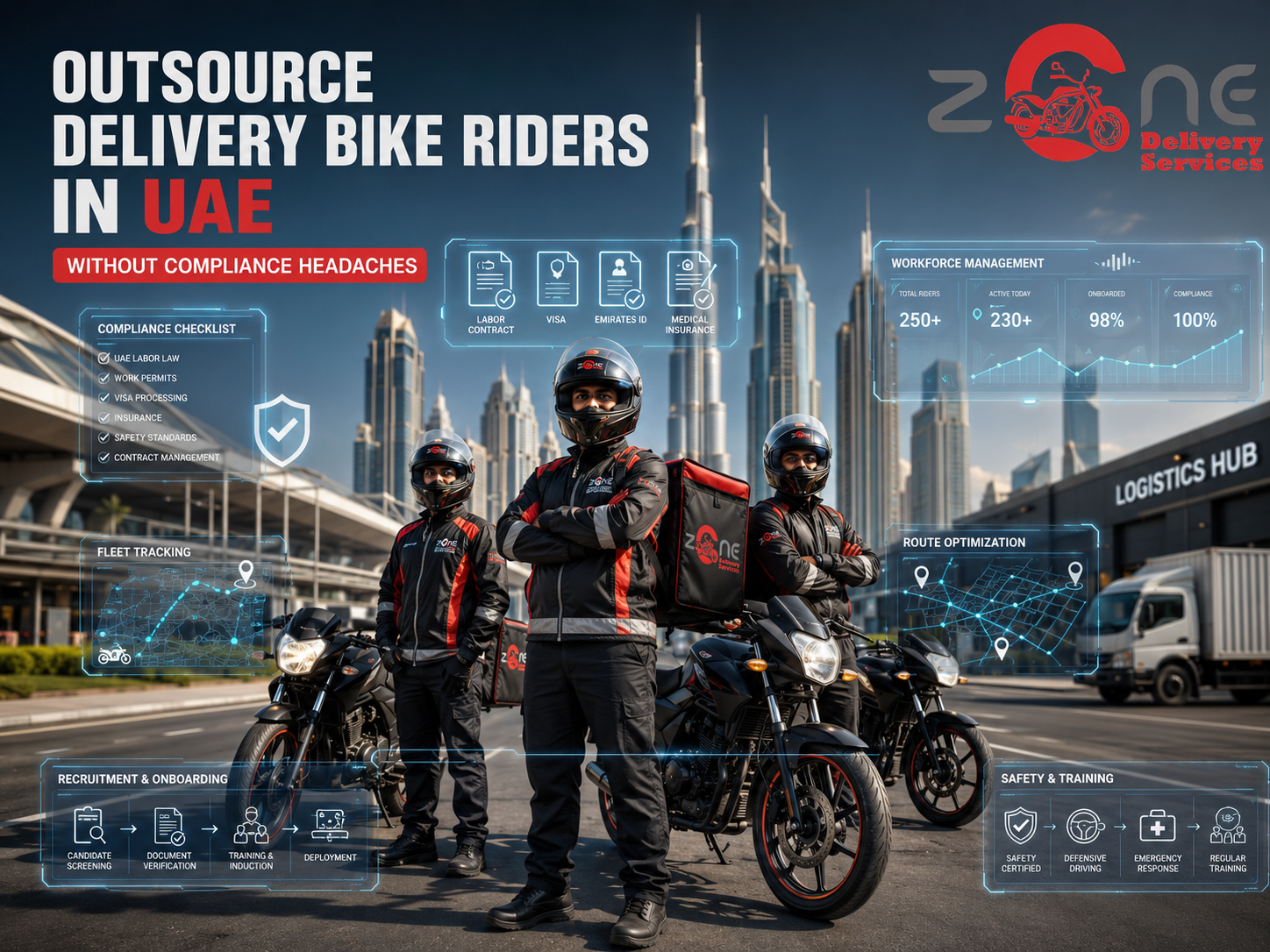
  • How to Outsource Delivery Bike Riders in UAE Without Compliance Headaches

    How to Outsource Delivery Bike Riders in UAE Without Compliance Headaches

    How to Outsource Delivery Bike Riders in UAE Without Compliance Headaches | Zone Delivery Services
    ⚠️ Compliance Guide — B2B Rider Outsourcing

    WPS fines that suspend your work permits. RTA motorcycle licenses that take 3 months. OHC cards most operators forget. Salik charges silently bleeding your budget. Here’s how to outsource riders and avoid every one of these landmines.

    Bike Rider Supply Last Mile Delivery Dubai WPS Compliance RTA Rules Rider Outsourcing UAE Fleet Management
    📅 May 30, 2026 ⏱ 9 min read ✍️ Zone Delivery Services 📍 Dubai, UAE
    ⚠️ Did you know? Under UAE law, failing to pay rider salaries through WPS for just 17 days past the due date results in an immediate suspension of your company’s work permit issuance — halting all new hiring. This is one of several compliance tripwires that delivery companies face when managing riders in-house.

    Outsourcing delivery bike riders in the UAE sounds simple on paper: you need riders, a supplier has riders, you sign a contract. Done.

    But in practice, the UAE has one of the most layered compliance environments for delivery workforce management in the region. Between WPS payroll regulations, RTA motorcycle licensing, Ministry of Labor alignment, OHC food cards, Salik tolls, insurance obligations, and a wave of new Dubai traffic rules — there are at least a dozen places where an under-prepared company gets caught.

    This guide walks you through every compliance layer, the true cost of getting it wrong, and exactly what to demand from any bike rider supply partner you work with in the UAE.

    The Real Problem With In-House Rider Management

    Most delivery companies don’t start out planning to outsource their riders. They hire a few directly, things seem manageable — then order volumes grow, headcount climbs, and suddenly the HR and admin burden is overwhelming.

    📜 Visa & Labour Burden

    Each rider requires UAE residency visa, MOHRE registration, and work permit — costing AED 5,000–8,000 upfront per person.

    🛵 License Bottleneck

    Converting a home-country motorcycle license to UAE Category 1 takes 1–3 months and AED 3,000–4,800 per rider.

    💰 Payroll Complexity

    WPS payroll for every rider must be submitted through MOHRE’s system on time, every month — with zero tolerance for errors or delays.

    🚧 Replacement Gaps

    When a rider calls in sick or leaves, you have no coverage. Re-hiring takes weeks. Your delivery SLA suffers immediately.

    This is why companies like Adecco, Transguard, and growing UAE-based operators like Zone Delivery Services exist: to absorb every one of these burdens so you can focus on running your delivery operations, not running an HR department.

    WPS Non-Compliance: The Fine That Freezes Your Business

    The Wage Protection System (WPS) is a mandatory electronic salary transfer system governed by MOHRE (Ministry of Human Resources and Emiratisation) and the UAE Central Bank. Every employee — including your delivery riders — must be paid through WPS on time, every month.

    Penalties under Cabinet Resolution No. 21 of 2020 escalate fast. Here’s the exact timeline of what happens when salaries go unpaid:

    Days Past Due Date MOHRE Penalty Action Severity
    Day 1–15 Grace period — system sends reminders on Day 1, Day 3, and Day 10 ⚠️ Warning
    Day 16–17 Work permit issuance suspended. You cannot hire any new employees. 🔴 Suspension
    Day 17–30 Company downgraded to MOHRE Category 3 — higher fees, stricter processing for all future permits and visas. 🔴 Downgrade
    Day 30+ MOHRE notifies Public Prosecution for companies with larger headcounts. Employees gain the right to transfer sponsors. 🚨 Prosecution
    4+ Months Company operations severely restricted. All entities under the same ownership may be affected. 🚨 Shutdown Risk

    Submitting incorrect salary data carries additional fines of AED 1,000 per employee for false wage records. Repeat offences within six months trigger further administrative fines and extended category downgrade periods.

    The outsourcing advantage: When you partner with Zone Delivery Services, all rider salaries are processed through our WPS account — under our MOHRE registration. You face zero exposure to WPS penalties because riders are not on your company’s payroll. You pay us a contract rate; we handle every salary obligation.

    The RTA & OHC Hurdle: Harder Than You Think

    Every delivery bike rider working on UAE roads must hold a valid UAE Category 1 Motorcycle Driving License. This is not transferable from a home-country license without a formal conversion or testing process.

    UAE Motorcycle License — What It Actually Takes

    1. Open an RTA file at an approved driving school (e.g. EDI) Requires Emirates ID, passport copy, residency visa, eye test, and NOC from visa sponsor.
    2. Complete mandatory training hours Beginners: 20 hours. Riders with an attested home-country license: minimum 10 hours. Riders from 52 Markhoos-approved countries may qualify for direct exchange.
    3. Pass RTA Theory Test Must be completed at an RTA-approved testing centre. Failure means re-booking, which adds days or weeks to the timeline.
    4. Pass Road Test Conducted at an RTA-approved driving school. Multiple test attempts are common, each adding cost.
    5. Collect Digital License via RTA Dubai App Licenses are now issued digitally. Total cost: AED 3,000–4,800. Total time: 1–3 months.

    OHC Card & Food Watch Card — The Compliance Most Companies Miss

    For any rider handling food delivery orders, two additional documents are mandatory under Dubai Municipality and DHA rules:

    • Occupational Health Card (OHC) — Issued by the Dubai Health Authority (DHA). Required for anyone working in food-adjacent roles in Dubai.
    • Food Watch Card — Issued by Dubai Municipality. Specifically required for riders delivering restaurant food orders within Dubai.

    Many in-house HR teams are simply unaware of the Food Watch Card requirement until they face a field inspection. Zone Delivery Services manages both cards for every rider before deployment — zero surprises.

    Hidden Fleet Costs: Salik, SIM Cards & Bike Maintenance

    Even companies that manage WPS and licensing correctly often get caught off guard by the operational costs of running a rider fleet in Dubai. These costs are real, recurring, and surprisingly large at scale.

    Salik Toll Costs Updated 2026

    Dubai now operates 10 Salik toll gates with dynamic pricing: AED 0 at night, up to AED 6 during peak hours. A delivery rider crossing 2–3 gates daily across 26 working days can accumulate AED 200–450 per month in Salik charges alone.

    Cost Item Per Rider / Month For 50-Rider Fleet
    Salik tolls (2–3 gates/day) AED 200–450 AED 10,000–22,500
    SIM card + data plan AED 50–100 AED 2,500–5,000
    Bike maintenance (tyres, oil, parts) AED 150–300 AED 7,500–15,000
    Bike insurance (annual ÷ 12) AED 80–150 AED 4,000–7,500
    Workmen compensation insurance AED 60–100 AED 3,000–5,000
    Uniform & safety kit (amortised) AED 30–60 AED 1,500–3,000
    Total Hidden Costs (in-house) AED 570–1,160 AED 28,500–58,000
    Zone Delivery Services (all-inclusive) Single contracted monthly rate — all above costs absorbed ✓

    These hidden costs are on top of salary, visa fees, and license costs. Most delivery businesses only discover the full picture after their first quarterly finance review — by which point they’ve already overspent significantly.

    New Dubai Delivery Rider Rules You Must Know 2025–2026

    The regulatory environment for delivery riders in Dubai has tightened significantly. If you manage riders in-house, staying current with these rules is your responsibility. Here’s what changed:

    🚦 Dubai RTA Delivery Rider Regulations — Current as of May 2026
    UPDATED
    • Lane Restrictions (Nov 2025): Delivery bikes banned from the two leftmost lanes on roads with 5+ lanes, and the leftmost lane on roads with 3–4 lanes. Fines up to AED 700 per violation, plus delivery permit suspension for repeat offenders.
    • Front Number Plates (Dec 2025): Company-operated delivery motorcycles must display front and rear plates, marked with delivery category code (9). Private bikes are exempt.
    • Telematics Monitoring (2026 Rollout): RTA is deploying AI cameras, GPS, and sensors across all 65,000 Dubai delivery riders to track speed, harsh braking, lane discipline, and safety gear use. Dangerous riders risk licence revocation.
    • Bike Lifespan & Inspection: Delivery motorcycles reaching the 4-year operational age limit must go through RTA’s Operational Life Extension process with mandatory safety inspections.
    • Delivery Box Standards: Boxes must be properly fixed, legible, free of sharp edges, and maintain food temperature. This is enforced in conjunction with Dubai Municipality food watch rules.

    When you outsource to Zone Delivery Services, we track and implement every regulatory update as it’s issued — so your operations are never exposed to rule-change risk.

    What a Fully Compliant Rider Outsourcing Package Covers

    Not all rider supply companies are equal. A genuinely compliant outsourcing package should cover every item below. Use this as your checklist when evaluating any supplier:

    • UAE Residency Visa: Rider on supplier’s visa — zero immigration liability on your company
    • UAE Category 1 Motorcycle License: Managed or verified by supplier before deployment
    • MOHRE Registration & WPS Payroll: 100% compliant salary processing through Wage Protection System
    • Occupational Health Card (OHC): DHA-issued, renewed annually by supplier
    • Food Watch Card: Dubai Municipality compliance for food delivery roles
    • Workmen Compensation Insurance: Mandatory under UAE Labour Law — on supplier’s policy
    • Safety Equipment: Helmet, jacket, gloves — supplied and replaced as needed
    • SIM Card & GPS Tracking: Real-time location visibility for your operations team
    • Platform Training: Rider briefed on your specific app (Talabat, Noon, Deliveroo, Porter etc.) before first shift
    • Salik & Fuel Management: Absorbed into package pricing — no surprise invoices
    • Same-Day Rider Replacement: Absent or underperforming rider replaced the same business day
    • End-of-Service Gratuity: UAE labour law entitlements handled by supplier — not your liability

    How to Choose the Right Rider Outsourcing Partner in UAE

    The UAE market has a growing number of rider outsourcing providers. Here’s how to separate credible, compliant partners from those cutting corners:

    Evaluation Criteria What to Ask Red Flag
    WPS Compliance “Can you show MOHRE payroll records?” No documentation provided
    Visa Sponsorship “Are riders on your trade license visa?” Riders on freelance or cancelled visas
    License Management “Do you verify all UAE motorcycle licenses before deployment?” Relying on home-country licenses without conversion
    OHC & Food Watch “Do riders hold DHA OHC and Dubai Municipality Food Watch cards?” “We’ll sort that later”
    Replacement SLA “What is your rider replacement guarantee?” No written SLA on replacements
    Platform Training “Are riders trained on our specific delivery app before Day 1?” Generic training only
    Insurance “What workmen compensation coverage do riders have?” No insurance documentation
    RTA Rule Compliance “How do you manage the 2025–2026 lane and plate regulations?” Unaware of new rules

    How Zone Delivery Services Handles It All

    Zone Delivery Services is not just a manpower recruitment agency — we are an active last-mile delivery operator currently running 500+ riders across platforms including Talabat, Noon, Deliveroo, Porter, NowNow, Careem, and Instashop. We built our compliance infrastructure for our own operations first — which means when we supply riders to you, we apply the same rigorous standards.

    • All riders on Zone’s UAE residency visa — zero immigration burden transferred to you
    • UAE Category 1 motorcycle licenses verified and managed in-house
    • 100% WPS-compliant payroll processing through MOHRE — we absorb all penalty risk
    • OHC and Food Watch cards obtained for every food delivery rider before deployment
    • Full insurance coverage — workmen compensation under Zone’s employer policy
    • RTA front/rear plate compliance and lane regulation briefings included in rider onboarding
    • Platform-specific training: Talabat, Noon, Deliveroo, Porter, NowNow, and more
    • Same-day rider replacement guaranteed in writing
    • Coverage across Dubai, Abu Dhabi, Sharjah, Ajman, Ras Al Khaimah, and beyond
    • E-bike riders available for businesses preparing for UAE’s 2030 EV mandate

    Explore Our Delivery Services

    Ready to Outsource Without the Compliance Risk?

    Get a custom rider supply quote from Zone Delivery Services — fully compliant, deployment-ready riders for your platform and UAE locations.

    Get a Free Quote → 📞 Call +971 42 73 7772

    Frequently Asked Questions

    Under Cabinet Resolution No. 21 of 2020, if salaries are unpaid for more than 15 days past the due date, MOHRE begins escalating penalties. At 17 days: new work permits are suspended. At 30 days: MOHRE notifies Public Prosecution for larger companies. At 4+ months: all operations under the same ownership can be severely restricted. Submitting incorrect salary data carries an additional AED 1,000 fine per affected employee.
    Getting a UAE Category 1 motorcycle license typically takes 1–3 months and costs AED 3,000–4,800 per rider. Beginners need 20 training hours; experienced riders with an attested home-country license need at least 10 hours. Riders from 52 countries under the UAE Markhoos initiative may qualify for a direct license exchange without training. A professional rider supply company like Zone Delivery Services manages this process entirely.
    Yes. Riders handling food delivery in Dubai require an Occupational Health Card (OHC) from the Dubai Health Authority (DHA) and a Food Watch Card from Dubai Municipality. Both are mandatory for food delivery operations and are subject to inspection. Zone Delivery Services obtains and manages both cards for every food delivery rider before deployment.
    As of 2025–2026: delivery bikes are banned from the two leftmost lanes on roads with 5+ lanes (fines up to AED 700); company-operated bikes must display front and rear plates with delivery category code (9); and the RTA is rolling out AI-camera and GPS telematics monitoring across all 65,000 Dubai delivery riders, with full deployment by end of 2026. Dangerous riders risk licence revocation under the new system.
    Each Salik crossing costs AED 4–6 under dynamic pricing (free at night, AED 6 at peak hours). A rider crossing 2–3 gates daily over 26 working days accumulates AED 200–450 per month. For a 50-rider fleet, this represents AED 10,000–22,500 monthly in Salik alone. When you outsource through Zone Delivery Services, toll costs are factored into the all-inclusive contract rate — no surprise invoices.
    Yes, for most delivery companies. When you account for all true costs — visa sponsorship (AED 5,000–8,000 per rider), license facilitation (AED 3,000–4,800), OHC and Food Watch cards, Salik top-ups, SIM cards, bike maintenance, insurance, WPS payroll admin, and end-of-service gratuity — outsourcing through a compliant partner is typically 20–35% cheaper at scale, with significantly lower operational risk and zero compliance exposure.
    Verify that the supplier: holds riders on their own UAE trade license visa; processes all salaries through WPS; manages UAE motorcycle license conversion; provides OHC and Food Watch cards; carries workmen compensation insurance; offers GPS-equipped riders with platform-specific training; and provides a written same-day replacement SLA. Ask for compliance documentation — any supplier that hesitates is a risk to your business.
    Z
    Zone Delivery Services — Operations & Compliance Team

    500+ active riders across UAE. Trusted by Talabat, Noon, Deliveroo, Porter, NowNow & more. Subsidiary of Zone Multiverse & Zone Elite Investment, Al Quoz, Dubai.

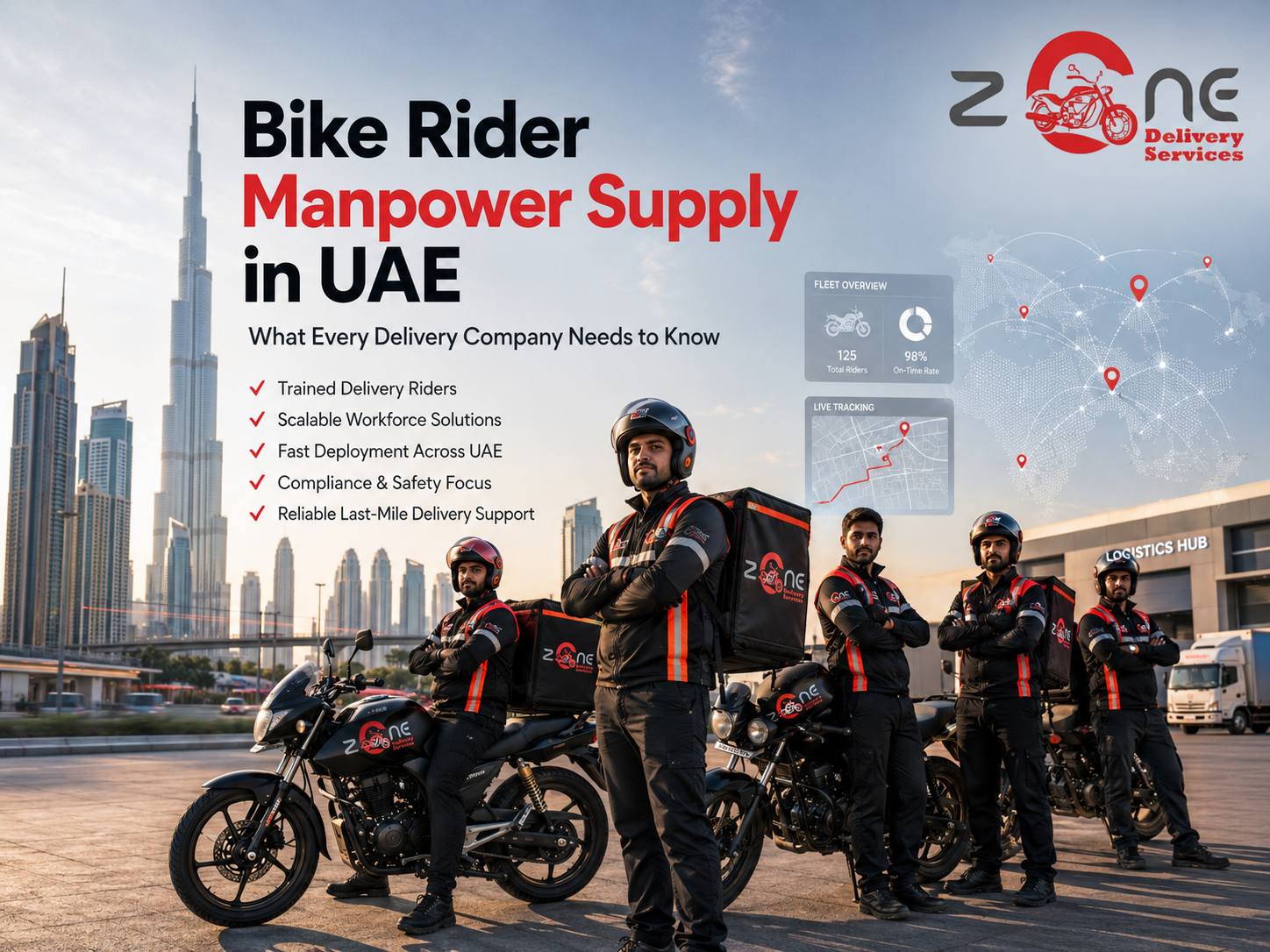
  • Bike Rider Manpower Supply in UAE — What Every Delivery Company Needs to Know

    Bike Rider Manpower Supply in UAE — What Every Delivery Company Needs to Know

    Bike Rider Manpower Supply in UAE — What Every Delivery Company Needs to Know | Zone Delivery Services
    Home › Blog › Bike Rider Manpower Supply UAE
    B2B Rider Outsourcing Guide
    📅 May 30, 2026 ⏱ 8 min read ✍️ Zone Delivery Services 📍 Dubai, UAE
    500+ Active Riders at Zone
    6.3% UAE Market CAGR 2030
    2030 EV Fleet Mandate

    If you run a delivery aggregator, restaurant chain, e-commerce platform, or logistics company in the UAE, you already know the pressure: orders go up, rider shortages appear, and hiring in-house is expensive, slow, and compliance-heavy.

    This is exactly why bike rider manpower supply in UAE has become one of the fastest-growing B2B services in the region. Instead of recruiting, licensing, training, and visa-sponsoring riders yourself, you partner with a specialist supplier who handles everything — and delivers work-ready riders to your door.

    At Zone Delivery Services, we’ve been supplying trained, licensed, and compliant two-wheeler riders to delivery companies across Dubai and the UAE. This guide explains exactly how it works, what to look for, and why it matters for your business in 2026.

    What Is Bike Rider Manpower Supply in UAE?

    Bike rider manpower supply is a B2B outsourcing model where a specialist company recruits, trains, licenses, visa-sponsors, and deploys two-wheeler delivery riders on behalf of client businesses.

    Instead of your company managing:

    • UAE motorcycle license acquisition and verification
    • Residence visa sponsorship and renewal
    • Rider onboarding, training, and conduct standards
    • WPS (Wage Protection System) compliance
    • Safety gear, SIM cards, and delivery equipment
    • Replacement riders during absences or peak seasons

    …your supplier does all of this. You simply receive deployment-ready riders, pay a flat monthly or per-delivery rate, and scale up or down as your volume demands.

    Key insight: The UAE two-wheeler delivery market is growing at 6.3% CAGR through 2030, driven by the boom in food delivery platforms like Talabat, Noon, and Deliveroo — all of which rely heavily on bike rider outsourcing partners to manage fleet capacity.

    Why Delivery Companies in UAE Are Outsourcing Riders

    The economics of running an in-house rider fleet in the UAE are challenging. Between visa costs, license transfers, RTA compliance, injury liability, and high turnover, most delivery businesses find that outsourcing is both cheaper and faster.

    Here are the primary reasons companies choose rider manpower suppliers:

    1. Speed to Deploy A quality supplier can have work-ready riders on your operations within days, not the weeks it takes to hire, license, and onboard internally.
    2. Zero Visa Liability Riders remain on the supplier’s visa — your company carries no immigration risk, renewal burden, or end-of-service gratuity obligation.
    3. Regulatory Compliance UAE motorcycle license, RTA food watch cards, OHC cards, WPS payroll — all handled by the supplier. You get compliance without the headache.
    4. Flexible Scaling Ramp up for Ramadan, Eid, or peak e-commerce seasons. Scale down in summer. Outsourced riders give you elasticity your in-house team can’t.
    5. Lower Total Cost When you account for visa fees, GOSI, training, bike maintenance, accident insurance, and admin overhead, outsourcing riders typically costs 20–35% less than in-house hiring at scale.

    The Gap: What Most Rider Suppliers Miss Research-Backed

    Through our operational experience and backed by academic research, we’ve identified critical gaps in how most bike rider suppliers in the UAE operate — gaps that directly cost delivery companies money and reputation.

    📚 Research Reference

    A landmark 2022 IEEE study by Mismar, Shamayleh & Qazi used Bayesian Belief Network modelling across UAE-region last mile delivery operations and found that the top risks in last mile delivery are interdependent — privacy/IT failures, operational disruptions, and shipment returns don’t occur in isolation. Conventional risk ranking methods miss these links entirely, which is why most rider supply companies under-train riders on these compounding failure points.


    Read the full paper: Prioritizing Risks in Last Mile Delivery (IEEE Access, 2022) →

    Gap 1 — No Training on Interdependent Failure Points

    Most suppliers train riders on basic route navigation. They don’t prepare riders for the cascade of issues that trigger failed deliveries: a GPS app failure → wrong address → customer complaint → return → revenue loss. Zone’s riders are drilled on failure recovery protocols, not just delivery execution.

    Gap 2 — No Real SLA Accountability

    Most rider vendors supply manpower and disappear. There’s no SLA on on-time rates, zero-defect delivery, or replacement times. At Zone, we maintain a 99% on-time delivery rate and guarantee same-day rider replacements for absences.

    Gap 3 — Poor Platform Literacy

    Riders who don’t understand the specific workflow of Talabat, Noon, or Deliveroo apps create friction, delays, and customer complaints. Zone riders are trained platform by platform before deployment.

    Gap 4 — No EV Transition Readiness

    The UAE government has mandated that all new delivery vehicles in urban areas must transition to electric by 2030. Most rider suppliers have no electric bike training programme. Zone is already operating and training on e-bikes — future-proofing your fleet today.

    What a Full Bike Rider Supply Package Includes

    When you partner with Zone Delivery Services for rider manpower, here is what a complete outsourcing package covers:

    • UAE Motorcycle License: Valid UAE two-wheeler driving license verified or facilitated by us
    • Residence Visa Sponsorship: Riders on Zone’s company visa — zero immigration burden on you
    • OHC & Food Watch Card: Compliance with Dubai Municipality and RTA requirements for food delivery
    • Safety Equipment: Helmet, riding jacket, gloves — full kit included
    • GPS & SIM Card: Real-time tracking enabled on every rider for your operations visibility
    • Platform Training: Rider briefed on your specific delivery app and client conduct standards
    • WPS Payroll Compliance: Wages processed via UAE Wage Protection System
    • Bike Option: With-bike or without-bike packages available (Honda / E-bike)
    • Gratuity & Leave: All end-of-service benefits managed by Zone, not your company
    • Same-Day Replacement: Absent riders replaced the same business day

    How the Outsourcing Process Works — Step by Step

    1. Initial Consultation & Requirements Assessment You tell us your delivery volume, coverage areas (Dubai, Abu Dhabi, Sharjah, etc.), platform(s), and required rider count. We design a custom package.
    2. Rider Selection & Vetting We select from our pre-screened, licensed rider pool. Background checks, road tests, and route assessments are completed internally.
    3. Platform & Client Onboarding Riders are briefed on your specific platform, brand standards, and delivery protocols before their first shift.
    4. Deployment & First Week Oversight Riders deploy to your operations. Our field supervisors monitor performance during the first week to resolve any teething issues.
    5. Ongoing SLA Management Monthly performance reviews, attendance tracking, replacement handling, and compliance renewals managed by Zone throughout the contract.

    In-House Riders vs. Outsourced Rider Supply — The Full Comparison

    Factor In-House Hiring Zone Rider Supply
    Deployment Time 3–6 weeks 3–7 days
    Visa Liability On your company On Zone’s visa
    License Management You coordinate Zone handles
    WPS Compliance Your payroll team Fully managed
    Rider Replacement Re-hire process Same-day replacement
    Peak Season Scaling Slow & expensive On-demand scaling
    Platform Training You design it Included pre-deployment
    EV Transition Your responsibility Zone e-bikes available
    Total Cost (at scale) Higher + hidden costs Predictable, lower

    UAE Compliance Every Rider Supplier Must Meet

    This is where many suppliers cut corners. Here is every compliance requirement a bike rider working in UAE delivery must meet — and which Zone Delivery Services manages for you:

    • Valid UAE Motorcycle Driving License: Required by RTA. Home-country licenses must be converted. Zone facilitates the conversion process.
    • UAE Residency Visa: Rider must hold a valid UAE work/residence visa. On Zone’s sponsorship — not yours.
    • OHC (Occupational Health Card): Required in Dubai for food handling-adjacent roles. Issued by DHA.
    • Food Watch Card: Required by Dubai Municipality for riders handling food deliveries from restaurants.
    • WPS Registration: Wage Protection System — all rider salaries processed electronically per UAE Labour Law.
    • Workmen Compensation Insurance: Mandatory under UAE law. Covered under Zone’s employer policy.
    • RTA Safety Equipment Compliance: Helmet, high-visibility jacket, correct tyre and brake standards enforced.

    2030 EV Mandate Alert: The UAE government has mandated that all new delivery vehicles in urban areas must be electric by 2030. Zone is already onboarding electric delivery bikes and training riders — ensuring your fleet partnership is compliant ahead of schedule. Learn more about our bike delivery services here.

    Why Zone Delivery Services for Rider Manpower Supply?

    We’re not just a recruitment agency — we’re an active last mile delivery operator with 500+ active riders currently deployed on platforms including Talabat, Noon, Deliveroo, Porter, NowNow, Careem, and Instashop. We know what makes a rider effective because we run the operations ourselves.

    • Operations in Dubai, Abu Dhabi, Sharjah, Ajman, Ras Al Khaimah, and more
    • Riders trained on Talabat, Noon, Deliveroo, Porter, NowNow workflows
    • Full compliance: UAE license, visa, OHC, WPS, RTA safety standards
    • E-bike fleet available for businesses transitioning for UAE’s 2030 EV mandate
    • 99% on-time rate, same-day replacement guarantee
    • Flexible contracts: monthly packages or per-delivery pricing
    • Part of Zone Multiverse — a multi-subsidiary logistics group with deep UAE roots

    Explore Our Delivery Services

    Zone Delivery Services covers every aspect of last-mile logistics across the UAE. Explore what we can do for your business:

    Need Bike Riders for Your Delivery Operations?

    Talk to Zone Delivery Services today. We’ll design a custom rider supply package for your volume, your platform, and your UAE locations — fully compliant and deployment-ready.

    Get a Free Quote → 📞 Call +971 42 73 7772

    Frequently Asked Questions — Bike Rider Manpower Supply UAE

    Bike rider manpower supply in UAE refers to a B2B outsourcing arrangement where a specialist company recruits, licenses, trains, visa-sponsors, and deploys two-wheeler delivery riders on behalf of delivery businesses. The supplier manages all compliance — UAE motorcycle license, residency visa, OHC cards, WPS payroll — while the client company simply receives work-ready riders for their delivery operations.
    Bike rider outsourcing in Dubai typically ranges from AED 1,800–2,500 per rider per month for a fully managed package (visa, license, safety gear, WPS compliance). Per-delivery pricing starts from AED 5–12 per order depending on volume and contract structure. Compared to in-house hiring costs (visa + training + equipment + gratuity), outsourcing usually saves 20–35% at scale.
    A delivery bike rider in the UAE requires: (1) a valid UAE motorcycle driving license, (2) a UAE residency/work visa, (3) an Occupational Health Card (OHC) issued by DHA, and (4) a Food Watch Card issued by Dubai Municipality for food delivery roles. A professional rider supplier like Zone Delivery Services manages all of these on behalf of the client business.
    Yes. Zone Delivery Services supplies trained riders specifically for Talabat, Noon, Deliveroo, Porter, NowNow, Careem, and Instashop operations across Dubai and the UAE. Riders are briefed on each platform’s specific workflow, app interface, and client conduct standards before deployment — reducing ramp-up time and ensuring quality from day one.
    With Zone Delivery Services, deployment for riders already on UAE visa typically takes 3–7 business days. For riders requiring fresh UAE visa processing, the timeline is 2–4 weeks depending on documentation and emirate. Emergency or surge deployments for existing clients can be arranged within 24–48 hours from our pre-cleared rider pool.
    Research by Mismar et al. (2022, IEEE Access) identified that the top risks in last mile delivery — including IT/GPS failure, shipment returns, and operational disruptions — are interdependent and cascade into each other. Professionally trained riders reduce these risks through GPS discipline and fallback protocols, careful package handling, real-time communication with dispatch, and traffic compliance. Zone riders receive failure-scenario training specifically covering these interdependent risk chains.
    Yes. The UAE government has mandated that all new delivery vehicles in urban areas must be electric by 2030. Zone Delivery Services is already deploying electric delivery bikes and training riders on e-bike operation, charging protocols, and range management. Businesses partnering with Zone today are positioned ahead of the transition deadline.
    Zone Delivery Services supplies bike riders across all key UAE emirates including Dubai, Abu Dhabi, Sharjah, Ajman, Ras Al Khaimah, Fujairah, Al Ain, and Umm Al Quwain. Within Dubai, we cover all major delivery zones including Deira, Bur Dubai, Business Bay, Al Quoz, Al Karama, Dubai Investment Park, Jebel Ali, and more.
    Z
    Zone Delivery Services — Operations Team

    Dubai’s trusted last-mile delivery partner with 500+ active riders across UAE. Subsidiary of Zone Multiverse & Zone Elite Investment. Serving Talabat, Noon, Deliveroo, Porter, NowNow & more.

  • Dubai Airport (DXB) 2026: Crisis, Recovery, Closure Plans & What It Means for UAE Businesses

    Dubai Airport (DXB) 2026: Crisis, Recovery, Closure Plans & What It Means for UAE Businesses

    No airport in the world has had a more turbulent 2026 than Dubai International Airport (DXB). The world’s busiest international airport — which was targeting a landmark 100 million passenger year — instead found itself managing over 100 missile alarms, operating at just 38% of normal capacity during the height of the Iran-US conflict, and watching March passenger traffic collapse by 66% year-on-year.

    And yet, by late May 2026, DXB has returned to 100% operational capacity. CEO Paul Griffiths is predicting Q3 will be the strongest growth quarter of the year. The Eid Al Adha holiday rush — with over 220,000 daily passengers — is already stressing terminals this week. And behind all the short-term drama, the biggest aviation story in a generation is quietly advancing: DXB will close and every single flight will move to the new Al Maktoum International Airport (DWC) by 2032.

    This article analyses the five major source articles on the DXB story, identifies the critical gaps in their coverage, and delivers the full picture — including what Dubai’s aviation transformation means directly for last-mile delivery businesses, e-commerce operators, and logistics companies operating across the UAE.

    66% Passenger Drop — March 2026
    38% Peak Crisis Capacity (April)
    100% Current Operational Capacity
    220K+ Daily Passengers (Eid Peak)
    AED 128B DWC Megaproject Investment
    260M DWC Final Annual Capacity

    The 2026 Crisis: A Month-by-Month Breakdown

    Period What Happened at DXB Operational Status
    Feb 28, 2026 Iran-US war breaks out; airspace disruption begins immediately Rapid capacity reduction begins
    March 2026 Passenger traffic falls 66% YoY; 100+ missile alarms managed; flights limited to southern Oman corridors Severely restricted — ~40% capacity
    Early April 2026 Only 541 daily movements vs normal 1,396; DXB at 38% of declared capacity Critical minimum operations
    Late April 2026 UAE lifts airspace restrictions; recovery phase begins; 6M passengers handled total during crisis period Recovery ramp-up starts
    May 2026 Full schedule restored; 220K+ daily passengers by Eid; Emirates & flydubai lead rebound 100% capacity — fully operational
    Q3 2026 (forecast) CEO expects “huge surges of visitors”; winter tourism season bookings accelerating Strong growth expected

    Despite the extraordinary disruption, DXB’s operational resilience is remarkable: the airport managed six million passengers, 32,000+ aircraft movements, and 213 tonnes of cargo during the entire crisis period — all while averaging three missile alarms per day.


    What the Top 5 Sources Say: A Comparative Analysis

    1. The Herald / USA Today — “World’s Busiest Airport to Relocate by 2032”

    The biggest structural story: DXB will close and all operations will transfer to Al Maktoum International Airport (DWC) by 2032. The AED 128 billion (£25.8 billion) megaproject will eventually handle 260 million passengers annually — making it the largest airport in the world by capacity, surpassing Atlanta, Beijing, and Istanbul. The first phase (150 million passengers) opens in 2032; the full project completes around 2057. DXB is physically constrained on all sides by residential areas and highways — there is no room to expand. Paul Griffiths confirmed: “There is little sense in operating two major hubs in such close proximity. We will move every single service to DWC.” The DXB site is expected to be redeveloped as a new urban district. Strong on the headline; thin on the transition mechanics and timeline detail for airlines and passengers.

    2. Gulf News — “DXB Recovery to Accelerate in Q3 2026”

    Gulf News’s CEO interview is the most operationally detailed source. Key quotes from Paul Griffiths: “DXB is open for full business now” and “Q3 will be the really, really strong growth quarter when we start to see huge surges of visitors coming back to Dubai.” The article confirms that the 100 million passenger milestone — originally targeted for 2026 — is now pushed to 2027, and that DWC expansion planning continued uninterrupted throughout the crisis. The strongest single source for the recovery story; lacks analysis of the cargo and logistics impact of the disruption period.

    3. VisaHQ / Global Mobility News — “Eid Al Adha Rush: Arrive 3 Hours Early”

    Timely and practical: Emirates, Etihad, and flydubai have all issued formal travel advisories urging passengers to arrive at least 3 hours before departure from DXB, with gate arrival at least 60 minutes before take-off, as daily departures push past 190,000–220,000 passengers. The advisories also recommend using the Dubai Metro to avoid road congestion. The RTA has issued a separate advisory reminding passengers of the 2-bag Metro limit and minimum Dh15 Nol card balance. The source covers the passenger experience angle well but doesn’t connect the Eid surge to the broader recovery narrative or the freight/logistics dimension.

    4. Arabian Business — “42+ Airlines Operating Through DXB”

    A resilience story: despite months of regional disruption, Emirates and flydubai plus more than 40 regional and international airlines have maintained continuous operations through DXB. Arabian Business confirms DXB will not reach the 100 million milestone until 2027 — but frames this as a delay, not a defeat. The article correctly positions DXB’s connectivity breadth as proof of its indispensable global hub status. However, it says nothing about which airlines are still holding back pending insurer clearances and lifted travel restrictions — a meaningful gap in the recovery picture.

    5. Times of India — “Indian Carriers’ Advisories & Managing the Crisis”

    India is DXB’s second-largest country market by passengers (Mumbai at 520,000 passengers even in the disrupted Q1). IndiGo, Air India Group, and other Indian carriers maintained 26+ daily flights to Dubai throughout the crisis, issuing regular advisories to check flight status before travel. The TOI coverage is the only source to explore how a specific country market managed the disruption — but it does so in isolation, without broader context of how Indian passenger volumes (and cargo) contribute to UAE supply chain and delivery demand. A key angle left underdeveloped.


    Gap Analysis: What All Five Sources Are Missing

    Gap 1

    The Air Cargo Crisis — Completely Absent from All Five Sources

    Not one of the five articles mentions air cargo. Yet DXB handles over 2.2 million tonnes of air freight annually — making it the busiest air cargo hub in the Middle East and among the top ten globally. When DXB operated at 38% capacity, belly-hold freight (which travels on passenger planes) was also at 38% capacity. Emirates SkyCargo alone transports over 2 million tonnes annually to 130+ destinations. Every disrupted passenger flight was also a disrupted freight flight. The impact on UAE importers, e-commerce operators receiving inbound goods, and e-commerce delivery businesses dependent on air-freighted inventory is a story none of the sources tell.

    Gap 2

    The Foreign Carrier Insurance Problem Is Underexplored

    The National briefly mentions that “foreign carriers are awaiting insurer clearances.” This is a critical detail that no source develops. Many international airlines cannot resume UAE services until their war-risk insurance policies are renewed or updated for the post-conflict airspace — a process that takes weeks to months. Until these clearances are secured, the 40+ airlines operating through DXB is likely an undercount of the full pre-crisis schedule. The real measure of DXB’s recovery is not just Emirates and flydubai returning to full schedule — it is the return of every Lufthansa, British Airways, Singapore Airlines, and Cathay Pacific service. None of the five sources investigates the insurance clearance timeline.

    Gap 3

    The DWC Transition Mechanics for Businesses Are Unexplained

    The relocation from DXB to DWC is the biggest aviation restructuring in the Middle East’s history — yet the five sources treat it as a headline without explaining the practical implications. Questions left unanswered include: Which airlines move first and when? What happens to DXB cargo operations — do they move to DWC simultaneously? How does the DXB-to-Jebel Ali Port bonded cargo corridor translate to DWC? What are the implications for last-mile delivery companies and customs brokers who have built their entire airport pickup operations around DXB’s Terminal locations? The 2032 headline is clear. The operational roadmap for businesses is not.

    Gap 4

    The Eid Rush Story Misses the Road Logistics Knock-On Effect

    Every source covering the Eid Al Adha travel advisory focuses on the passenger experience. None explores what 220,000+ daily airport passengers means for road congestion across Dubai and the Emirates road network more broadly. The RTA metro advisory is the closest any source comes. But for same-day delivery businesses, the Eid airport rush period is one of the most congested delivery windows of the year — with Sheikh Zayed Road and airport-adjacent routes severely impacted. None of the sources provides any guidance or data for businesses planning logistics operations during peak aviation periods.

    Gap 5

    What Happens to the DXB Site? The Urban Development Story

    DXB sits on some of the most valuable real estate in Dubai — surrounded by Deira, Al Garhoud, and central Dubai. When DXB closes, this land will be redeveloped. Early statements from Dubai Airports indicate it will become a “new urban district.” But no source explores what this means: potentially tens of thousands of new residential and commercial units, new retail districts, and fundamentally changed traffic and logistics patterns in central Dubai. For businesses planning their Dubai delivery footprint over a 10-year horizon, the DXB redevelopment is a demand-shifting event that nobody is writing about.

    Gap 6

    The Indian Market Dependency Is Underanalysed

    India is consistently DXB’s largest or second-largest passenger market — Mumbai alone had 520,000 passengers in the disrupted Q1 2026. The TOI article covers Indian airline advisories but misses the deeper story: Indian expatriates are simultaneously DXB’s biggest passenger constituency AND the UAE’s biggest consumer and delivery market. When Indian routes are disrupted, the ripple extends beyond passenger numbers — it affects remittance flows, retail purchasing patterns, and domestic courier and delivery volumes across the UAE. None of the five sources connects aviation disruption to its downstream consumer and logistics effects.


    What the DXB Story Means for UAE Logistics & Delivery Businesses

    The Dubai airport story is not just about passengers — it is one of the most significant events in UAE logistics in 2026. Here is the direct commercial read-through for delivery, courier, and e-commerce businesses.

    Air Cargo Recovery = Inbound Inventory Recovery

    DXB handles over 2.2 million tonnes of air cargo annually. During the crisis, every belly-hold flight that was cancelled or restricted was also a cargo shipment delayed or rerouted. For UAE retailers, e-commerce operators, and businesses receiving time-sensitive inbound goods — pharmaceuticals, electronics, fashion, perishables — the period from March to late April 2026 created significant inventory disruption. As DXB returns to full capacity and Emirates SkyCargo expands its freighter fleet to 21 aircraft by end-2026, inbound supply normalisation means delivery volumes will rebound sharply. Same-day and next-day delivery operators should prepare for accelerated order volumes through Q3 and Q4 as inventory levels are rebuilt.

    Peak Travel Periods = Peak Road Congestion

    The Eid Al Adha advisory — 3 hours early, use the Metro — is a clear signal of what peak DXB traffic does to Dubai’s road network. With 220,000+ daily airport passengers, Sheikh Zayed Road, Airport Road, and key arterials near Deira experience severe congestion. For delivery businesses operating in these corridors, peak aviation periods require proactive route planning, earlier dispatch windows, and buffer time built into SLA commitments. Businesses that don’t adjust for airport-driven congestion see delivery performance degrade precisely during the periods when customers most need reliability.

    The DWC Move Will Shift Logistics Geography

    Al Maktoum International Airport (DWC) is located in southern Dubai — 40 miles from DXB, near Jebel Ali Port and the Dubai South free zone. When operations migrate to DWC from 2032 onwards, the entire airport pickup, cargo clearance, and final-mile delivery ecosystem shifts south. Businesses in Dubai and Abu Dhabi that today collect cargo from DXB’s SkyCargo centre will need to reconfigure their logistics operations for DWC. The synergy between DWC and Jebel Ali Port — the world’s largest man-made harbour — will make the Dubai South corridor the most important logistics zone in the Middle East. Last-mile delivery operators with flexible coverage across all of Dubai will be best positioned for this shift.

    Tourism Recovery = Delivery Demand Surge

    Paul Griffiths has said Dubai has “no comparable destination” — and the Q3 2026 tourist surge he is predicting has direct delivery implications. Tourism growth in Dubai historically correlates with restaurant ordering volumes, retail delivery, e-commerce purchases, and hospitality supply chain demand. For delivery businesses serving restaurants, cloud kitchens, hotels, and retail in Dubai and Sharjah, the Q3 tourism rebound is a direct revenue opportunity — if they have the capacity to absorb it.

    For businesses looking to scale their delivery capacity ahead of the Q3 surge, Zone Delivery Services is ready to support you today.


    Al Maktoum International (DWC): The Airport That Will Replace DXB

    Feature DXB (Current) DWC (Future)
    Annual Capacity ~110–115M (max) 260M (full build-out)
    Phase 1 Capacity — 150M passengers
    Runways 2 parallel runways 5 parallel runways
    Aircraft Gates ~180 400 gates
    Cargo Capacity 2.2M tonnes/year 12M tonnes/year
    Investment Fully built AED 128 billion ($35B)
    Full Operations Closing ~2032–2035 Opening Phase 1: 2032
    Full Build-Out — ~2057

    Key Milestones to Watch for the Rest of 2026

    1. Q3 2026 passenger data — Paul Griffiths has staked his recovery narrative on Q3. When official numbers are released, they will either confirm or challenge the “strong surge” narrative. Watch for monthly DXB traffic reports from July onwards.
    2. Foreign carrier return to full schedules — The 40+ airlines currently operating through DXB is a subset of pre-crisis numbers. Watch for Lufthansa, British Airways, Cathay Pacific, and other major carriers announcing full schedule restoration once war-risk insurance clearances are secured.
    3. DWC phased migration announcements — flydubai is expected to be among the first movers to DWC as DXB slots fill. Any official announcement of a DWC transition timeline will be a landmark event for businesses planning their logistics footprint.
    4. Emirates SkyCargo fleet expansion — Ten additional Boeing 777F freighters are arriving in 2026 plus ten passenger-to-freighter conversions. By December 2026, Emirates expects to operate 21 dedicated cargo aircraft. This is a major air freight capacity expansion that directly affects inbound inventory supply for UAE retailers and e-commerce businesses.
    5. 100 million passenger target (now 2027) — DXB was targeting this milestone in 2026 before the crisis. Its revised 2027 target is the next major aviation KPI for the region.
    6. DXB site redevelopment announcement — When Dubai announces the masterplan for the DXB land after aviation operations move to DWC, it will be one of the largest urban development announcements in the city’s history, with major implications for central Dubai delivery demand patterns.

    Conclusion

    Dubai International Airport’s 2026 story has two distinct chapters. The first is a crisis chapter: a 66% passenger collapse, 100+ missile alarms, operations cut to 38% of capacity for weeks, and a 100 million passenger milestone pushed back by a year. The second is a recovery and transformation chapter: 100% capacity restored by May, Q3 surge forecast, the world’s largest airport megaproject advancing on schedule, and DXB’s long-term closure-and-relocation plan confirmed.

    The five source articles cover the headline of each chapter reasonably well. What they collectively miss is the full commercial ecosystem that depends on DXB — the cargo flows, the e-commerce inbound supply chains, the road logistics disruption during peak aviation periods, and the long-term business geography implications of the DWC transition.

    🛬 The Operational Bottom Line for UAE Businesses DXB is back at full capacity. Q3 2026 will bring the biggest tourism and passenger surge since the crisis began. Air cargo volumes are recovering. If your business depends on inbound goods from DXB or serves Dubai’s consumer market — now is the time to ensure your last-mile delivery and same-day fulfilment capacity is ready for the rebound.
  • Etihad Rail 2026 Passenger Launch: Routes, Travel Times, Gap Analysis & What It Means for UAE Logistics

    Etihad Rail 2026 Passenger Launch: Routes, Travel Times, Gap Analysis & What It Means for UAE Logistics

    May 2026 has been a landmark month for the UAE’s most ambitious infrastructure project. Etihad Rail — the UAE’s national railway network — has made a rapid series of announcements that collectively signal one thing clearly: passenger services are imminent. Staff uniforms have been unveiled. The first passenger station in Fujairah is complete. The full 11-city network map has been published. And this week, The National confirmed the exact travel times between Abu Dhabi, Dubai, and Fujairah for the opening phase.

    Yet despite the flood of news, critical questions remain unanswered in the mainstream coverage — including what the launch means for UAE road logistics, last-mile delivery businesses, e-commerce operators, and the millions of residents who will interact with this network not just as passengers but as consumers whose deliveries travel on it.

    This article analyses the top five source articles on the Etihad Rail 2026 passenger rollout, identifies the gaps each leaves open, and delivers the complete picture — including the direct implications for UAE logistics and delivery businesses.

    11 Cities & Regions Connected
    57 min Abu Dhabi ↔ Dubai
    ~400 Passengers Per Train
    10M+ Annual Passengers Expected
    900 km Total Network Length

    What’s Actually Happening: The Full Picture

    Etihad Rail’s passenger rollout is structured in phases. Phase 1 (2026) connects three stations: Mohamed bin Zayed City (Abu Dhabi), Jumeirah Golf Estates (Dubai), and Al Hilal (Fujairah). The Fujairah station — 51,900 square metres spread across Madinat Al Hilal — is the first fully complete station, as confirmed by Khaleej Times. Abu Dhabi and Dubai stations are receiving finishing touches.

    Beyond Phase 1, the full passenger network will eventually include stations at Sharjah (University City), Al Sila’, Al Dhannah, Al Mirfa, Madinat Zayed, Mezaira’a, Al Faya, and Al Dhaid — commissioned in phases over 2026 and beyond. The trains themselves carry up to 400 passengers each at speeds up to 200 km/h, with Wi-Fi, individual charging ports, ergonomic seating, and digital display systems throughout.

    Ten of the 13 trains in the fleet have already arrived, been tested, and certified to international safety standards. The project involved 24.5 million working hours and more than 7,000 experts and workers over three years of delivery.

    Travel Time: Route-by-Route Breakdown

    Route Expected Travel Time Max Speed Current Drive Time (est.)
    Abu Dhabi → Dubai 57 minutes 200 km/h ~90–120 min (traffic dependent)
    Dubai → Fujairah 69 minutes 200 km/h ~100–130 min
    Abu Dhabi → Fujairah 105 minutes 200 km/h ~150–180 min
    Abu Dhabi → Al Ruwais 70 minutes 200 km/h ~150–160 min

    The route from Fujairah to Abu Dhabi passes through nine tunnels carved through the Hajar Mountains with a cumulative length of 6.9 kilometres, including the dramatic Al Bithnah Bridge — 40 metres tall and over 600 metres long — the highest structure in the entire network. Passengers will experience sweeping views of the Hajar Mountains, the Sheikh Zayed Mosque in Fujairah, and Al-Bithnah Fort along the way, as Gulf News reported after a media preview ride.


    What the Top 5 Sources Say: A Comparative Analysis

    1. The National — “Official Staff Uniforms Unveiled” (May 26, 2026)

    The most recent announcement: grey uniforms with bold red trim for all passenger-facing staff — onboard hosts and station teams. Commercial Executive Director Adhraa Almansoori described them as representing “safety, professionalism, hospitality and national pride.” More than a fashion story, this is a clear signal of imminent operational readiness — companies don’t mass-produce and unveil staff uniforms unless launch is weeks, not months, away. The article also confirms the 57-minute Abu Dhabi–Dubai travel time for the first time officially. Read the full article →

    2. Economy Middle East — “Fujairah Passenger Station Completed”

    Covers the completion of the first passenger station — a 51,900 sq metre facility at Madinat Al Hilal in Fujairah. The station includes food and beverage outlets, a car park, dedicated waiting areas, ticketing machines with QR code scanning, car rental services, and a taxi rank. It is the most detailed station-level coverage published, establishing that at least one part of the passenger network is physically 100% ready. However, the article focuses entirely on Fujairah and says little about the Abu Dhabi and Dubai stations still under completion.

    3. Etihad Rail Official Press — “Full Passenger Network Revealed”

    The primary source document from Etihad Rail’s official newsroom is the most comprehensive single source. It confirms all 11 stations, the phased rollout plan, train capacity (400 passengers), onboard amenities, the 24.5 million working hours figure, and the strategic intent to boost domestic tourism and reduce emissions. Being an official release, it is inherently promotional and lacks critical analysis of pricing, accessibility, or competitive context.

    4. Gulf News — Nissan Cars Freight Milestone

    A critically underappreciated story: Al Masaood Automobiles became the first company to transport finished passenger vehicles (Nissan Patrol cars) via Etihad Rail. This demonstrates the freight network’s maturity — it is no longer just for bulk industrial cargo but is moving high-value finished goods. The carbon reduction implication is significant: shifting long-haul cargo from road to rail cuts CO₂ emissions by 70–80%. However, this article frames the story purely as a corporate freight milestone and misses the larger systemic point about what the freight–passenger combined network means for UAE logistics architecture. See the Gulf News Etihad Rail topic page →

    5. Etihad Rail Newsroom — Hafeet Rail & Regional Expansion

    The international dimension: the Hafeet Rail project (UAE–Oman cross-border connection) is 40% complete. Agreements with Jordan for railway development have been signed. The GCC Railway Project will eventually link Al Sila’ (UAE’s westernmost planned station) into a broader Gulf-wide network. Coverage from the official Etihad Rail newsroom frames this well strategically but gives no timeline clarity on when international routes will be operational.


    Gap Analysis: What All Five Sources Are Missing

    Gap 1

    Ticket Prices — The Most Critical Unanswered Question

    Across all five sources, there is not a single confirmed ticket price. This is the number that will determine whether Etihad Rail becomes a mass-market commuter service or a premium occasional-use transport option. Time Out Abu Dhabi confirms ticket prices have not been released. Unofficial market estimates range from AED 50–75 (Economy) to AED 120–150 (Business) for the Abu Dhabi–Dubai route, but these are unconfirmed. For UAE residents making commute decisions — and for businesses in transport and logistics assessing the competitive landscape — this missing data point is significant.

    Gap 2

    The “Last-Mile Problem” from Stations to Final Destinations

    None of the five articles addresses what happens when passengers arrive at Jumeirah Golf Estates station in Dubai or Mohamed bin Zayed City in Abu Dhabi. These are not city-centre locations. A passenger arriving from Fujairah still needs to get from the station to their actual destination — their office, hotel, or home. The last-mile connectivity gap (taxis, ride-hailing, buses, rental cars) around Etihad Rail stations is the defining factor in whether this becomes a truly integrated transport network or an island of rail surrounded by car dependency. This is a massive business opportunity for last-mile delivery and transport operators across the UAE.

    Gap 3

    Impact on Road Logistics & Delivery Businesses Is Completely Absent

    Etihad Rail’s own Acting CEO of Freight has stated publicly: “Rail removes long-haul and bulk movements from roads, freeing trucks to focus on last-mile delivery — where they deliver the greatest operational value.” This is a direct and explicit statement about how rail reshapes road logistics. Yet none of the five passenger-focused articles explores this connection. As freight volumes shift to rail, UAE road corridors between Dubai, Abu Dhabi, and Sharjah will see reduced heavy-vehicle congestion, improving delivery reliability for van and bike-based same-day delivery operations.

    Gap 4

    No Exact Launch Date — “2026” Is Not Enough

    Every article says passenger services will launch “in 2026” — but 2026 has nearly eight months remaining. Is it Q2? Q3? Before or after summer? Before or after Eid? None of the five sources nails down a specific launch window, and Etihad Rail itself has not officially confirmed a date. For businesses, commuters, and investors making decisions tied to this network, the absence of a confirmed launch window is a material information gap. The Abu Dhabi and Dubai stations are still under construction — which is the most honest indicator of where the timeline actually stands.

    Gap 5

    E-Commerce & Retail Business Implications Are Ignored

    The passenger rail network will connect Abu Dhabi, Dubai, and Fujairah in ways that transform retail and e-commerce geography. A consumer in Fujairah who today cannot access Dubai’s retail ecosystem within a lunch break will be able to do so in 69 minutes each way. This shifts delivery demand patterns for e-commerce delivery operators, creates new demand for next-day delivery services in previously underserved markets, and opens opportunities for businesses in Fujairah that can now access Dubai’s labour market. None of the five source articles touches on any of this.

    Gap 6

    The High-Speed Abu Dhabi–Dubai Project Is Not Contextualised

    In parallel with the 200 km/h passenger network, Etihad Rail has separately announced a 350 km/h high-speed rail project specifically for Abu Dhabi–Dubai that would reduce that journey to just 30 minutes. This project — expected to contribute Dh145 billion to UAE GDP over five decades — is a completely different and additional development from the one launching in 2026. Not a single one of the five source articles makes this distinction clearly, leaving readers confused about whether the 57-minute Abu Dhabi–Dubai service is the permanent solution or a stepping stone.


    What Etihad Rail Means for UAE Logistics & Delivery Businesses

    The launch of Etihad Rail passenger services is not just a transport story — it is a logistics restructuring event for the entire UAE supply chain. Here is why this matters directly to delivery, courier, and e-commerce businesses operating across the Emirates.

    Rail Takes Long-Haul Off the Roads

    Etihad Rail Freight already moves the equivalent of up to 300 heavy trucks per train. It has transported over 80 million tonnes of bulk cargo since launch, including 16 million tonnes in the past year alone. As more industrial freight — construction materials, petrochemicals, metals, containerised cargo — shifts from road to rail, the UAE’s major road corridors between Dubai, Abu Dhabi, and Sharjah will carry meaningfully less heavy vehicle traffic. For bike delivery riders and same-day delivery vans, less congestion means faster, more reliable delivery windows.

    Rail Defines the Backbone; Road Delivery Owns the Edge

    Omar Alsebeyi, Acting CEO of Etihad Rail Freight, put it directly: “Road freight remains essential, particularly for last-mile delivery. Rail removes long-haul and bulk movements from roads, easing congestion and freeing trucks to operate where they are most effective.” This is the new logistics architecture of the UAE: rail forms the backbone; road delivery provides agility at the edges. For last-mile delivery specialists, this is an endorsement of their core role in the UAE’s future logistics ecosystem — not a threat to it.

    New Commuter Patterns = New Delivery Demand Patterns

    When passengers begin commuting between Abu Dhabi and Dubai by rail, their retail and delivery behaviour changes. A Dubai-based worker who can now commute to Abu Dhabi affordably will start shopping across both emirates. A Fujairah resident newly connected to Dubai in 69 minutes will access retail options previously unavailable to them. This geographic expansion of consumer reach will shift demand for e-commerce delivery across the UAE, opening new route corridors and increasing order volumes in areas like Sharjah, Fujairah, and the East Coast.

    Station-Adjacent Retail Will Need Delivery Infrastructure

    International precedent is clear: new rail stations create dense retail and hospitality clusters within 1–2 km. The Fujairah, Dubai (Jumeirah Golf Estates), and Abu Dhabi (Mohamed bin Zayed City) station areas will each develop as commercial hubs over the next 2–3 years. Restaurants, supermarkets, pharmacies, and retail outlets clustering near these stations will need reliable same-day and next-day delivery partners to serve the new commuter population.

    For businesses looking to position for this infrastructure-driven growth, the time to build delivery partnerships is before the demand spike — not after. Zone Delivery Services is already operating across all major Etihad Rail corridor cities.


    Key Milestones to Watch Before Launch

    1. Official launch date announcement — Etihad Rail has confirmed 2026 but not a specific date. Watch for a formal announcement from Etihad Rail Mobility, likely accompanied by ticket sales going live.
    2. Ticket pricing release — The pricing strategy will define whether this is a mass-market commuter service or a premium product. Affordable pricing will accelerate commuter adoption and reshape road demand almost immediately.
    3. Abu Dhabi and Dubai station completion — Both stations are receiving finishing touches as of May 2026. Their formal opening marks the last construction milestone before passenger operations.
    4. Last-mile connectivity announcements — Whether taxi, ride-hail, or dedicated shuttle bus services are integrated at stations will determine the real-world usability of the network for everyday commuters.
    5. Phase 2 station timeline — Sharjah (University City), Al Ruwais, Al Mirfa and other stations will follow. When these come online, the network’s impact on inter-emirate delivery demand will significantly expand.
    6. Hafeet Rail cross-border update — 40% complete as of 2026. When the UAE–Oman connection opens, it creates a new cross-border freight and passenger corridor that will affect domestic courier and logistics dynamics across both countries.

    Conclusion

    Etihad Rail’s 2026 passenger launch is the UAE’s most significant infrastructure event since the Dubai Metro opened in 2009. A 57-minute Abu Dhabi–Dubai journey, a Fujairah connection through the Hajar Mountains, 400-seat trains with modern amenities, and a 900-kilometre network covering 11 cities — these are not future promises but confirmed operational realities arriving this year.

    What the mainstream coverage has missed is the downstream commercial story: the restructuring of UAE road logistics as freight shifts to rail; the new delivery demand corridors created by commuter behaviour changes; the last-mile opportunity at station-adjacent retail clusters; and the e-commerce market expansion as Fujairah and East Coast consumers gain access to UAE-wide delivery networks with dramatically reduced travel friction.

    🚆 The Strategic Takeaway for UAE Businesses Etihad Rail is not replacing road logistics — it is defining its future role. Rail owns the long-haul backbone. Last-mile delivery operators own the critical final connection between rail stations, commercial hubs, and consumers’ doors. The businesses that understand this complementary relationship — and build their delivery infrastructure around it now — will be best positioned when the network goes live.
  • India’s Gold Import Duty Hike to 15%: Full Analysis, Gap Report & What It Means for UAE Buyers (2026)

    India’s Gold Import Duty Hike to 15%: Full Analysis, Gap Report & What It Means for UAE Buyers (2026)

    In mid-May 2026, the Indian government announced one of the most dramatic trade policy decisions of the year: a sharp hike in gold and silver import duty from 6% to 15% — the single largest increase in India’s recorded history. The move, formalised as 10% Basic Customs Duty + 5% AIDC cess, was driven by India’s mounting pressure on foreign exchange reserves, a rupee that has depreciated over 7% year-to-date, and surging household demand for gold amid global geopolitical instability.

    The decision sent ripples far beyond Indian borders. For the millions of Indian expatriates living and working in the UAE, and for Dubai’s gold retail and logistics ecosystem, this policy shift has created the largest India-UAE gold price arbitrage opportunity in years.

    This article analyses the five major published sources on this topic, identifies the critical gaps in their coverage, and delivers the complete picture — including what this means specifically for businesses and consumers in the UAE.

    6% → 15% Gold Import Duty Jump
    ~12% UAE Gold Now Cheaper vs India
    50–60t Projected India Demand Drop 2026
    +80% India Import Surge (April YoY)

    What Happened: The Policy Shift Explained

    India’s gold import duty history has been marked by infrequent but large swings. Between 2013 and 2019, duty was held steady at 10% after a series of hikes. It was cut to 6% in July 2024 to curb smuggling and boost official imports. Now, in a full reversal, the World Gold Council (WGC) confirms the 2026 hike is the steepest single increase ever recorded — fully undoing that 2024 cut in one move.

    The policy sits within a broader government effort to reduce India’s import bill. Gold consistently ranks among India’s top five imports, accounting for around 8% of total merchandise imports in 2025. With the rupee under sustained pressure from elevated oil prices, Iran-US tensions affecting the Strait of Hormuz, and rising household demand treating gold as a financial hedge, the government acted on multiple fronts simultaneously:

    • Raised the import duty from 6% to 15% (10% BCD + 5% AIDC)
    • Tightened rules on gold imports linked to exports under the advance authorisation scheme
    • Delayed issuing annual bullion import licences to banks, effectively pausing official imports for over a month
    • Imposed restrictions on gold, silver, and platinum jewellery imports to curb FTA misuse
    • PM Narendra Modi made an unusual direct appeal to citizens to avoid buying gold for at least one year

    What the Top 5 Sources Say: A Comparative Analysis

    1. Economic Times — “A Double-Edged Sword”

    The ET coverage frames the policy as inherently contradictory: a duty hike aimed at cutting imports while India’s cultural obsession with gold — at weddings, festivals, and family milestones — ensures demand will never drop to zero. Their reporting correctly captures that the policy will shift behaviour rather than eliminate it: consumers will gravitate toward lighter-weight jewellery, older gold exchange programmes, and more discreet purchases rather than stop buying altogether. The framing is solid but primarily domestic-focused, with little attention paid to the international arbitrage effect. Read the full ET analysis →

    2. LiveMint — “Gold Fever: ETF & Buying Rush”

    LiveMint focuses on the immediate market reaction: the announcement triggered panic buying at retail counters and a rush into Gold ETFs and digital gold platforms. Their analysis captures the short-term demand spike well — as soon as the duty was confirmed, buyers front-loaded purchases before prices adjusted. This is an important behavioural data point. However, LiveMint’s coverage stops at the Indian market and does not explore the downstream effect on Gulf jewellery retail or the price arbitrage opportunity now opening up for UAE-based buyers. Read the LiveMint article →

    3. Times of India — “What It Means for Jewellery Buyers”

    TOI provides the most consumer-friendly breakdown. Their key calculation: on ₹1 lakh of imported gold, the duty burden rises from ₹6,000 to ₹15,000 — a ₹9,000 per-lakh increase. Crucially, they point out that even small components used in jewellery manufacturing — hooks, clasps, settings — are now individually dutiable, adding hidden costs throughout the supply chain that consumers may not immediately see. This ripple effect on making charges is underreported elsewhere. Read the TOI breakdown →

    4. World Gold Council — “Import Tightening & Smuggling Risk”

    The WGC’s analysis by Kavita Chacko is the most data-rich source. Key findings from their research:

    • Domestic gold prices have risen only 4–6% despite a 9% duty hike, because of seasonally weak demand and ample supply from old gold exchange programmes
    • The domestic-to-international price discount widened from US$14/oz before the hike to nearly US$150/oz immediately after
    • Historical data shows a clear correlation (0.52) between higher import duties and smuggling: after the 2013 hike, unofficial imports grew seven-fold within a year
    • Official imports remain resilient regardless of duty level — historical data shows quarterly imports between 175t–236t across duty regimes from 6% to 15%
    • Combined jewellery and bar/coin demand projected to fall 50–60 tonnes (~10% year-on-year) in 2026

    5. IndexBox — “Demand Forecast 2026”

    The IndexBox market report corroborates the WGC demand decline estimate (50–60 tonnes, ~10%) and adds important context: April 2026 imports surged over 80% year-on-year to USD 5.6 billion, driven by refinery purchases ahead of Akshaya Tritiya and front-loading ahead of anticipated further restrictions. The report also highlights that bank import licence delays have added a further administrative barrier on top of the duty hike, creating a dual squeeze on official supply channels.


    Gap Analysis: What All Five Sources Are Missing

    Taken together, the five articles cover the Indian domestic story well. But several significant angles remain unaddressed or underdeveloped.

    Gap 1

    The UAE & Gulf Opportunity Is Almost Entirely Absent

    None of the five source articles meaningfully addresses the direct commercial windfall for UAE jewellery retailers and the Dubai gold ecosystem. Yet this is arguably the most immediately actionable story for a large audience. Gulf News reports that gold in the UAE is now roughly 12% cheaper than in India because of the widened duty gap — the largest such price advantage in years. With millions of Indian expatriates in the UAE and a summer travel/wedding season approaching, this is a major commercial event that none of the five source articles covers.

    Gap 2

    NRI Baggage Rules & Travel Behaviour Are Ignored

    The duty hike is inseparable from a parallel question: how much gold can NRIs and travellers legally bring back from Dubai to India? The updated 2026 baggage rules set clear limits (20g / ₹50,000 duty-free for men; 40g / ₹1 lakh for women after 1+ year abroad), and customs enforcement has tightened at airports. None of the five articles explains this practically, leaving a huge information gap for the large NRI community making real purchase decisions right now.

    Gap 3

    The Delivery & Logistics Angle for Gold Retail Is Completely Absent

    Both in India and the UAE, a 12% price difference and surging gold retail demand directly affects last-mile delivery, jewellery courier services, cash-on-delivery operations, and secure logistics. As retail jewellers see volume spikes — particularly in the UAE’s Indian-expat market — the demand for compliant, insured, tracked jewellery delivery grows proportionally. None of the source articles touches on this operational dimension. For UAE-based last-mile delivery businesses serving retail and e-commerce jewellery clients, this is a direct growth opportunity.

    Gap 4

    The Smuggling Story Lacks Practical Depth

    The WGC rightly flags the historical correlation between high duties and smuggling. But no source explains the operational mechanics of how smuggled gold enters India, what the penalties are for travellers caught carrying excess undeclared gold, or how tightened customs enforcement at Indian airports affects ordinary NRI travellers who may unintentionally exceed limits. This is a critical knowledge gap for the large UAE-Indian community.

    Gap 5

    The Impact on Smaller Jewellers vs. Large Chains Is Underplayed

    The WGC briefly mentions that smaller retailers are “most vulnerable,” but this deserves far more attention. Large chain jewellers — with deep inventory buffers and bridal demand backstop — can absorb the shock. Independent and regional jewellers, already squeezed by high prices, now face margin compression, procurement pauses, and the risk of customers shifting to exchange programmes. The structural divergence in impact across jeweller size-segments is an important story that none of the five articles develops.

    Gap 6

    Digital Gold & ETF Behaviour Post-Hike Gets Shallow Treatment

    LiveMint mentions an ETF buying rush, but the WGC data tells a more nuanced story: ETF inflows in April 2026 were already at just 13% of January’s peak before the hike, and ETFs experienced net outflows in the days immediately after the May announcement as investors took profits. The panic buying narrative in LiveMint is partially contradicted by the WGC’s more granular flow data — a contradiction none of the sources reconciles.


    The UAE Angle: What This Means for Dubai & the Gulf

    While India’s domestic market braces for a demand slowdown, the UAE is positioned to benefit significantly. The mechanics are straightforward: India’s new 15% duty has widened the domestic-international price gap to its largest level in years. Gold purchased in Dubai is now approximately 12% cheaper than the same gold bought in India — a price difference that makes the UAE an immediately attractive destination for Indian expatriates, tourists, and NRI travellers heading home for the July–August wedding season.

    The Dubai Jewellery Group reported that UAE gold business grew by approximately 15% in March–April 2026 compared to the same period the previous year. Khaleej Times reports that Dubai’s bullion ecosystem — already deeply tied to Indian demand — could be heading into one of its strongest summer seasons in recent memory, with jewellers adapting their product mix toward investment-grade bullion, lighter jewellery collections, and digital gold options.

    For the UAE retail and logistics ecosystem, this creates a cascade of downstream demand:

    • Jewellery retailers across Dubai, Abu Dhabi, and Sharjah are expecting higher Indian NRI footfall from June through August
    • Online jewellery platforms and e-commerce gold retailers need faster, more reliable e-commerce delivery to capitalise on the buying surge
    • Same-day and next-day fulfilment for high-value retail orders becomes a competitive differentiator as purchase volumes rise — see our guide on same-day delivery across the UAE
    • Cash-on-delivery operations for jewellery purchases remain high-value, high-trust requirements for many Indian expatriate buyers, particularly those unfamiliar with digital payment flows for large purchases — Zone Delivery offers COD services across the UAE

    The broader principle is clear: when India’s domestic gold market tightens, the UAE benefits — and businesses in the UAE’s retail and logistics sectors that are positioned to serve the resulting demand spike will gain a material competitive advantage through the summer of 2026.

    For retail and e-commerce businesses looking to handle increased jewellery delivery volumes reliably and compliantly across the UAE, Zone Delivery Services is ready to support your growth.


    India’s Gold Import Duty — A Historical Timeline

    Understanding the current hike requires context. India has swung its gold duty policy repeatedly, each time creating market distortions. Per World Gold Council data:

    Period Duty Rate Key Market Effect
    Pre-2012 Flat ₹/10g Fixed amount, not value-based; stable market
    2012–2013 2% → 10% Series of hikes; gold accounts for rising % of import bill
    2013–2019 10% (stable) Prolonged high duty; unofficial imports peak at 34t/quarter average
    July 2019 12.5% +2.5% hike; demand moderates; COVID disrupts 2020
    July 2022 15% Sharp hike; smuggling rises from 17t to ~50t/quarter within 6 months
    July 2024 6% Deep cut to curb smuggling; UAE jewellery demand drops 13% as price gap narrows
    May 2026 15% Record single hike (+9%); rupee pressure, forex conservation; UAE price gap re-opens

    What to Watch in the Coming Months

    Based on the full analysis of all sources and the historical pattern, here are the key developments to monitor through the rest of 2026:

    1. Smuggling volumes — Historical data shows unofficial imports surge within 3–6 months of a major duty hike. Watch for Directorate of Revenue Intelligence (DRI) seizure data from Indian airports from July onwards, particularly Dubai-origin routes.
    2. UAE summer jewellery sales — June–August 2026 will be the first test of whether Indian NRI demand shifts to the Gulf at scale. Watch for quarterly trade data from Dubai Gold & Jewellery Group and the Dubai Multi Commodities Centre (DMCC).
    3. ETF and digital gold flows — The WGC data already shows ETF flows softening from January peaks. Post-duty, whether digital gold becomes a substitute for physical buying (as LiveMint suggests) or also suffers from the broader market cooling will clarify the nature of India’s gold demand shift.
    4. Bank import licence renewals — The IGST exemption delay that caused banks to pause bullion imports for over a month is a continued wild card. If licences are not renewed smoothly, official import volumes may diverge further from demand, widening domestic discounts and worsening smuggling incentives.
    5. Rupee trajectory — The entire policy logic rests on rupee weakness. If the INR stabilises or appreciates on the back of a US-Iran de-escalation or oil price correction, the urgency to restrict gold imports may ease — and a partial reversal of the duty cannot be ruled out, as happened in 2024.

    Conclusion

    India’s gold import duty hike to 15% is the country’s most aggressive single intervention in the gold market on record. The five source articles collectively cover the domestic demand suppression story well. What they miss is the international ripple — particularly the direct and immediate benefit flowing to the UAE’s gold retail and logistics sector, the practical implications for the millions of NRI families navigating new baggage rules, and the operational opportunities this creates for UAE businesses positioned to serve a high-value retail market in surge mode.

    🔑 The Bottom Line for UAE Businesses Gold in Dubai is now ~12% cheaper than in India. Indian NRI footfall at UAE jewellery retailers will rise significantly through the summer. E-commerce gold and jewellery platforms, same-day delivery providers, and cash-on-delivery operators in the UAE are in a strong position to capitalise — if they are ready for the volume increase.
  • UAE Wage Protection System 2026: What Every Private Sector Employer Must Know Before June 1

    UAE Wage Protection System 2026: What Every Private Sector Employer Must Know Before June 1

    The Clock Is Ticking — Are You Ready?

    Starting June 1, 2026, the UAE’s Wage Protection System (WPS) undergoes its most significant overhaul since its launch in 2009. The Ministry of Human Resources and Emiratisation (MoHRE) has issued Ministerial Resolution No. 340 of 2026, replacing the more lenient 2022 framework (Resolution No. 598 of 2022) with a tighter, zero-tolerance regime.

    The change is real, it is imminent, and — as many small business owners are only now discovering — most companies have not yet updated their payroll systems. Whether you run a restaurant, a retail store, or a last-mile delivery operation, this regulation affects you directly.

    This article gives you the full picture: what the new rules say, what the major publications missed, and what UAE employers — including businesses in the logistics and delivery sector — must do before the deadline.


    What the New WPS Rules Actually Say

    1. Unified Payday: The 1st of Every Month, No Exceptions

    Previously, private sector employers had staggered or flexible salary payment timelines depending on their contract terms. That flexibility is now gone.

    Under the new resolution, all private sector employers registered with MoHRE must pay the previous month’s salaries on the first day of every calendar month. There is no grace period. A salary paid on the 2nd is already delayed. A salary paid on the 5th triggers formal enforcement. You can verify this on the official UAE Government WPS portal.

    2. Compliance Threshold Raised from 80% to 85%

    An establishment is deemed compliant if it transfers at least 85% of total wages to its workforce by the due date (up from 80% under the old rules). At the individual employee level, a worker is considered “paid” if they receive at least 85% of their entitled salary, with any shortfall backed by documented, lawful deductions under Federal Decree-Law No. 33 of 2021 (the UAE Labour Law).

    3. No More 30-Day Grace for New Employees

    The previous framework exempted new hires for their first 30 days from the WPS due date. That exemption has been removed. New employees are immediately within scope from their first day, meaning payroll systems must be able to onboard and process new staff on the very first monthly cycle. For businesses with high staff turnover — such as those running bike delivery courier services or large warehousing teams — this is a critical operational change.

    4. Employers Can Delegate — But Cannot Escape Responsibility

    The new resolution expressly permits employers to authorise third parties (such as payroll service providers) to process salary transfers. However, the legal responsibility for timely payment remains entirely with the employer. If your outsourced payroll partner misses the deadline, you are the one facing fines. As DLA Piper confirmed in their May 2026 analysis, employers must take immediate action to update payroll systems regardless of delegation arrangements.

    5. Expanded Exemptions

    Certain categories are explicitly excluded from WPS calculations:

    • Workers already involved in wage-related disputes referred to the judiciary
    • Employees reported as absent (work abandonment)
    • Workers on unpaid leave (with supporting documentation submitted to MoHRE)
    • Foreign workers whose salaries are processed outside the UAE by overseas entities
    • Short-term work permit holders (less than three months)
    • Fishing boats, citizen-owned public taxis, banks, and places of worship

    The Penalty Escalation: A Day-by-Day Breakdown

    This is where the new regime is fundamentally different from what came before. According to Gulf News reporting on the resolution, enforcement now begins almost immediately — far faster than under the previous 2022 framework.

    Day What Happens
    Day 1 MoHRE begins active monitoring from the salary due date
    Day 2 Automated warning notices issued electronically to the employer
    Day 5 Suspension of new work permit issuance; formal notice to settle unpaid wages
    Day 11 Administrative fines under Cabinet regulations; downgrade to third business classification tier (for repeat violations within 6 months)
    Day 16 Automatic registration of individual or collective labour disputes on behalf of workers; further work permit suspensions for companies with 25+ workers in sectors including construction, transport, storage, security, cleaning, and recruitment
    Day 21+ Referral to Public Prosecutor (for companies employing 50+ workers in repeat violation cases); enforcement orders to recover wages; precautionary asset seizures; travel bans on responsible company officials; notification to other government entities
    ⚠️ Key Takeaway for Logistics & Delivery Businesses A Day 5 work permit suspension is not just a fine — it can immediately halt your ability to hire new delivery riders and disrupt active operations across Dubai, Abu Dhabi, and Sharjah.

    Who Is Affected Beyond Standard MoHRE-Registered Companies?

    The resolution applies to all onshore entities registered with MoHRE. It also extends to certain free zones that have already adopted the WPS framework — specifically Jebel Ali Free Zone (JAFZA) and the Dubai Multi Commodities Centre (DMCC). According to Morgan Lewis’s legal analysis, whether other free zones will align their internal rules remains to be confirmed — an important open question for businesses operating in those environments.


    Gap Analysis: What the Major Articles Are Missing

    A close reading of coverage from Fragomen, Times of India, DLA Piper, Gulf News, and Reddit reveals that while the core facts are well-reported, there are meaningful gaps across all sources.

    Gap 1

    The Free Zone Ambiguity Is Glossed Over

    Most articles mention JAFZA and DMCC in passing but do not address the wider question of the 50+ other UAE free zones that have not formally adopted WPS. Businesses in Dubai Silicon Oasis, Dubai Healthcare City, Abu Dhabi Global Market, and dozens of others need clarity that none of the mainstream coverage provides. Employers in those zones should seek specific legal advice rather than assume they are either in or out of scope.

    Gap 2

    The Gig Economy and Rider-Based Businesses Are Completely Absent

    Not a single article addresses the logistics, courier, delivery, and gig workforce sectors — arguably the most WPS-sensitive industries in the UAE. Businesses running e-commerce delivery or same-day delivery commonly employ hundreds of riders on rolling contracts, often with variable hours and performance-based pay. The 85% threshold, combined with zero grace period and Day 1 monitoring, creates acute compliance risk for any company that:

    • Pays riders on performance or hourly rather than fixed monthly salaries
    • Has high rider turnover and frequent new onboarding
    • Uses third-party aggregators or labour supply agencies

    The removal of the 30-day grace period for new employees is particularly significant, as delivery companies may onboard dozens of new riders in a single week.

    Gap 3

    Payroll Delegation Liability Is Under-Explained

    Several articles mention that employers can delegate payroll processing to third parties, but none explain what happens when the delegate fails. The resolution is unambiguous: the employer bears ultimate legal liability. For SMEs using shared payroll services or HR outsourcing firms, this is not a minor footnote — it is a major operational risk that needs contractual and compliance attention.

    Gap 4

    Classification Downgrade Consequences Are Under-Reported

    The downgrade to “third business classification” at Day 11 is mentioned briefly, but its real-world implications — restrictions on hiring new staff, impact on government contract eligibility, difficulty renewing trade licences — are not explored in any source article. For growth-stage companies dependent on continuous hiring (particularly relevant to last-mile delivery businesses), this can be more damaging than the monetary fine itself.

    Gap 5

    No Guidance for Businesses With Cross-Border or Multi-Currency Payroll

    The Fragomen and DLA Piper pieces are aimed at legal professionals and gloss over practical challenges faced by SMEs employing workers whose contracts are denominated in foreign currencies or paid partly outside the UAE. The exemption for “foreign workers paid outside the UAE by overseas entities” needs much clearer practical guidance for multinational SMEs.

    Gap 6

    No Compliance Checklist for Small Businesses

    Small business unpreparedness is a real and urgent issue. None of the formal publications provide a simple, actionable compliance checklist — a significant gap for the tens of thousands of small UAE employers not served by law firms. We address that below.


    What Every UAE Employer Must Do Before June 1, 2026

    Immediate Actions:

    1. Audit your payroll calendar. Confirm that your bank’s processing time allows wages to be credited — not just transferred — to employee accounts by the 1st of each month. Banks typically need 1–2 business days for processing.
    2. Update payroll software settings. Remove any system-level grace period assumptions inherited from the old 80% / 30-day new-employee framework.
    3. Review all new employee onboarding procedures. Since new hires are immediately within WPS scope, HR and finance must be aligned on same-cycle processing. This is especially critical if you regularly onboard delivery riders or warehouse staff.
    4. Check your third-party payroll provider’s SLA. If you delegate payroll, ensure your contract explicitly requires the provider to meet the Day 1 deadline — and understand that you, not them, face the legal consequences of failure.
    5. Document all lawful deductions clearly. If any employee receives less than 100% of their salary due to authorised deductions, ensure full documentation is on file to support the 85% threshold calculation.
    6. Identify your exempt employees. Verify which workers (if any) fall under the exemption categories and document this proactively before the June 1 deadline.
    7. Notify and train line managers. Many payroll delays originate from late approval of timesheets or variable pay components. Line managers need to understand the new deadlines clearly.

    What This Means for the Logistics and Delivery Sector

    The delivery and last-mile logistics industry in the UAE is one of the most dynamic and fastest-growing sectors in the region — and also one of the most exposed to WPS risk under the new rules.

    Companies operating in this space — whether providing food delivery, e-commerce fulfilment, temperature-controlled logistics, or courier services — typically manage large rider and driver workforces with the following characteristics:

    • High monthly turnover and frequent onboarding — no more 30-day grace for new hires means every new bike delivery rider falls immediately within WPS scope
    • Variable performance-based pay components — monthly total wages fluctuate; the 85% threshold must be calculated correctly each cycle
    • Third-party labour supply relationships — the employer of record, not the aggregator, bears WPS liability for e-commerce delivery and food platform operations
    • Multi-emirate operations — payroll timing must account for national holidays and banking availability across Dubai, Abu Dhabi, Sharjah, and beyond

    For businesses like Zone Delivery Services — a Dubai-based last-mile delivery company operating across the UAE and serving major aggregators such as Talabat, Deliveroo, Noon, and Careem — the new WPS framework underscores the importance of robust, tech-enabled payroll compliance. Companies that invest in clean payroll governance not only avoid escalating penalties but also protect their work permit pipeline, which is existential for any business that depends on continuous rider hiring to maintain service capacity.

    In a sector where a Day 5 work permit suspension could disrupt active same-day delivery operations and damage relationships with aggregator partners, WPS compliance is not an HR administrative issue — it is an operational continuity issue.

    If you are a restaurant, retail brand, or e-commerce business looking to partner with a WPS-compliant delivery provider across the UAE, get in touch with our team today.


    Frequently Asked Questions

    Q: Does the June 1 deadline mean salaries due in May must be paid by June 1?

    Yes. Salaries for the month of May must be transferred through the approved WPS channels on June 1, 2026. There is no grace period.

    Q: We use a payroll bureau — are we still responsible?

    Yes. The resolution expressly states that employers retain ultimate legal responsibility even when payroll is delegated to a third party. Review your provider’s SLA immediately.

    Q: We operate in a free zone that hasn’t adopted WPS — do these rules apply?

    Only if your free zone has specifically implemented WPS (currently JAFZA and DMCC). Other free zones are not directly covered, but check with your free zone authority as rules may evolve. See Morgan Lewis’s detailed breakdown for further guidance.

    Q: What if we are a small business and miss the deadline by one day?

    There is no grace period. Day 2 triggers warning notices. Day 5 triggers work permit suspension. Even a one-day delay requires urgent remedial action. For food delivery businesses or logistics operators reliant on continuous rider hiring, a permit suspension can be operationally catastrophic.

    Q: Can employees waive their right to timely payment?

    No. The WPS obligation is a regulatory requirement, not a contractual one that can be waived by agreement between the parties.

    Q: Where can I read the official resolution?

    The resolution details are available through the official UAE Government portal and have been analysed in detail by DLA Piper and Morgan Lewis.


    Conclusion

    The UAE’s updated Wage Protection System is a fundamental shift in how the country enforces payroll compliance. The combination of a hard Day 1 deadline, an 85% threshold, the removal of grace periods for new employees, and a Day 2 enforcement trigger means there is essentially no room for administrative delay.

    For businesses across every sector — from professional services to retail to logistics — the message is clear: if your payroll is not already set up to pay on the 1st of each month, it needs to be before June 1, 2026.

    ⚠️ The Stakes Are Real Non-compliance can result in fines, work permit suspensions, business classification downgrades, automatic labour disputes registered on behalf of your workers, asset seizures, and — in serious cases — criminal referrals. The cost of non-compliance vastly outweighs the cost of early preparation. If you need a compliant, professional delivery partner already operating within these frameworks, contact Zone Delivery Services today.
    Sources & Further Reading:

    MoHRE Ministerial Resolution No. 340 of 2026 — UAE Official Government Portal

    DLA Piper: UAE introduces stricter salary payment rules under new wage protection framework (May 2026)

    Gulf News: UAE sets monthly salary deadline for private sector from June 1 (May 2026)

    Morgan Lewis: UAE Introduces New Wage Protection System Resolution Effective 1 June 2026 (May 2026)

    Khaleej Times: UAE sets unified salary deadline for private sector from June 1, 2026

    AWS Legal Group: UAE’s New Wage Protection System 2026

    ActivPayroll: UAE Introduces Amendments to the Wage Protection System

    KPMG Flash Alert 2026-013

  • How Same Day Delivery Grows E-Commerce Businesses in UAE — 2026 Complete Guide

    How Same Day Delivery Grows E-Commerce Businesses in UAE — 2026 Complete Guide

    If you run an online store in the UAE, you already know the competition is fierce. From Amazon.ae and Noon to thousands of homegrown Shopify brands and Instagram shops, the UAE e-commerce market is projected to exceed USD 20 billion by 2030. In that environment, having a great product is necessary but no longer sufficient. How fast you deliver is now one of the top three factors determining whether a customer buys from you — or your competitor.

    This guide explains exactly how same day delivery for e-commerce in the UAE works, what it costs, which businesses benefit most, and how to set it up without rebuilding your entire logistics operation from scratch.


    Why Same Day Delivery Is No Longer Optional for UAE E-Commerce

    The data is blunt. According to PwC research, 63% of UAE shoppers say they would pay extra for same day delivery — a figure higher than the global average. More importantly, slow delivery is the second most common reason for shopping cart abandonment in the region.

    Put simply: if your checkout says “delivery in 3–5 days” and your competitor’s says “delivered today,” many customers will not even reach your payment page.

    The shift has accelerated because major players have raised the baseline expectation. Amazon.ae now offers same day delivery in Dubai for Prime members. Noon has invested heavily in hyperlocal last-mile capacity. Small and medium e-commerce brands that fail to match this expectation do not just lose sales — they damage brand trust.

    The good news for UAE SMEs is that outsourcing same day delivery to a professional courier company is now affordable, scalable, and straightforward to set up.


    How Same Day E-Commerce Delivery Works in the UAE

    The operational model for same day e-commerce delivery in the UAE typically follows this structure:

    1. Order Cutoff and Picking Window

    When a customer places an order before your cutoff time — usually between 10:00 AM and 12:00 PM — your team picks and packs the item from your inventory. This is where operational efficiency matters. A slow picking process eats into the delivery window.

    2. Courier Pickup from Your Location

    Your courier partner arrives at your warehouse, shop, or home-based fulfilment point at a scheduled pickup time. The courier scans each parcel, confirms package details, and dispatches immediately.

    3. Direct Last-Mile Delivery

    Unlike next-day services that sort parcels overnight at a hub, same day couriers route your packages directly to the recipient’s address. This is why same day service costs slightly more per parcel — there is no batching efficiency.

    4. Recipient Notification and Delivery Confirmation

    The customer receives real-time tracking updates and a delivery confirmation with photo and timestamp. This reduces customer service queries and return rates dramatically.

    5. COD Collection (Where Applicable)

    In the UAE, cash on delivery remains popular — particularly for first-time buyers and customers in Sharjah, Ajman, and Abu Dhabi. Your courier should collect cash and reconcile it back to your account within 24–48 hours.


    Which UAE E-Commerce Categories Benefit Most from Same Day Delivery?

    Same day delivery creates the biggest business impact in categories where speed directly influences the purchase decision:

    Fashion and Clothing
    UAE fashion shoppers are spontaneous. A customer who spots a dress on Instagram at 9 AM wants it before a dinner at 8 PM. Brands offering same day delivery in Dubai, Sharjah, and Abu Dhabi report significantly higher conversion rates on impulse purchases.

    Gifts and Flowers
    Birthdays happen every day. Anniversaries, Eid celebrations, gender reveals, and baby showers generate constant demand for same day gifting. This category has one of the highest willingness-to-pay rates for express delivery in the UAE.

    Health and Beauty
    Skincare, makeup, vitamins, and personal care products are frequently purchased with urgency — especially when a product runs out unexpectedly. Same day delivery removes the need to visit a physical store.

    Electronics and Accessories
    A broken phone charger, a missing cable, a replacement earphone — these are small-ticket items with high urgency. Customers will pay a premium for same day delivery rather than wait two days for a standard shipment.

    Food and Grocery (Non-Platform)
    Specialty food brands, organic grocery stores, and gourmet suppliers serving the UAE market use same day delivery to compete with aggregator platforms like Talabat and Deliveroo without paying platform commission fees.

    Medical and Pharmaceutical
    Online pharmacies and health supplement brands operating in the UAE face strict customer expectations around delivery speed. Same day delivery for prescription drugs and medical devices requires a licensed courier with appropriate handling capabilities.


    The Direct Business Impact: What Same Day Delivery Does for Your Numbers

    Based on e-commerce performance data from UAE markets, businesses that implement same day delivery typically see:

    • Cart abandonment reduction of 15–25% — because “delivered today” removes the hesitation that “3–5 days” creates
    • Repeat purchase rate increase of 20–35% — customers who receive orders the same day are significantly more likely to return
    • Fewer returns and disputes — same day delivery eliminates the frustration of waiting, which is one of the leading causes of buyer’s remorse and return requests
    • Higher average order value — customers who trust your delivery reliability are more willing to add more items to their cart

    How to Set Up Same Day E-Commerce Delivery in UAE Without Disrupting Your Operations

    Setting up same day delivery does not require a complete logistics overhaul. Here is a practical roadmap:

    Step 1 — Audit Your Fulfilment Speed
    Can your team pick, pack, and have parcels ready within 2 hours of an order coming in? If not, this is the first thing to fix before offering same day delivery to customers.

    Step 2 — Choose a Courier Partner with Multi-Emirate Coverage
    If your customer base spans Dubai, Sharjah, Abu Dhabi, and Ajman, your courier partner must cover all these markets under a single contract. Switching couriers per emirate creates reconciliation nightmares.

    Step 3 — Integrate Tracking into Your Store
    Connect your courier’s tracking API to your Shopify, WooCommerce, or custom platform so customers receive automated updates. Stores that do this see a 40–50% drop in “where is my order” customer service contacts.

    Step 4 — Set Clear Cutoff Times on Your Website
    Display your same day delivery cutoff prominently — on your homepage, product pages, and checkout. “Order before 12 PM for same day delivery in Dubai” is a direct conversion driver when placed above the buy button.

    Step 5 — Start with Your Top Cities, Then Expand
    You do not need to offer same day delivery everywhere on day one. Start with your highest-demand city — typically Dubai — and expand to Sharjah, Abu Dhabi, and Ajman as your volume grows and your courier partnership matures.


    Zone Delivery: UAE’s Same Day Courier Partner for E-Commerce Brands

    Zone Delivery Services works with online stores of all sizes across the UAE — from solo Instagram sellers shipping 10 parcels a day to established e-commerce brands processing 500+ orders daily. We offer:

    • Daily scheduled pickups from your location
    • Same day delivery across Dubai, Sharjah, Abu Dhabi, Ajman, and the Northern Emirates
    • Shopify and WooCommerce-compatible tracking integration
    • COD collection with 24-hour reconciliation
    • Dedicated business account management
    • Competitive per-parcel rates with volume discounts

    Growing your e-commerce brand in the UAE starts with getting your logistics right. Contact Zone Delivery today for a custom same day delivery solution tailored to your business.


    Frequently Asked Questions — Same Day E-Commerce Delivery UAE

    Q: Can a new e-commerce business in UAE afford same day delivery?
    A: Yes. Per-parcel rates for same day delivery in Dubai start from AED 20–30 for intra-city deliveries. There is no minimum volume requirement to start.

    Q: How do I show the same day delivery option in my Shopify store?
    A: Your courier partner should provide a checkout widget or shipping rate API. Zone Delivery supports direct integration with major e-commerce platforms.

    Q: What happens if a delivery attempt fails?
    A: Our couriers make a second attempt and immediately notify both the store and the customer. Undelivered parcels are returned to your location the next business day.

    Q: Is COD safe for e-commerce businesses in UAE?
    A: COD is fully managed by Zone Delivery. We collect cash, verify amounts, and transfer funds to your account within 24 hours with a full reconciliation report.

    Q: Do you offer next-day delivery as a fallback option?
    A: Yes. Zone Delivery provides both same day and next day delivery options, allowing you to offer customers multiple delivery speeds at checkout.