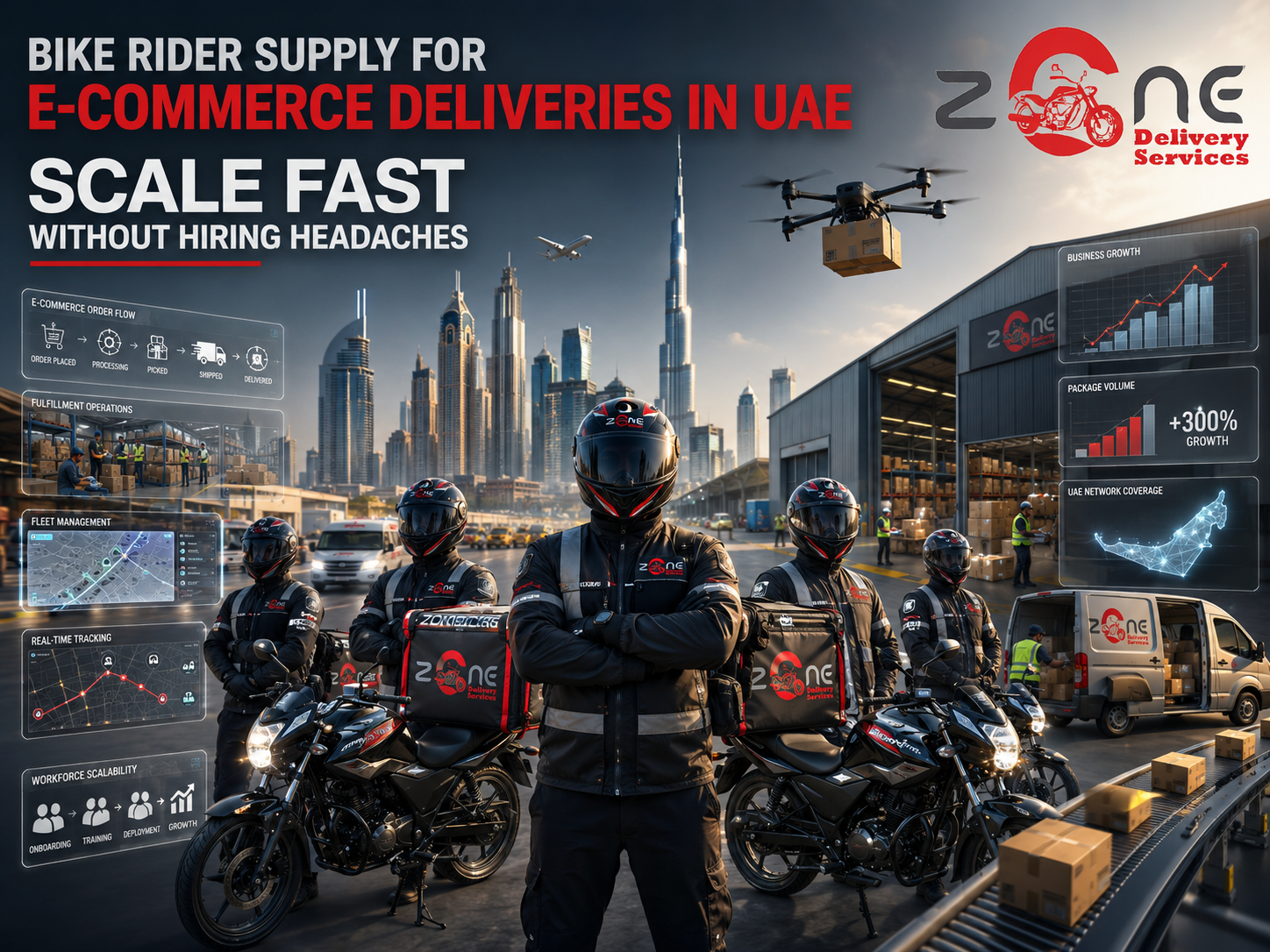
The UAE last mile delivery market is racing toward USD 5.2 billion by 2030. E-commerce sales spike 30–50% during Ramadan. Your riders need to scale with it — without the hiring delays, CapEx burden, or compliance risk of building an in-house fleet.
- The UAE E-Commerce Delivery Opportunity in 2026
- Gap Analysis: What Competitors Miss
- The Peak Season Problem — and the Scalability Hack
- CapEx vs. OpEx — Why Outsourcing Wins for E-Commerce
- Plug-and-Play SOPs: What “Ready to Ride” Really Means
- What a Full E-Commerce Rider Package Covers
- How Zone Delivery Services Works With E-Commerce Brands
- Explore Our Services
- FAQ
If you are an operations manager at an e-commerce platform, a growing D2C brand, or a quick-commerce operator in the UAE, you already understand the delivery rider problem: orders scale unpredictably, full-time headcount is expensive, and building your own compliant rider fleet takes months you don’t have.
The smarter model — used by platforms from Noon and Amazon.ae down to fast-growing D2C stores — is outsourced bike rider supply: a B2B partnership where a specialist operator like Zone Delivery Services deploys pre-trained, fully compliant, plug-and-play riders to your operations on demand.
This guide explains the market context, the gaps your competitors are missing, and exactly how to use outsourced rider manpower as a genuine scalability engine for your e-commerce delivery operations in UAE.
The UAE E-Commerce Delivery Opportunity in 2026
The numbers are unambiguous. The UAE is the most mature e-commerce logistics market in the Middle East, holding 38.5% of the entire region’s last mile delivery market share. And the infrastructure powering all of it is two-wheeled.
The UAE last mile delivery market is projected to reach USD 5.2 billion by 2030, growing at a CAGR of 12.5%. Motorcycles and scooters represent the largest vehicle type share at 39.7% of all deliveries — confirming that bike riders are the essential workforce of UAE e-commerce logistics. The e-commerce segment alone accounts for 42.5% of all last mile delivery end-use.
The competitive landscape is intensifying rapidly. In January 2026, Noon activated 20 additional dark stores across Dubai and Abu Dhabi, shrinking average delivery windows to 12 minutes. In October 2025, Amazon launched its 15-minute delivery service (Amazon Now) to the UAE. In March 2025, Talabat acquired Instashop, consolidating quick-commerce grocery delivery under Delivery Hero.
What all of this means for e-commerce operators: delivery speed and fleet capacity are now competitive differentiators, not just operational necessities. And the only way to compete without burning capital is to outsource your rider supply.
Gap Analysis: What Your Competitors Are Missing Research-Backed
After analysing the top-ranking UAE rider supply pages — including Roadline Delivery, AK International, King Riders, Al Busayra, and Motoboy — we identified three critical gaps that none of them address fully. These are the angles that will make your operations decision-making smarter and this content rank higher:
Gap 1 — They List Services. They Don’t Solve the Peak Season Surge.
Competitors mention “flexible scaling” but give no framework for how to actually execute it during Ramadan, Eid, or White Friday. Most operations managers discover during a peak week that their supplier can’t deliver extra riders in time — because pre-cleared rider pools require weeks of preparation. Zone maintains a standing pool of pre-licensed, pre-vetted riders specifically for surge deployment.
Gap 2 — No One Addresses the CapEx vs. OpEx Decision
Finance teams at e-commerce companies are asking: “Should we own our fleet or outsource it?” Competitors never answer this question. We do — with numbers. Owning bikes, hiring riders, and managing compliance is pure CapEx. Outsourcing is pure OpEx: predictable, scalable, and immediately tax-deductible in the current period.
Gap 3 — “Trained Riders” Means Different Things to Different Suppliers
Most suppliers call their riders “trained” after a 2-hour safety briefing. True plug-and-play deployment for e-commerce means riders arrive knowing your scanner app, your package handling SOP, your escalation process for failed deliveries, and your customer communication standard. Zone trains riders on each platform’s specific workflow before Day 1.
The Peak Season Problem — and the Scalability Hack
No e-commerce challenge in the UAE is more operationally punishing than peak season delivery demand. Order volumes don’t just increase — they multiply. Here’s what the data shows:
The real operational challenge: During Ramadan 2025, UAE e-commerce saw a 143% year-over-year increase in online marketplace spending. Three peak ordering windows replace the standard single evening peak — pre-iftar (4–5 PM), post-iftar (8 PM–2 AM), and pre-suhoor (around 4 AM, with grocery orders up 70%). A static rider fleet cannot serve all three windows profitably.
The Scalability Hack: On-Demand Rider Pools
The solution is not hiring 300% more full-time riders in October to be ready for Ramadan in February. That approach ties up budget, creates year-round payroll for underutilised headcount, and collapses your cost-per-delivery metrics outside of peak.
The scalability hack is outsourcing to a supplier who maintains a standing pool of pre-cleared riders — UAE-licensed, visa-sponsored, platform-trained, and available for rapid deployment. You scale up weeks before peak, and scale back down after Eid with zero long-term commitment.
- Pre-Peak Planning (4–6 weeks before) Confirm your projected order volume surge with Zone. We identify the rider count increase, confirm pre-cleared rider availability, and schedule platform briefings.
- Surge Deployment (7–10 days before peak) Additional riders deployed and briefed on your app, zones, and surge SOPs. No new visa processing, no license delays.
- Peak Operations Zone’s field supervisors monitor performance in real time. Absent riders replaced same day. SLA maintained throughout surge period.
- Post-Peak Scale-Down Riders return to the general pool. Your headcount and cost return to baseline. No redundancy costs, no gratuity obligations on your side.
CapEx vs. OpEx — Why Outsourcing Wins for E-Commerce Fleets
This is the question every CFO and operations director at an e-commerce company faces: do we own our delivery fleet, or do we outsource it? The answer, for virtually every UAE e-commerce operator outside the largest platforms, is OpEx — and here’s why:
| Cost Factor | In-House CapEx Model | Zone OpEx Model |
|---|---|---|
| Bike purchase (per unit) | AED 4,500–9,000 upfront | Included in monthly rate |
| UAE motorcycle license | AED 3,000–4,800 per rider | Managed by Zone |
| Residency visa | AED 5,000–8,000 per rider | On Zone’s visa |
| Insurance & WPS | Your HR team manages | Fully covered |
| Peak season scaling | Weeks of hiring delays | 7–10 days deployment |
| Balance sheet impact | Assets depreciate, tied-up capital | Pure OpEx — fully deductible |
| Flexibility | Headcount locked in | Scale up / down on demand |
| Gratuity & leave liability | Your company’s obligation | Zone’s obligation — not yours |
Finance insight: Under the OpEx model, every dirham paid to Zone Delivery Services is fully deductible as an operating expense in the same period — unlike CapEx bike purchases, which depreciate over years and tie up working capital. For e-commerce companies in a growth phase, preserving capital for inventory, marketing, and platform development while outsourcing delivery fleet costs is the strategically correct move.
Plug-and-Play SOPs: What “Ready to Ride” Actually Means
Most rider suppliers hand over a rider with a license and a helmet and call them “trained.” That’s not plug-and-play — that’s a liability. Here’s what genuine e-commerce-ready deployment looks like at Zone Delivery Services:
Riders trained on your specific delivery app — Noon, Amazon.ae, Talabat, Porter, NowNow, Instashop, Deliveroo — before their first shift. They know the acceptance flow, status updates, and escalation steps.
Riders briefed on your specific package types — fragile items, temperature-sensitive goods, oversized orders — and how to handle, secure, and deliver each correctly.
Riders assigned to their specific delivery zones with pre-briefing on building access points, parking restrictions, and common delivery address challenges in that area.
Riders trained on your escalation process for failed delivery attempts — customer call script, re-attempt timing, return procedure — reducing failed delivery rates from Day 1.
Grooming, communication, and professionalism standards aligned with your brand. Riders know they represent your company, not just a generic delivery service.
Riders equipped with GPS-enabled devices and briefed on Salik-efficient routing to minimise toll costs and maximise delivery density per shift.
What a Full E-Commerce Rider Supply Package Covers
Every rider supplied by Zone Delivery Services for e-commerce operations comes with full compliance and operational coverage:
- UAE Residency Visa: All riders on Zone’s visa — zero immigration liability on your business
- UAE Category 1 Motorcycle License: Verified or facilitated by Zone before deployment
- WPS Payroll Compliance: 100% MOHRE-compliant salary processing — not your payroll burden
- OHC & Food Watch Card: Dubai Health Authority and Dubai Municipality compliance for food/grocery delivery roles
- Workmen Compensation Insurance: On Zone’s employer policy — not your liability
- Helmet, Jacket & Safety Gear: Full RTA-compliant safety kit included
- GPS Device & SIM Card: Real-time rider visibility for your operations dashboard
- E-commerce Platform Training: App-specific briefing before first deployment
- Bike Option: With-bike or without-bike packages — Honda or e-bike available
- Same-Day Rider Replacement: Written SLA guarantee for absences or underperformance
- Peak Season Surge Capacity: Pre-cleared rider pool for Ramadan, Eid, White Friday scaling
- End-of-Service Gratuity: Zone’s obligation — completely off your balance sheet
How Zone Delivery Services Works With E-Commerce Brands
Zone Delivery Services is not a staffing agency that passes riders over a fence. We are an active last-mile delivery operator with 500+ riders currently deployed across UAE platforms. We understand e-commerce operations from the inside — which means when we supply riders to you, they’re already calibrated to the pace and precision that e-commerce delivery demands.
- Currently supplying riders to Noon, Talabat, Deliveroo, Porter, NowNow, Careem, Instashop and multiple D2C brands
- Operations across Dubai, Abu Dhabi, Sharjah, Ajman, Ras Al Khaimah, Fujairah, and Al Ain
- Flexible contracts: fixed monthly rider packages, per-delivery pricing, or hybrid models
- E-bike fleet available for platforms preparing for UAE’s 2030 EV delivery mandate
- Part of Zone Multiverse — a multi-subsidiary group with deep UAE logistics roots
- 99% on-time delivery rate maintained across all active operations
- 30-minute average delivery time across major Dubai zones
Explore Our Delivery Services
Ready to Scale Your E-Commerce Delivery Fleet?
Tell us your platform, your volume, and your UAE coverage zones. We’ll design a custom rider supply package — with peak season surge capacity built in.
Get a Free Quote → 📞 Call +971 42 73 7772Frequently Asked Questions
500+ active riders across UAE. Trusted by Noon, Talabat, Deliveroo, Porter, NowNow, Careem & more. Part of Zone Multiverse & Zone Elite Investment. Al Quoz Industrial Area 3, Dubai.
Leave a Reply