
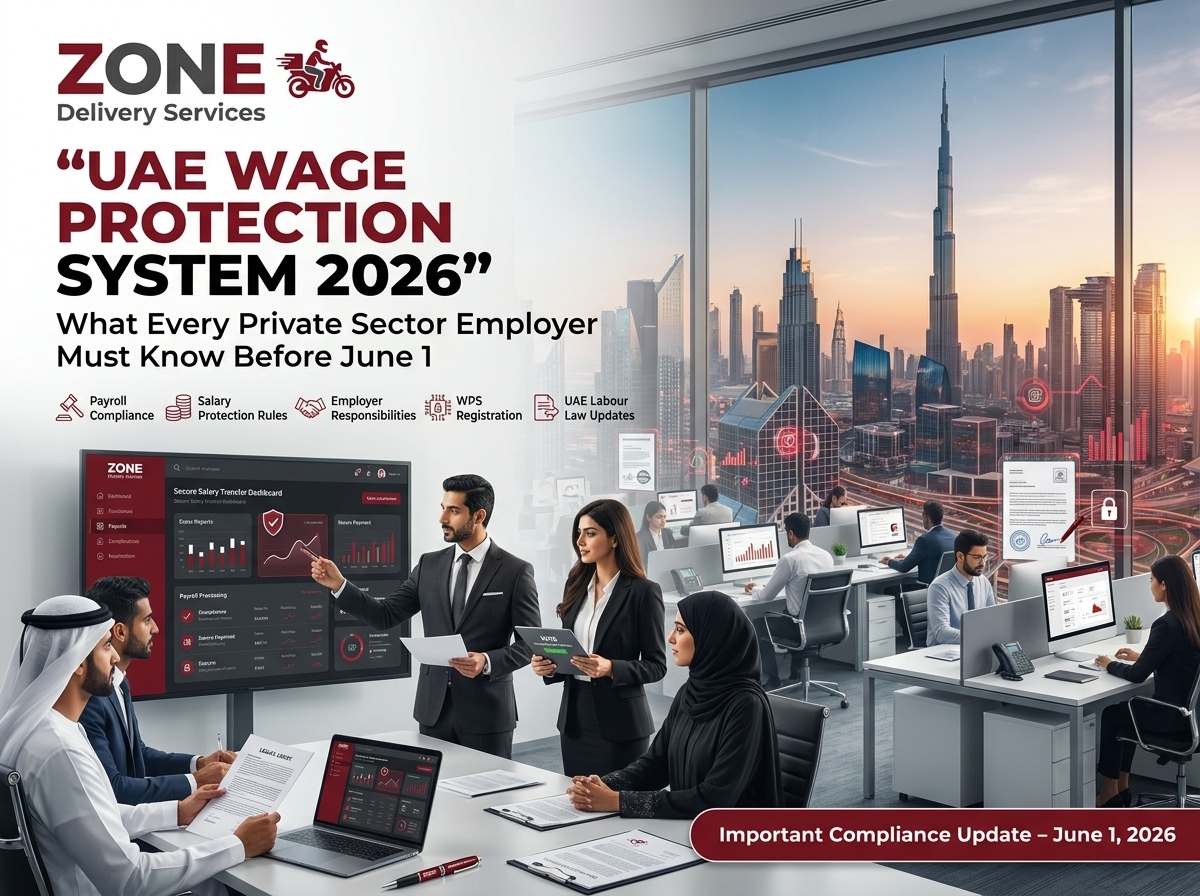
Published: May 26, 2026 | Category: UAE Labour Law & Business Compliance
The Clock Is Ticking — Are You Ready?
Starting June 1, 2026, the UAE's Wage Protection System (WPS) undergoes its most significant overhaul since its launch in 2009. The Ministry of Human Resources and Emiratisation (MoHRE) has issued Ministerial Resolution No. 340 of 2026, replacing the more lenient 2022 framework (Resolution No. 598 of 2022) with a tighter, zero-tolerance regime.
The change is real, it is imminent, and — as many small business owners are only now discovering — most companies have not yet updated their payroll systems. Whether you run a restaurant, a retail store, or a last-mile delivery operation, this regulation affects you directly.
This article gives you the full picture: what the new rules say, what the major publications missed, and what UAE employers — including businesses in the logistics and delivery sector — must do before the deadline.
What the New WPS Rules Actually Say
1. Unified Payday: The 1st of Every Month, No Exceptions
Previously, private sector employers had staggered or flexible salary payment timelines depending on their contract terms. That flexibility is now gone.
Under the new resolution, all private sector employers registered with MoHRE must pay the previous month's salaries on the first day of every calendar month. There is no grace period. A salary paid on the 2nd is already delayed. A salary paid on the 5th triggers formal enforcement. You can verify this on the official UAE Government WPS portal.
2. Compliance Threshold Raised from 80% to 85%
An establishment is deemed compliant if it transfers at least 85% of total wages to its workforce by the due date (up from 80% under the old rules). At the individual employee level, a worker is considered "paid" if they receive at least 85% of their entitled salary, with any shortfall backed by documented, lawful deductions under Federal Decree-Law No. 33 of 2021 (the UAE Labour Law).
3. No More 30-Day Grace for New Employees
The previous framework exempted new hires for their first 30 days from the WPS due date. That exemption has been removed. New employees are immediately within scope from their first day, meaning payroll systems must be able to onboard and process new staff on the very first monthly cycle. For businesses with high staff turnover — such as those running bike delivery courier services or large warehousing teams — this is a critical operational change.
4. Employers Can Delegate — But Cannot Escape Responsibility
The new resolution expressly permits employers to authorise third parties (such as payroll service providers) to process salary transfers. However, the legal responsibility for timely payment remains entirely with the employer. If your outsourced payroll partner misses the deadline, you are the one facing fines. As DLA Piper confirmed in their May 2026 analysis, employers must take immediate action to update payroll systems regardless of delegation arrangements.
5. Expanded Exemptions
Certain categories are explicitly excluded from WPS calculations:
- Workers already involved in wage-related disputes referred to the judiciary
- Employees reported as absent (work abandonment)
- Workers on unpaid leave (with supporting documentation submitted to MoHRE)
- Foreign workers whose salaries are processed outside the UAE by overseas entities
- Short-term work permit holders (less than three months)
- Fishing boats, citizen-owned public taxis, banks, and places of worship
The Penalty Escalation: A Day-by-Day Breakdown
This is where the new regime is fundamentally different from what came before. According to Gulf News reporting on the resolution, enforcement now begins almost immediately — far faster than under the previous 2022 framework.
| Day | What Happens |
|---|---|
| Day 1 | MoHRE begins active monitoring from the salary due date |
| Day 2 | Automated warning notices issued electronically to the employer |
| Day 5 | Suspension of new work permit issuance; formal notice to settle unpaid wages |
| Day 11 | Administrative fines under Cabinet regulations; downgrade to third business classification tier (for repeat violations within 6 months) |
| Day 16 | Automatic registration of individual or collective labour disputes on behalf of workers; further work permit suspensions for companies with 25+ workers in sectors including construction, transport, storage, security, cleaning, and recruitment |
| Day 21+ | Referral to Public Prosecutor (for companies employing 50+ workers in repeat violation cases); enforcement orders to recover wages; precautionary asset seizures; travel bans on responsible company officials; notification to other government entities |
Who Is Affected Beyond Standard MoHRE-Registered Companies?
The resolution applies to all onshore entities registered with MoHRE. It also extends to certain free zones that have already adopted the WPS framework — specifically Jebel Ali Free Zone (JAFZA) and the Dubai Multi Commodities Centre (DMCC). According to Morgan Lewis's legal analysis, whether other free zones will align their internal rules remains to be confirmed — an important open question for businesses operating in those environments.
Gap Analysis: What the Major Articles Are Missing
A close reading of coverage from Fragomen, Times of India, DLA Piper, Gulf News, and Reddit reveals that while the core facts are well-reported, there are meaningful gaps across all sources.
The Free Zone Ambiguity Is Glossed Over
Most articles mention JAFZA and DMCC in passing but do not address the wider question of the 50+ other UAE free zones that have not formally adopted WPS. Businesses in Dubai Silicon Oasis, Dubai Healthcare City, Abu Dhabi Global Market, and dozens of others need clarity that none of the mainstream coverage provides. Employers in those zones should seek specific legal advice rather than assume they are either in or out of scope.
The Gig Economy and Rider-Based Businesses Are Completely Absent
Not a single article addresses the logistics, courier, delivery, and gig workforce sectors — arguably the most WPS-sensitive industries in the UAE. Businesses running e-commerce delivery or same-day delivery commonly employ hundreds of riders on rolling contracts, often with variable hours and performance-based pay. The 85% threshold, combined with zero grace period and Day 1 monitoring, creates acute compliance risk for any company that:
- Pays riders on performance or hourly rather than fixed monthly salaries
- Has high rider turnover and frequent new onboarding
- Uses third-party aggregators or labour supply agencies
The removal of the 30-day grace period for new employees is particularly significant, as delivery companies may onboard dozens of new riders in a single week.
Payroll Delegation Liability Is Under-Explained
Several articles mention that employers can delegate payroll processing to third parties, but none explain what happens when the delegate fails. The resolution is unambiguous: the employer bears ultimate legal liability. For SMEs using shared payroll services or HR outsourcing firms, this is not a minor footnote — it is a major operational risk that needs contractual and compliance attention.
Classification Downgrade Consequences Are Under-Reported
The downgrade to "third business classification" at Day 11 is mentioned briefly, but its real-world implications — restrictions on hiring new staff, impact on government contract eligibility, difficulty renewing trade licences — are not explored in any source article. For growth-stage companies dependent on continuous hiring (particularly relevant to last-mile delivery businesses), this can be more damaging than the monetary fine itself.
No Guidance for Businesses With Cross-Border or Multi-Currency Payroll
The Fragomen and DLA Piper pieces are aimed at legal professionals and gloss over practical challenges faced by SMEs employing workers whose contracts are denominated in foreign currencies or paid partly outside the UAE. The exemption for "foreign workers paid outside the UAE by overseas entities" needs much clearer practical guidance for multinational SMEs.
No Compliance Checklist for Small Businesses
Small business unpreparedness is a real and urgent issue. None of the formal publications provide a simple, actionable compliance checklist — a significant gap for the tens of thousands of small UAE employers not served by law firms. We address that below.
What Every UAE Employer Must Do Before June 1, 2026
Immediate Actions:
- Audit your payroll calendar. Confirm that your bank's processing time allows wages to be credited — not just transferred — to employee accounts by the 1st of each month. Banks typically need 1–2 business days for processing.
- Update payroll software settings. Remove any system-level grace period assumptions inherited from the old 80% / 30-day new-employee framework.
- Review all new employee onboarding procedures. Since new hires are immediately within WPS scope, HR and finance must be aligned on same-cycle processing. This is especially critical if you regularly onboard delivery riders or warehouse staff.
- Check your third-party payroll provider's SLA. If you delegate payroll, ensure your contract explicitly requires the provider to meet the Day 1 deadline — and understand that you, not them, face the legal consequences of failure.
- Document all lawful deductions clearly. If any employee receives less than 100% of their salary due to authorised deductions, ensure full documentation is on file to support the 85% threshold calculation.
- Identify your exempt employees. Verify which workers (if any) fall under the exemption categories and document this proactively before the June 1 deadline.
- Notify and train line managers. Many payroll delays originate from late approval of timesheets or variable pay components. Line managers need to understand the new deadlines clearly.
What This Means for the Logistics and Delivery Sector
The delivery and last-mile logistics industry in the UAE is one of the most dynamic and fastest-growing sectors in the region — and also one of the most exposed to WPS risk under the new rules.
Companies operating in this space — whether providing food delivery, e-commerce fulfilment, temperature-controlled logistics, or courier services — typically manage large rider and driver workforces with the following characteristics:
- High monthly turnover and frequent onboarding — no more 30-day grace for new hires means every new bike delivery rider falls immediately within WPS scope
- Variable performance-based pay components — monthly total wages fluctuate; the 85% threshold must be calculated correctly each cycle
- Third-party labour supply relationships — the employer of record, not the aggregator, bears WPS liability for e-commerce delivery and food platform operations
- Multi-emirate operations — payroll timing must account for national holidays and banking availability across Dubai, Abu Dhabi, Sharjah, and beyond
For businesses like Zone Delivery Services — a Dubai-based last-mile delivery company operating across the UAE and serving major aggregators such as Talabat, Deliveroo, Noon, and Careem — the new WPS framework underscores the importance of robust, tech-enabled payroll compliance. Companies that invest in clean payroll governance not only avoid escalating penalties but also protect their work permit pipeline, which is existential for any business that depends on continuous rider hiring to maintain service capacity.
In a sector where a Day 5 work permit suspension could disrupt active same-day delivery operations and damage relationships with aggregator partners, WPS compliance is not an HR administrative issue — it is an operational continuity issue.
If you are a restaurant, retail brand, or e-commerce business looking to partner with a WPS-compliant delivery provider across the UAE, get in touch with our team today.
Frequently Asked Questions
Q: Does the June 1 deadline mean salaries due in May must be paid by June 1?
Yes. Salaries for the month of May must be transferred through the approved WPS channels on June 1, 2026. There is no grace period.
Q: We use a payroll bureau — are we still responsible?
Yes. The resolution expressly states that employers retain ultimate legal responsibility even when payroll is delegated to a third party. Review your provider's SLA immediately.
Q: We operate in a free zone that hasn't adopted WPS — do these rules apply?
Only if your free zone has specifically implemented WPS (currently JAFZA and DMCC). Other free zones are not directly covered, but check with your free zone authority as rules may evolve. See Morgan Lewis's detailed breakdown for further guidance.
Q: What if we are a small business and miss the deadline by one day?
There is no grace period. Day 2 triggers warning notices. Day 5 triggers work permit suspension. Even a one-day delay requires urgent remedial action. For food delivery businesses or logistics operators reliant on continuous rider hiring, a permit suspension can be operationally catastrophic.
Q: Can employees waive their right to timely payment?
No. The WPS obligation is a regulatory requirement, not a contractual one that can be waived by agreement between the parties.
Q: Where can I read the official resolution?
The resolution details are available through the official UAE Government portal and have been analysed in detail by DLA Piper and Morgan Lewis.
Conclusion
The UAE's updated Wage Protection System is a fundamental shift in how the country enforces payroll compliance. The combination of a hard Day 1 deadline, an 85% threshold, the removal of grace periods for new employees, and a Day 2 enforcement trigger means there is essentially no room for administrative delay.
For businesses across every sector — from professional services to retail to logistics — the message is clear: if your payroll is not already set up to pay on the 1st of each month, it needs to be before June 1, 2026.
MoHRE Ministerial Resolution No. 340 of 2026 — UAE Official Government Portal
DLA Piper: UAE introduces stricter salary payment rules under new wage protection framework (May 2026)
Gulf News: UAE sets monthly salary deadline for private sector from June 1 (May 2026)
Morgan Lewis: UAE Introduces New Wage Protection System Resolution Effective 1 June 2026 (May 2026)
Khaleej Times: UAE sets unified salary deadline for private sector from June 1, 2026
AWS Legal Group: UAE's New Wage Protection System 2026
ActivPayroll: UAE Introduces Amendments to the Wage Protection System
KPMG Flash Alert 2026-013