Published: May 26, 2026 | Category: UAE Infrastructure & Transport
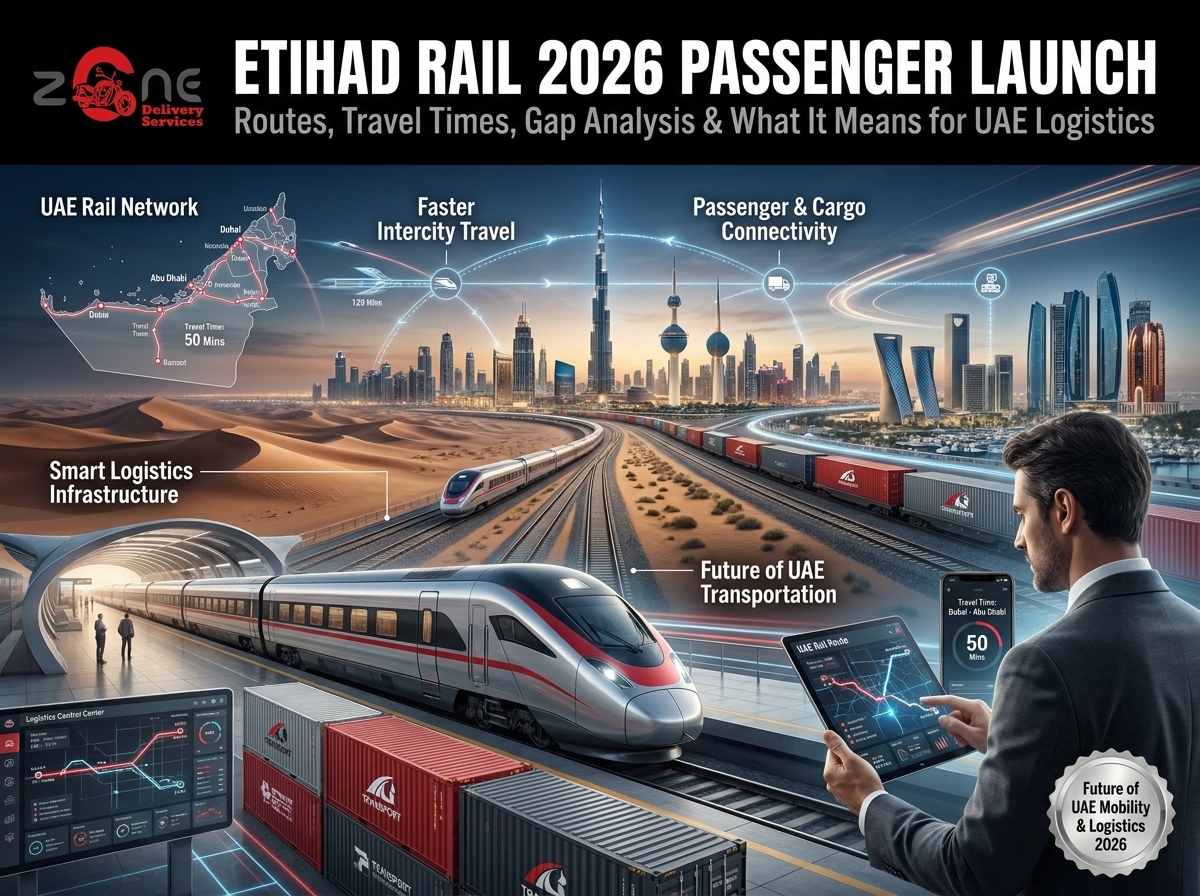
May 2026 has been a landmark month for the UAE’s most ambitious infrastructure project. Etihad Rail — the UAE’s national railway network — has made a rapid series of announcements that collectively signal one thing clearly: passenger services are imminent. Staff uniforms have been unveiled. The first passenger station in Fujairah is complete. The full 11-city network map has been published. And this week, The National confirmed the exact travel times between Abu Dhabi, Dubai, and Fujairah for the opening phase.
Yet despite the flood of news, critical questions remain unanswered in the mainstream coverage — including what the launch means for UAE road logistics, last-mile delivery businesses, e-commerce operators, and the millions of residents who will interact with this network not just as passengers but as consumers whose deliveries travel on it.
This article analyses the top five source articles on the Etihad Rail 2026 passenger rollout, identifies the gaps each leaves open, and delivers the complete picture — including the direct implications for UAE logistics and delivery businesses.
What’s Actually Happening: The Full Picture
Etihad Rail’s passenger rollout is structured in phases. Phase 1 (2026) connects three stations: Mohamed bin Zayed City (Abu Dhabi), Jumeirah Golf Estates (Dubai), and Al Hilal (Fujairah). The Fujairah station — 51,900 square metres spread across Madinat Al Hilal — is the first fully complete station, as confirmed by Khaleej Times. Abu Dhabi and Dubai stations are receiving finishing touches.
Beyond Phase 1, the full passenger network will eventually include stations at Sharjah (University City), Al Sila’, Al Dhannah, Al Mirfa, Madinat Zayed, Mezaira’a, Al Faya, and Al Dhaid — commissioned in phases over 2026 and beyond. The trains themselves carry up to 400 passengers each at speeds up to 200 km/h, with Wi-Fi, individual charging ports, ergonomic seating, and digital display systems throughout.
Ten of the 13 trains in the fleet have already arrived, been tested, and certified to international safety standards. The project involved 24.5 million working hours and more than 7,000 experts and workers over three years of delivery.
Travel Time: Route-by-Route Breakdown
| Route | Expected Travel Time | Max Speed | Current Drive Time (est.) |
|---|---|---|---|
| Abu Dhabi → Dubai | 57 minutes | 200 km/h | ~90–120 min (traffic dependent) |
| Dubai → Fujairah | 69 minutes | 200 km/h | ~100–130 min |
| Abu Dhabi → Fujairah | 105 minutes | 200 km/h | ~150–180 min |
| Abu Dhabi → Al Ruwais | 70 minutes | 200 km/h | ~150–160 min |
The route from Fujairah to Abu Dhabi passes through nine tunnels carved through the Hajar Mountains with a cumulative length of 6.9 kilometres, including the dramatic Al Bithnah Bridge — 40 metres tall and over 600 metres long — the highest structure in the entire network. Passengers will experience sweeping views of the Hajar Mountains, the Sheikh Zayed Mosque in Fujairah, and Al-Bithnah Fort along the way, as Gulf News reported after a media preview ride.
What the Top 5 Sources Say: A Comparative Analysis
1. The National — “Official Staff Uniforms Unveiled” (May 26, 2026)
The most recent announcement: grey uniforms with bold red trim for all passenger-facing staff — onboard hosts and station teams. Commercial Executive Director Adhraa Almansoori described them as representing “safety, professionalism, hospitality and national pride.” More than a fashion story, this is a clear signal of imminent operational readiness — companies don’t mass-produce and unveil staff uniforms unless launch is weeks, not months, away. The article also confirms the 57-minute Abu Dhabi–Dubai travel time for the first time officially. Read the full article →
2. Economy Middle East — “Fujairah Passenger Station Completed”
Covers the completion of the first passenger station — a 51,900 sq metre facility at Madinat Al Hilal in Fujairah. The station includes food and beverage outlets, a car park, dedicated waiting areas, ticketing machines with QR code scanning, car rental services, and a taxi rank. It is the most detailed station-level coverage published, establishing that at least one part of the passenger network is physically 100% ready. However, the article focuses entirely on Fujairah and says little about the Abu Dhabi and Dubai stations still under completion.
3. Etihad Rail Official Press — “Full Passenger Network Revealed”
The primary source document from Etihad Rail’s official newsroom is the most comprehensive single source. It confirms all 11 stations, the phased rollout plan, train capacity (400 passengers), onboard amenities, the 24.5 million working hours figure, and the strategic intent to boost domestic tourism and reduce emissions. Being an official release, it is inherently promotional and lacks critical analysis of pricing, accessibility, or competitive context.
4. Gulf News — Nissan Cars Freight Milestone
A critically underappreciated story: Al Masaood Automobiles became the first company to transport finished passenger vehicles (Nissan Patrol cars) via Etihad Rail. This demonstrates the freight network’s maturity — it is no longer just for bulk industrial cargo but is moving high-value finished goods. The carbon reduction implication is significant: shifting long-haul cargo from road to rail cuts CO₂ emissions by 70–80%. However, this article frames the story purely as a corporate freight milestone and misses the larger systemic point about what the freight–passenger combined network means for UAE logistics architecture. See the Gulf News Etihad Rail topic page →
5. Etihad Rail Newsroom — Hafeet Rail & Regional Expansion
The international dimension: the Hafeet Rail project (UAE–Oman cross-border connection) is 40% complete. Agreements with Jordan for railway development have been signed. The GCC Railway Project will eventually link Al Sila’ (UAE’s westernmost planned station) into a broader Gulf-wide network. Coverage from the official Etihad Rail newsroom frames this well strategically but gives no timeline clarity on when international routes will be operational.
Gap Analysis: What All Five Sources Are Missing
Ticket Prices — The Most Critical Unanswered Question
Across all five sources, there is not a single confirmed ticket price. This is the number that will determine whether Etihad Rail becomes a mass-market commuter service or a premium occasional-use transport option. Time Out Abu Dhabi confirms ticket prices have not been released. Unofficial market estimates range from AED 50–75 (Economy) to AED 120–150 (Business) for the Abu Dhabi–Dubai route, but these are unconfirmed. For UAE residents making commute decisions — and for businesses in transport and logistics assessing the competitive landscape — this missing data point is significant.
The “Last-Mile Problem” from Stations to Final Destinations
None of the five articles addresses what happens when passengers arrive at Jumeirah Golf Estates station in Dubai or Mohamed bin Zayed City in Abu Dhabi. These are not city-centre locations. A passenger arriving from Fujairah still needs to get from the station to their actual destination — their office, hotel, or home. The last-mile connectivity gap (taxis, ride-hailing, buses, rental cars) around Etihad Rail stations is the defining factor in whether this becomes a truly integrated transport network or an island of rail surrounded by car dependency. This is a massive business opportunity for last-mile delivery and transport operators across the UAE.
Impact on Road Logistics & Delivery Businesses Is Completely Absent
Etihad Rail’s own Acting CEO of Freight has stated publicly: “Rail removes long-haul and bulk movements from roads, freeing trucks to focus on last-mile delivery — where they deliver the greatest operational value.” This is a direct and explicit statement about how rail reshapes road logistics. Yet none of the five passenger-focused articles explores this connection. As freight volumes shift to rail, UAE road corridors between Dubai, Abu Dhabi, and Sharjah will see reduced heavy-vehicle congestion, improving delivery reliability for van and bike-based same-day delivery operations.
No Exact Launch Date — “2026” Is Not Enough
Every article says passenger services will launch “in 2026” — but 2026 has nearly eight months remaining. Is it Q2? Q3? Before or after summer? Before or after Eid? None of the five sources nails down a specific launch window, and Etihad Rail itself has not officially confirmed a date. For businesses, commuters, and investors making decisions tied to this network, the absence of a confirmed launch window is a material information gap. The Abu Dhabi and Dubai stations are still under construction — which is the most honest indicator of where the timeline actually stands.
E-Commerce & Retail Business Implications Are Ignored
The passenger rail network will connect Abu Dhabi, Dubai, and Fujairah in ways that transform retail and e-commerce geography. A consumer in Fujairah who today cannot access Dubai’s retail ecosystem within a lunch break will be able to do so in 69 minutes each way. This shifts delivery demand patterns for e-commerce delivery operators, creates new demand for next-day delivery services in previously underserved markets, and opens opportunities for businesses in Fujairah that can now access Dubai’s labour market. None of the five source articles touches on any of this.
The High-Speed Abu Dhabi–Dubai Project Is Not Contextualised
In parallel with the 200 km/h passenger network, Etihad Rail has separately announced a 350 km/h high-speed rail project specifically for Abu Dhabi–Dubai that would reduce that journey to just 30 minutes. This project — expected to contribute Dh145 billion to UAE GDP over five decades — is a completely different and additional development from the one launching in 2026. Not a single one of the five source articles makes this distinction clearly, leaving readers confused about whether the 57-minute Abu Dhabi–Dubai service is the permanent solution or a stepping stone.
- How Late Deliveries Are Killing Small Business Revenue in Dubai
- Same-Day Fulfilment in UAE: How Ecommerce Brands Hit Tight Cut-Offs Consistently
- Top Delivery Companies in UAE & Dubai — 2026 Guide
- Best Logistics Companies in UAE (2026) — Top 10 Ranked
- In-House vs 3PL Warehousing in Dubai: True Cost Guide 2026
What Etihad Rail Means for UAE Logistics & Delivery Businesses
The launch of Etihad Rail passenger services is not just a transport story — it is a logistics restructuring event for the entire UAE supply chain. Here is why this matters directly to delivery, courier, and e-commerce businesses operating across the Emirates.
Rail Takes Long-Haul Off the Roads
Etihad Rail Freight already moves the equivalent of up to 300 heavy trucks per train. It has transported over 80 million tonnes of bulk cargo since launch, including 16 million tonnes in the past year alone. As more industrial freight — construction materials, petrochemicals, metals, containerised cargo — shifts from road to rail, the UAE’s major road corridors between Dubai, Abu Dhabi, and Sharjah will carry meaningfully less heavy vehicle traffic. For bike delivery riders and same-day delivery vans, less congestion means faster, more reliable delivery windows.
Rail Defines the Backbone; Road Delivery Owns the Edge
Omar Alsebeyi, Acting CEO of Etihad Rail Freight, put it directly: “Road freight remains essential, particularly for last-mile delivery. Rail removes long-haul and bulk movements from roads, easing congestion and freeing trucks to operate where they are most effective.” This is the new logistics architecture of the UAE: rail forms the backbone; road delivery provides agility at the edges. For last-mile delivery specialists, this is an endorsement of their core role in the UAE’s future logistics ecosystem — not a threat to it.
New Commuter Patterns = New Delivery Demand Patterns
When passengers begin commuting between Abu Dhabi and Dubai by rail, their retail and delivery behaviour changes. A Dubai-based worker who can now commute to Abu Dhabi affordably will start shopping across both emirates. A Fujairah resident newly connected to Dubai in 69 minutes will access retail options previously unavailable to them. This geographic expansion of consumer reach will shift demand for e-commerce delivery across the UAE, opening new route corridors and increasing order volumes in areas like Sharjah, Fujairah, and the East Coast.
Station-Adjacent Retail Will Need Delivery Infrastructure
International precedent is clear: new rail stations create dense retail and hospitality clusters within 1–2 km. The Fujairah, Dubai (Jumeirah Golf Estates), and Abu Dhabi (Mohamed bin Zayed City) station areas will each develop as commercial hubs over the next 2–3 years. Restaurants, supermarkets, pharmacies, and retail outlets clustering near these stations will need reliable same-day and next-day delivery partners to serve the new commuter population.
For businesses looking to position for this infrastructure-driven growth, the time to build delivery partnerships is before the demand spike — not after. Zone Delivery Services is already operating across all major Etihad Rail corridor cities.
Key Milestones to Watch Before Launch
- Official launch date announcement — Etihad Rail has confirmed 2026 but not a specific date. Watch for a formal announcement from Etihad Rail Mobility, likely accompanied by ticket sales going live.
- Ticket pricing release — The pricing strategy will define whether this is a mass-market commuter service or a premium product. Affordable pricing will accelerate commuter adoption and reshape road demand almost immediately.
- Abu Dhabi and Dubai station completion — Both stations are receiving finishing touches as of May 2026. Their formal opening marks the last construction milestone before passenger operations.
- Last-mile connectivity announcements — Whether taxi, ride-hail, or dedicated shuttle bus services are integrated at stations will determine the real-world usability of the network for everyday commuters.
- Phase 2 station timeline — Sharjah (University City), Al Ruwais, Al Mirfa and other stations will follow. When these come online, the network’s impact on inter-emirate delivery demand will significantly expand.
- Hafeet Rail cross-border update — 40% complete as of 2026. When the UAE–Oman connection opens, it creates a new cross-border freight and passenger corridor that will affect domestic courier and logistics dynamics across both countries.
Conclusion
Etihad Rail’s 2026 passenger launch is the UAE’s most significant infrastructure event since the Dubai Metro opened in 2009. A 57-minute Abu Dhabi–Dubai journey, a Fujairah connection through the Hajar Mountains, 400-seat trains with modern amenities, and a 900-kilometre network covering 11 cities — these are not future promises but confirmed operational realities arriving this year.
What the mainstream coverage has missed is the downstream commercial story: the restructuring of UAE road logistics as freight shifts to rail; the new delivery demand corridors created by commuter behaviour changes; the last-mile opportunity at station-adjacent retail clusters; and the e-commerce market expansion as Fujairah and East Coast consumers gain access to UAE-wide delivery networks with dramatically reduced travel friction.
Zone Delivery Services provides fast, tracked, and reliable last-mile delivery, same-day delivery, and e-commerce fulfilment across every major city in the UAE — including Dubai, Abu Dhabi, Sharjah, and Fujairah. As Etihad Rail reshapes how people and goods move across the UAE, we are already there at the last mile. Get in touch today.
The National — Etihad Rail Unveils Official Uniforms (May 26, 2026)
Etihad Rail Official — UAE Full Passenger Railway Network Revealed
Khaleej Times — First Etihad Rail Passenger Stations Revealed (May 2026)
Gulf News — Inside Etihad Rail’s Passenger Trains: First Look at Fujairah Station
Gulf News — Etihad Rail Topic Hub (Freight & Updates)
Gulf Business — Etihad Rail Freight CEO: Why the Future of UAE Logistics Runs on Rail
Economy Middle East — Etihad Rail Completes First Passenger Station
Leave a Reply